
Start with a requirement a supplier can answer
Write the specification, quantity, delivery geography, timing and any mandatory capability before searching. Include whether a distributor is acceptable or the purchase requires a manufacturer. “Find reliable suppliers for pumps” gives a model too much room to invent what reliable or suitable means.
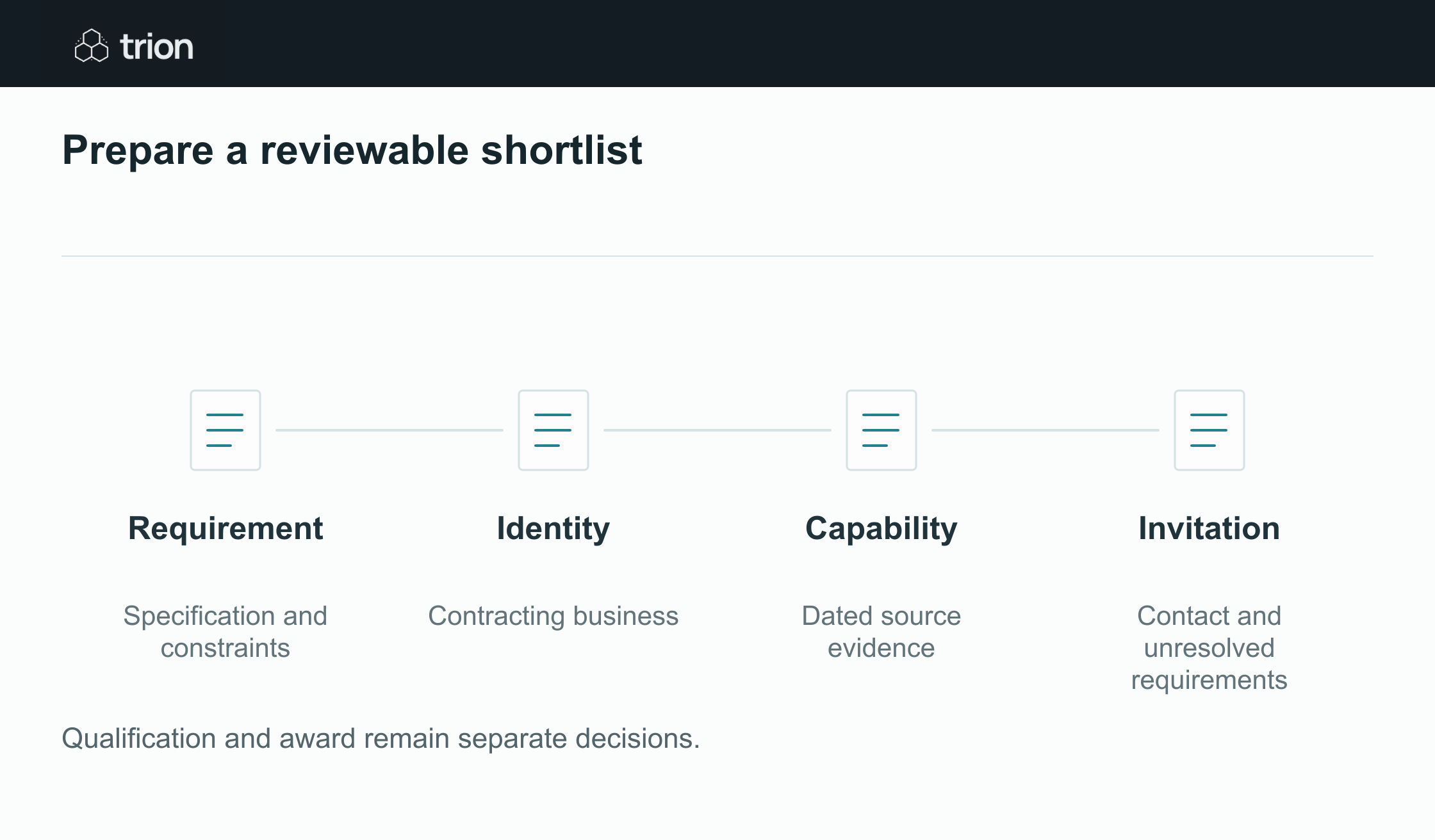

Prepare a reviewable shortlist
- Requirement
- Specification and constraints
- Identity
- Contracting business
- Capability
- Dated source evidence
- Invitation
- Contact and unresolved requirements
| Evidence | Meaning |
|---|---|
| Requirement | Specification and constraints |
| Identity | Contracting business |
| Capability | Dated source evidence |
| Invitation | Contact and unresolved requirements |
Qualification and award remain separate decisions.
SAP's Discovery documentation describes reviewing responses and supplier profiles before importing qualifying suppliers. That distinction is useful beyond the platform: discovery creates candidates, while qualification evaluates them against a requirement. A polished profile or quick reply does not establish that the supplier can perform this purchase.
Search sources that your team is permitted to use: current approved records, relevant past quotations, official supplier websites and suitable directories. If using email history, define the mailbox scope and authorization first. A contact appearing in a message is not automatically an approved supplier.
Keep identity separate from capability
Record the legal business name, jurisdiction and identifier where available. Match the website, quotation and contact to that entity. Similar trading names may refer to unrelated companies; a group's reputation should not silently transfer to every subsidiary or reseller.
For UK companies, Companies House provides registration and filing information, including addresses and officers. Such records can help check identity. They do not demonstrate product quality, available capacity or the ability to meet your delivery date.
| Question | Useful evidence | Still unresolved |
|---|---|---|
| Who is this business? | Entity identifier and attributable company records | Whether it can perform this order |
| Can it provide the item? | Relevant product specification or direct response | Current availability and accepted alternatives |
| Can it meet the requirement? | Dated answer covering quantity, location and timing | Unanswered conditions or qualification checks |
| Who should receive the RFQ? | Checked business contact and role | Any uncertain address or routing instruction |
Attribute every capability claim
Store the claim, source URL or document, source date and review date together. “Supplier website lists stainless-steel fabrication” is more defensible than “Supplier is a verified specialist” when nobody has checked the required process. Preserve uncertainty in the wording.
A certificate logo on a webpage is a reason to ask for supporting information, not to mark a qualification complete. Where a credential is mandatory, the responsible reviewer should check its scope, named entity and validity through the appropriate issuing source. AI can prepare that evidence checklist without deciding that a screenshot proves compliance.
Separate a source's claim from your team's conclusion. A candidate may claim nationwide delivery while the actual quotation excludes your warehouse. The relevant purchase-specific answer should govern the shortlist record, with the contradiction visible.
Example shortlist for a bracket purchase
Suppose a requester needs 400 brackets to drawing BR-18, revision 3, delivered in six weeks. Candidate A publishes generic metalwork examples. Candidate B supplies a drawing-specific response and identifies the proposed manufacturing entity. Candidate C is a distributor whose website lists a similar standard bracket.
All three remain candidates initially. Ask A about the drawing and production window. Check B's stated capability and the business behind its response. Ask C whether the standard product is an alternative, then send the difference to the technical requester. Do not award a compatibility score from visual resemblance.
The resulting shortlist can show A as awaiting capability evidence, B as ready for qualification review, and C as an alternative requiring technical review. Those labels tell a buyer what to do next without falsely ranking businesses that have supplied different levels of evidence.
Use stages that preserve the decision boundary
Keep discovered, contact checked, capability evidenced, invited and onboarding pending as separate states. Include a reason for exclusion and who reviewed it. A missing response should not be rewritten as a verified lack of capability; a supplier may simply not have seen the invitation.
Require checked entities and dated capability evidence in the acceptance criteria for Trion’s supplier discovery workflow.
Use the RFQ guide for invitations and responses, then the onboarding checklist for the selected entity.