
Record the signal without upgrading its meaning
Use factual descriptions of what was observed: a promised dispatch date passed, a supplier asked to change payment timing, or a public report described restructuring. Avoid replacing those observations with conclusions such as “insolvent,” “unreliable” or “high risk” before the relevant evidence has been reviewed.
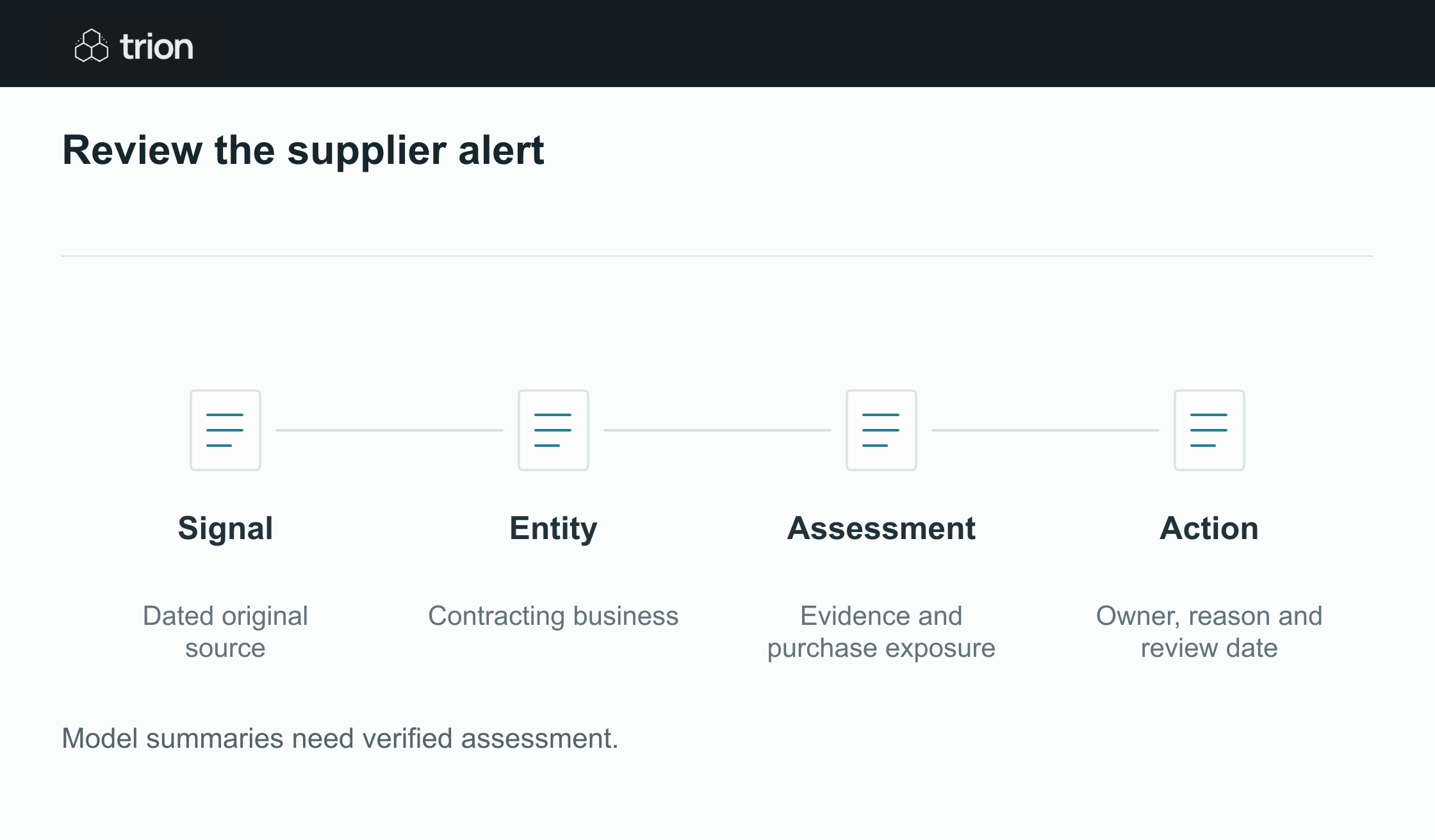

Review the supplier alert
- Signal
- Dated original source
- Entity
- Contracting business
- Assessment
- Evidence and purchase exposure
- Action
- Owner, reason and review date
| Evidence | Meaning |
|---|---|
| Signal | Dated original source |
| Entity | Contracting business |
| Assessment | Evidence and purchase exposure |
| Action | Owner, reason and review date |
Model summaries need verified assessment.
The UK guidance on supplier economic and financial standing, updated in September 2026, addresses financial capacity and monitoring in a public-sector procurement context. It calls for appropriately skilled assessment. A model summary can organize information; it should not stand in for that assessment or be treated as a universal pass/fail rule.
Keep the original source, publication date, collection date and exact observed fact. If an automated summary cannot point to supporting material, label it as an unverified suggestion and exclude it from a confirmed-facts section.
Match the contracting entity first
A parent group, local subsidiary and unrelated business with a similar name can appear in the same search. Check the entity named in the purchase agreement or order against the entity discussed by the source. Record jurisdiction and identifier where available, rather than using the company name alone.
Companies House offers registration and filing information for UK companies. These records can support identity checks. A matching registration record does not by itself establish that a supplier can deliver your order, and a report about another entity should not be silently attached to it.
Keep uncertain matches in a separate queue. If the supplier trades under a brand, ask which legal entity supplies and invoices the order. AI can propose the relationship, but the evidence needs to show it.
Example alert with two different questions
Consider a news report about “River Group” restructuring. Your active order names “River Components East Ltd.” The alert first raises an identity and relationship question. It does not establish that the contracting supplier is unable to deliver.
Separately, the supplier's email confirms that one required component will arrive eight days after the agreed date. That is direct evidence of a proposed schedule difference for this order. Route it to the buyer and requester even if the news relationship remains unresolved.
| Observation | Evidence status | Next action |
|---|---|---|
| Group restructuring report | Source retained; contracting-entity relationship unresolved | Check identity and obtain relevant assessment. |
| Revised delivery date | Supplier message covers this order | Review operational impact and available alternatives. |
| Predicted business failure | No supporting assessment | Do not present as a verified conclusion. |
Check the group relationship separately while the buyer reviews the evidenced schedule change.
Assess exposure as well as the signal
Record affected items, open quantity, needed date, available stock and feasible alternatives. The same schedule delay has different consequences for a stocked consumable and an irreplaceable production component. A risk record should explain that dependency rather than rely on a context-free score.
Identify who can assess financial information, contractual obligations and technical alternatives. Ask the appropriate reviewer for the specific conclusion needed. Do not derive a financial-health verdict from one ratio, stale accounts or an unexplained model probability.
Use a review date and freshness rules appropriate to the issue. A resolved schedule difference can close after the agreed evidence arrives. A continuing supplier assessment may remain open with a named monitoring owner. Reading an alert should never resolve it automatically.
Make actions proportional and reviewable
Possible actions include requesting clarification, checking an alternative source, adjusting an approved delivery plan or escalating a specialist review. Record the owner, reason and authority for the chosen action. An automated alert should not blacklist a supplier or cancel an order without the required decision.
Specify the purchase references, source evidence and assessment owner in Trion’s supplier alert workflow.
The acknowledgement guide covers current commitments; the scorecard guide covers historical performance.