
Past prices can help a buyer ask better questions. They become misleading when different pack sizes, order quantities or freight terms are compared as though nothing changed.
Keep the price connected to its document
SAP's order price history records PO-item prices and lets a buyer inspect the individual documents behind the history. Its purpose includes reviewing a vendor's past price changes for a material. The underlying order matters because a number without its purchasing conditions is incomplete. Read SAP's order price history documentation.
Decide whether your worksheet records quoted, ordered, invoiced or credited prices. These are different events. For negotiation, an ordered-price series might provide a consistent starting point, while an invoice reconciliation can reveal what was actually charged. Keep each price type labeled rather than mixing them into one trend.
Build the comparison worksheet
| Keep for each observation | Comparison check |
|---|---|
| Supplier, item and specification revision | Is it the same product and quality requirement? |
| Document date and price type | Is it an accepted order price or an unaccepted quote? |
| Unit, pack contents and order quantity | Can the price be expressed on the same unit basis? |
| Currency and conversion basis, if used | Is an exchange-rate effect being mistaken for a supplier increase? |
| Freight, tax basis and other charges | What is included, excluded or unknown? |
| Payment, lead time and minimum quantity | What changed alongside the price? |
Retain the raw source values alongside normalized values. Do not replace a missing freight charge with zero. If a specification changed, start a separate comparison group or document why the items remain comparable. A spreadsheet's matching description is not enough to establish equivalence.
A fictional price-history question
A facilities buyer purchased packs of 20 seals. January's order was $48 per pack and March's was $52 per pack, each for 20 packs under the same specification and freight basis. The normalized prices were $2.40 and $2.60 per seal. A new quote is $58 per pack, or $2.90 per seal, with a minimum order of 40 packs.
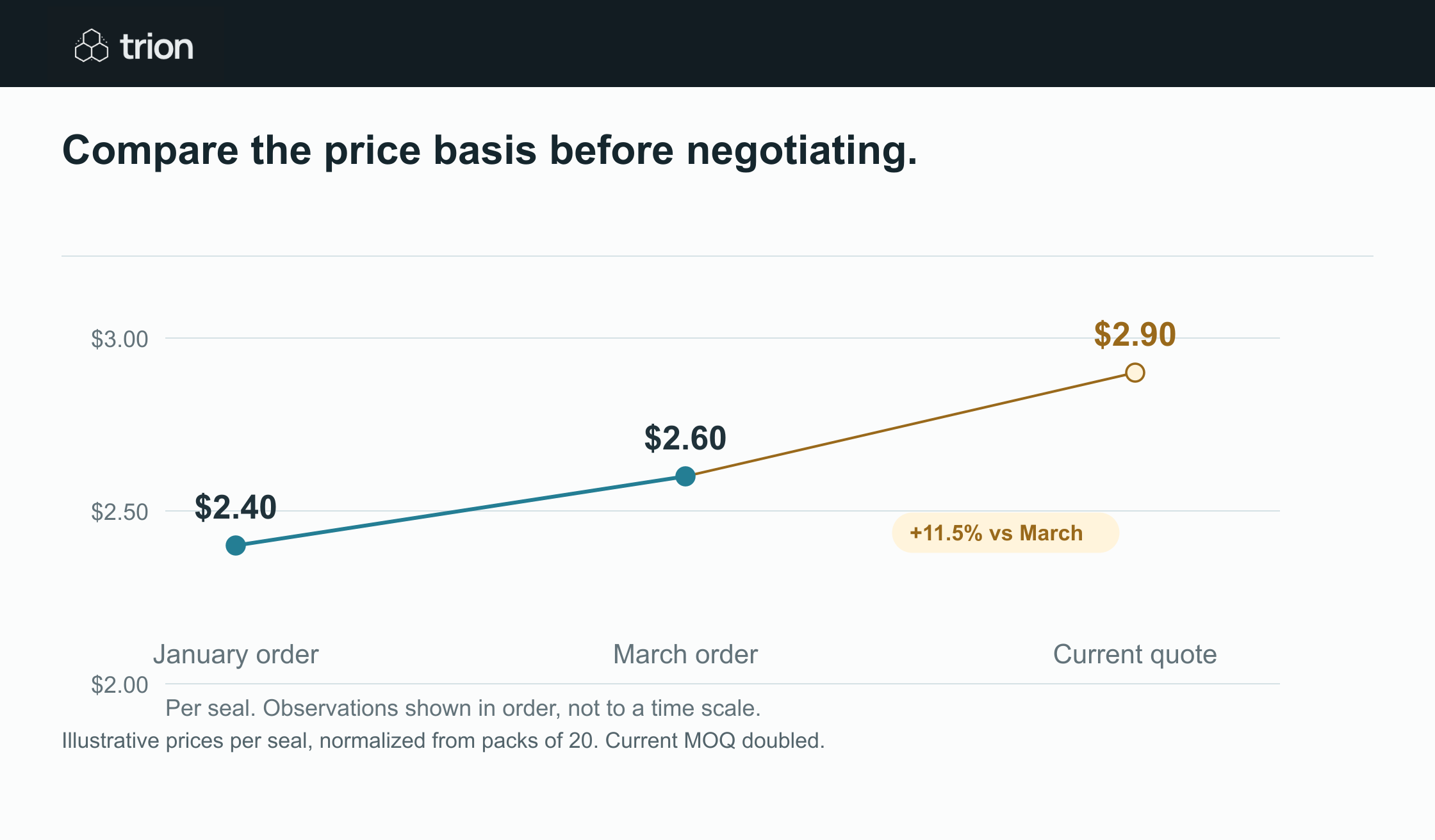

Compare the price basis before negotiating.
- January order
- $2.40 per seal
- March order
- $2.60 per seal
- Current quote
- $2.90 per seal, about 11.5% above March
- Basis
- Normalized from packs of 20; current MOQ doubled
- Chart spacing
- Ordered observations, not a proportional time scale
View data
| Evidence | Meaning |
|---|---|
| January order | $2.40 per seal |
| March order | $2.60 per seal |
| Current quote | $2.90 per seal, about 11.5% above March |
| Basis | Normalized from packs of 20; current MOQ doubled |
| Chart spacing | Ordered observations, not a proportional time scale |
Illustrative prices per seal, normalized from packs of 20. Current MOQ doubled.
Download imageThe current unit price is approximately 11.5% above the most recent $2.60 price: ($2.90 − $2.60) ÷ $2.60 × 100. That is a price comparison, not measured inflation or a justified savings opportunity. The increased minimum quantity also changes cash commitment and storage needs.
The buyer's first questions are specific: “What changed in the price basis since the March order? Can you quote both 20-pack and 40-pack quantities? Are freight and specification unchanged?” A higher minimum should not be accepted merely because a negotiated unit price looks attractive.
Prepare an evidence packet, not an automatic demand
- Select the relevant item and period, noting missing or excluded records.
- Attach the recent source orders and current quotation.
- Summarize the comparable unit price and differences in terms.
- Describe the actual future requirement without promising unapproved volume.
- List the questions and the buyer's authorized negotiation boundaries.
An older low price may reflect a promotion, a different market or a one-time concession. History can prompt a conversation; it does not prove the supplier must repeat that price. Assess lead time, quality and service alongside cost, using consistently defined evidence rather than an invented overall supplier rating.
Record the outcome and its conditions
AI can help propose product groupings or summarize the packet, but a buyer verifies comparable specifications and commercial meaning. Preserve the supplier's response, the accepted price basis, validity period and quantity condition. Finance and authorized approvers handle payment terms or spending commitments that exceed the buyer's authority.
Use the quote comparison tool for current alternatives and the scorecard guide for performance evidence. Keep the historical worksheet as support for a decision, not a substitute for current requirements or approval.