
Lead time is useful only when its start, end and calendar are defined. A team can measure the same purchase from request to approval, order to receipt, or request to usable stock and get different valid answers.
Choose the clock before calculating days
NetSuite's documented automatic purchasing lead-time calculation uses the difference between PO transaction date and final receipt date, averaged across three recent fully received orders. That is a specific product method. Your operational measure may use issued time or accepted receipt instead, so label it explicitly rather than assuming every “lead time” field means the same thing. Read NetSuite's lead-time calculation documentation.
Decide which decision the measure supports. Replenishment planning needs a time until stock is available. A supplier discussion needs to distinguish internal delays from the period under supplier control. A request-service review may need the whole elapsed time experienced by the requester.
Write a date-boundary worksheet
| Measure | Suggested start and end | Owner |
|---|---|---|
| Internal purchasing interval | Ready request to issued order | Procurement and approval process owner |
| Order-to-final-receipt interval | Issued order to final receipt for the defined requirement | Buyer and receiving team |
| Availability interval | Ready request to accepted, usable stock | Operations and quality, where applicable |
| Promise variance | Actual event compared with the applicable confirmed date | Buyer, with the source confirmation retained |
These are proposed measures, not software defaults. Record whether you use calendar days or working days, the named time zone and whether an event is a date or timestamp. A working-day measure needs the applicable holiday calendar; it cannot be inferred by just removing weekends.
A fictional timeline
A complete purchase request is ready on 1 October. Approval occurs on 4 October, the order is issued on 6 October, the supplier ships on 14 October, the first delivery arrives on 17 October, final receipt occurs on 20 October and inspection releases the stock on 22 October.
Using elapsed calendar days between these dates, the internal purchasing interval is 5 days. Issued order to final receipt is 14 days. Ready request to usable stock is 21 days. None of those numbers contradicts the others; they answer different questions.
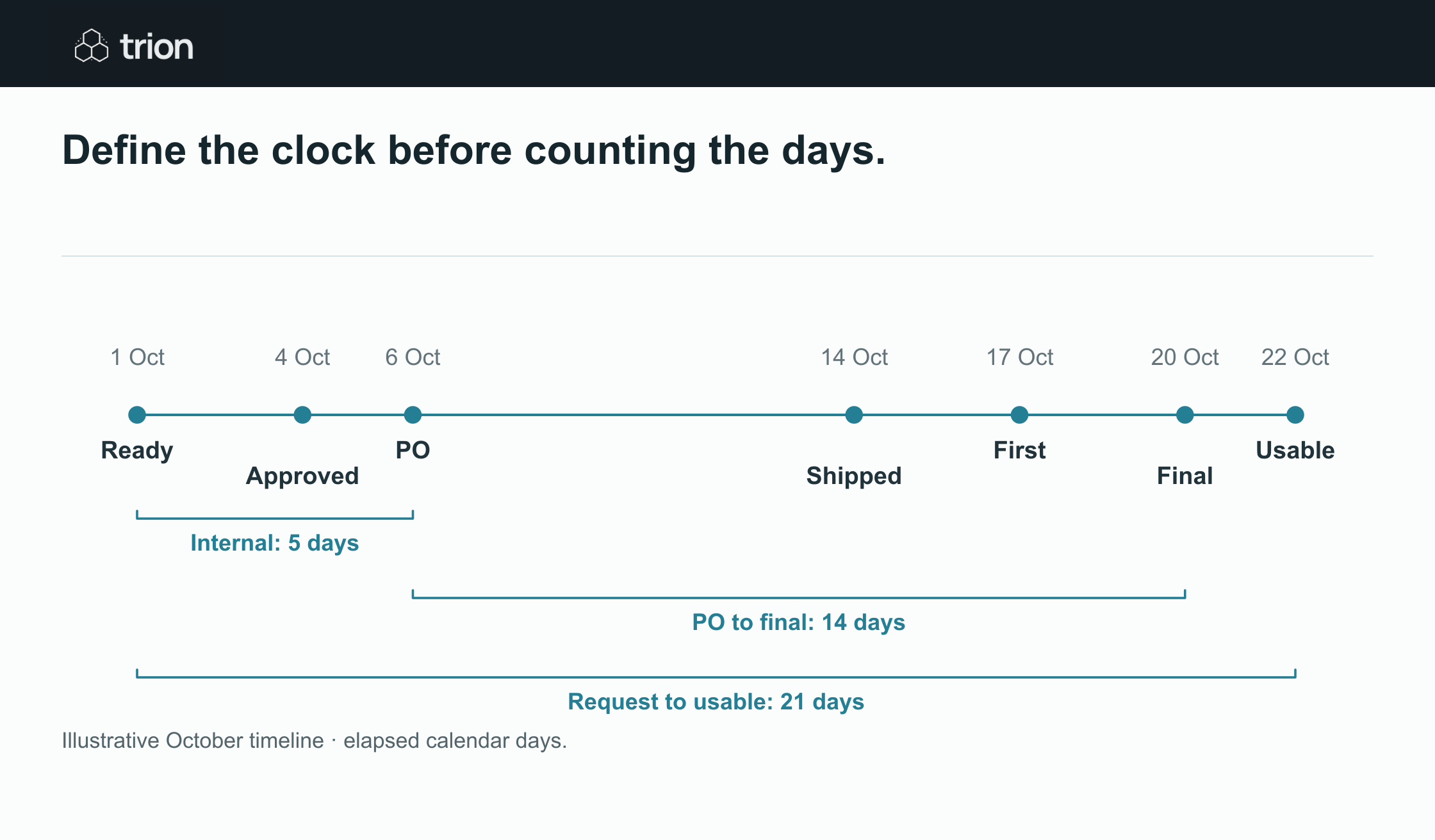

Define the clock before counting the days.
- 1 October
- Ready request
- 4 October
- Approved
- 6 October
- PO issued
- 14 October
- Shipped
- 17 October
- First receipt
- 20 October
- Final receipt
- 22 October
- Usable stock
- Internal purchasing
- 1 to 6 October: 5 elapsed calendar days
- PO to final receipt
- 6 to 20 October: 14 elapsed calendar days
- Request to usable stock
- 1 to 22 October: 21 elapsed calendar days
View data
| Evidence | Meaning |
|---|---|
| 1 October | Ready request |
| 4 October | Approved |
| 6 October | PO issued |
| 14 October | Shipped |
| 17 October | First receipt |
| 20 October | Final receipt |
| 22 October | Usable stock |
| Internal purchasing | 1 to 6 October: 5 elapsed calendar days |
| PO to final receipt | 6 to 20 October: 14 elapsed calendar days |
| Request to usable stock | 1 to 22 October: 21 elapsed calendar days |
Illustrative October timeline · elapsed calendar days.
Download imageIf the supplier's applicable confirmed final-arrival date was 18 October, final receipt is 2 days later. Do not compare a confirmed dispatch date with an arrival event. A change in the requested quantity or delivery location should also remain visible alongside the measured interval.
Handle incomplete and split deliveries honestly
Define whether a line completes on first receipt, receipt of its required quantity, or acceptance after inspection. Keep first and final dates when both matter. If a remainder is cancelled, record that reason instead of pretending it arrived. The partial receipt guide covers the receipt ledger itself.
Open orders do not yet have a final elapsed lead time. Report their current age separately. Excluding every outstanding late order can make completed-order averages look reassuring while the largest delays are still unresolved.
Summarize comparable orders, then inspect the spread
In another fictional sample, three comparable completed orders take 8, 10 and 18 days. Their mean is 12 days and median is 10 days. Display the individual values and sample count. Neither average establishes that a new order will arrive within 12 days.
Group by relevant supplier site, item family, destination and shipping method before pooling data. Separate emergency orders when their process differs. Keep unusual delays visible with a reason rather than deleting them to improve the result. Choose a review period that reflects the actual operating conditions and explain exclusions.
Use the measurement for a specific action
Procurement can examine approval queue time; the buyer can discuss a supplier's date changes; operations can update planning assumptions. Keep the source timestamps and correction history so a disputed interval can be reconstructed. Use the reorder-point tool only after choosing the relevant planning lead time, and the scorecard tool for clearly defined performance measures. An unexplained average should not automatically change purchasing commitments.