
A reorder point tells a team when replenishment needs attention. Safety stock supplies a buffer within that calculation. Neither number is useful without a clear demand period, lead-time basis and view of inventory already committed or inbound.
The simple formula and what it means
For a stable-demand planning example, reorder point equals expected demand during replenishment lead time plus safety stock. With average daily demand, that becomes daily demand × lead time in days + safety stock. Oracle NetSuite documents this structure and rounds its calculated reorder point up to the next whole unit. See the inventory optimization calculation.
The formula is a planning model. It does not decide the order quantity, guarantee availability or establish an appropriate service level. The assumptions need to match the item's consumption pattern and the organization's inventory policy.
A worked example: packaging labels
A fictional warehouse consumes an average of 15 rolls of labels per calendar day. Replenishment takes 12 calendar days from approved order to usable stock. The planner chooses a simple four-day demand buffer for this example, giving 15 × 4 = 60 rolls of safety stock. Expected demand during lead time is 15 × 12 = 180 rolls.
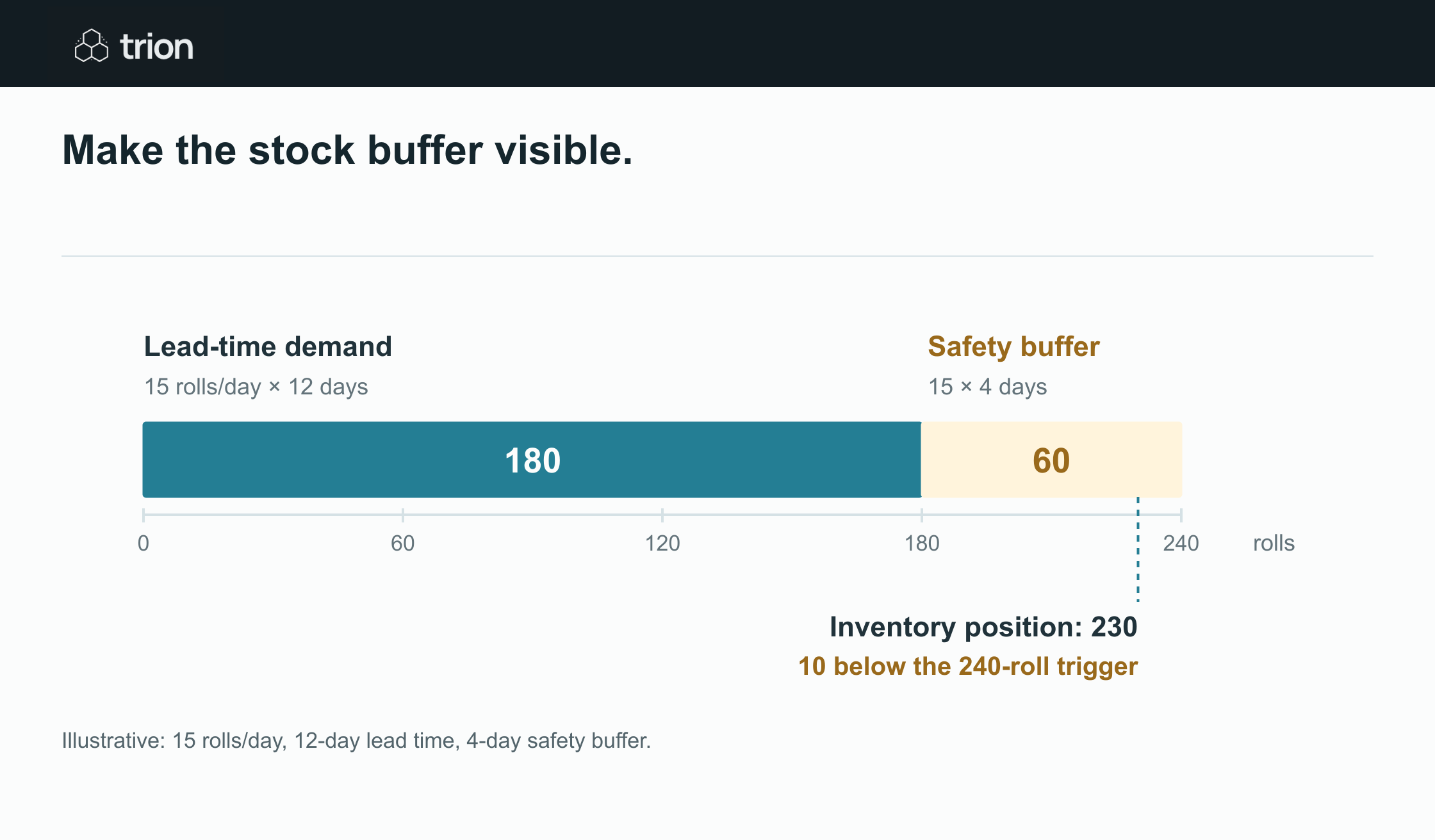

Make the stock buffer visible.
- Demand
- 15 rolls per day
- Lead time
- 12 days; demand 180 rolls
- Safety buffer
- 4 days; demand 60 rolls
- Reorder point
- 180 + 60 = 240 rolls
- Inventory position
- 230 rolls; 10 below trigger
View data
| Evidence | Meaning |
|---|---|
| Demand | 15 rolls per day |
| Lead time | 12 days; demand 180 rolls |
| Safety buffer | 4 days; demand 60 rolls |
| Reorder point | 180 + 60 = 240 rolls |
| Inventory position | 230 rolls; 10 below trigger |
Illustrative: 15 rolls/day, 12-day lead time, 4-day safety buffer.
Download image| Input or result | Calculation | Rolls |
|---|---|---|
| Lead-time demand | 15 per day × 12 days | 180 |
| Illustrative safety buffer | 15 per day × 4 days | 60 |
| Reorder point | 180 + 60 | 240 |
The four-day buffer is a transparent assumption, not a statistical guarantee. The planner should test whether it is suitable using actual variability, stockout consequences, carrying constraints and approved policy. A critical spare and a routine packaging item may need very different approaches.
Compare the threshold with the right inventory position
For this illustration, define inventory position as usable on-hand stock plus confirmed inbound stock minus committed outbound quantities not otherwise included in available stock. The warehouse has 150 usable rolls, 120 confirmed inbound and 40 committed for an imminent dispatch. Its position is 150 + 120 − 40 = 230 rolls, below the 240-roll threshold.
Check how the inventory system already treats reservations, backorders and planned receipts before applying this definition. Subtracting the same commitment twice understates availability. Adding an unconfirmed or late inbound order can overstate it. The planner needs the source quantities and their status, not merely a threshold badge.
Use compatible demand and lead-time units
Calendar-day demand cannot be multiplied by working-day lead time without adjustment. Include the actual interval to usable stock, which may involve internal approval, supplier processing, transport and inspection. If approval takes three days but the recorded lead time starts only after issue, the planning assumption can miss consumption during those three days.
Check the historical demand period. A temporary promotion, an outage or a seasonal peak may make the recent average unsuitable. Returns, internal transfers and data corrections also need consistent treatment. Use actual consumption where appropriate; an order placed for a large one-off job is not necessarily recurring daily demand.
Keep reorder quantity separate
A position below the threshold signals that replenishment needs review. It does not mean order exactly the threshold amount. The quantity may depend on target coverage, current position, supplier minimum order quantity, pack size, storage space and the item's shelf life. Show those constraints explicitly before preparing a purchase request.
If labels are sold in packs of ten rolls, round the proposed purchase quantity under the agreed pack rule, while preserving the unrounded planning result. If the supplier's minimum is larger than the warehouse can hold, create an exception for the buyer and planner. Do not silently increase the order to satisfy one constraint while violating another.
Review the assumptions when reality changes
If observed replenishment rises from 12 to 16 calendar days, the same demand and buffer imply 15 × 16 + 60 = 300 rolls. That change needs a dated assumption update and an owner. Conversely, a permanent decline in demand can make an old threshold create unnecessary stock.
Try the reorder point tool to explore the calculation. In a pilot, test missing demand, zero consumption, delayed inbound stock and a pack-size constraint. The inventory planner owns the assumptions; the buyer owns the purchasing action. AI can help summarize patterns, but a simple, visible calculation should remain reproducible without a model's explanation.