
AI can help organize procurement contracts and prepare questions for review. A useful workflow treats its output as document triage: proposed facts, cited clauses and unresolved issues, not legal advice or authority to accept an agreement.
Start with a review packet, not a legal verdict
Contract triage can identify document parties, stated dates, pricing references and the locations of clauses for human review. It can also compare proposed wording with a playbook supplied and maintained by the organization's qualified reviewers. The system should present the text it used and say when a required section could not be found.
IBM describes AI-supported contract data extraction, clause organization and obligation tracking, while emphasizing human judgment in contract management. These capabilities support a review process; they do not establish that a particular clause is lawful, enforceable or acceptable for your organization. Read IBM's contract management overview.
Define the questions and the evidence format
Ask narrow questions: where is the renewal wording, what notice period is stated, which appendix contains the price schedule, and what document version was reviewed? Require an evidence location and the relevant wording. If the document references an absent appendix, the output should show missing evidence rather than complete the answer from a familiar template.
| Triage item | Required output | Decision owner |
|---|---|---|
| Renewal wording | Clause location, stated dates and unresolved interpretation | Authorized contract reviewer |
| Price schedule | Referenced appendix and whether it is present | Buyer and commercial reviewer |
| Nonstandard clause | Difference from the maintained playbook | Qualified legal reviewer |
| Required approval | Policy route and missing review decisions | Approval owner |
A worked example: an uncertain renewal date
In a fictional supplier agreement, the main document states a twelve-month initial term. Another paragraph describes a renewal notice period, while the effective date is defined in a signature page that is not included in the supplied file. A model may be able to summarize the term and notice wording, but it cannot establish a reliable calendar deadline from the incomplete packet.
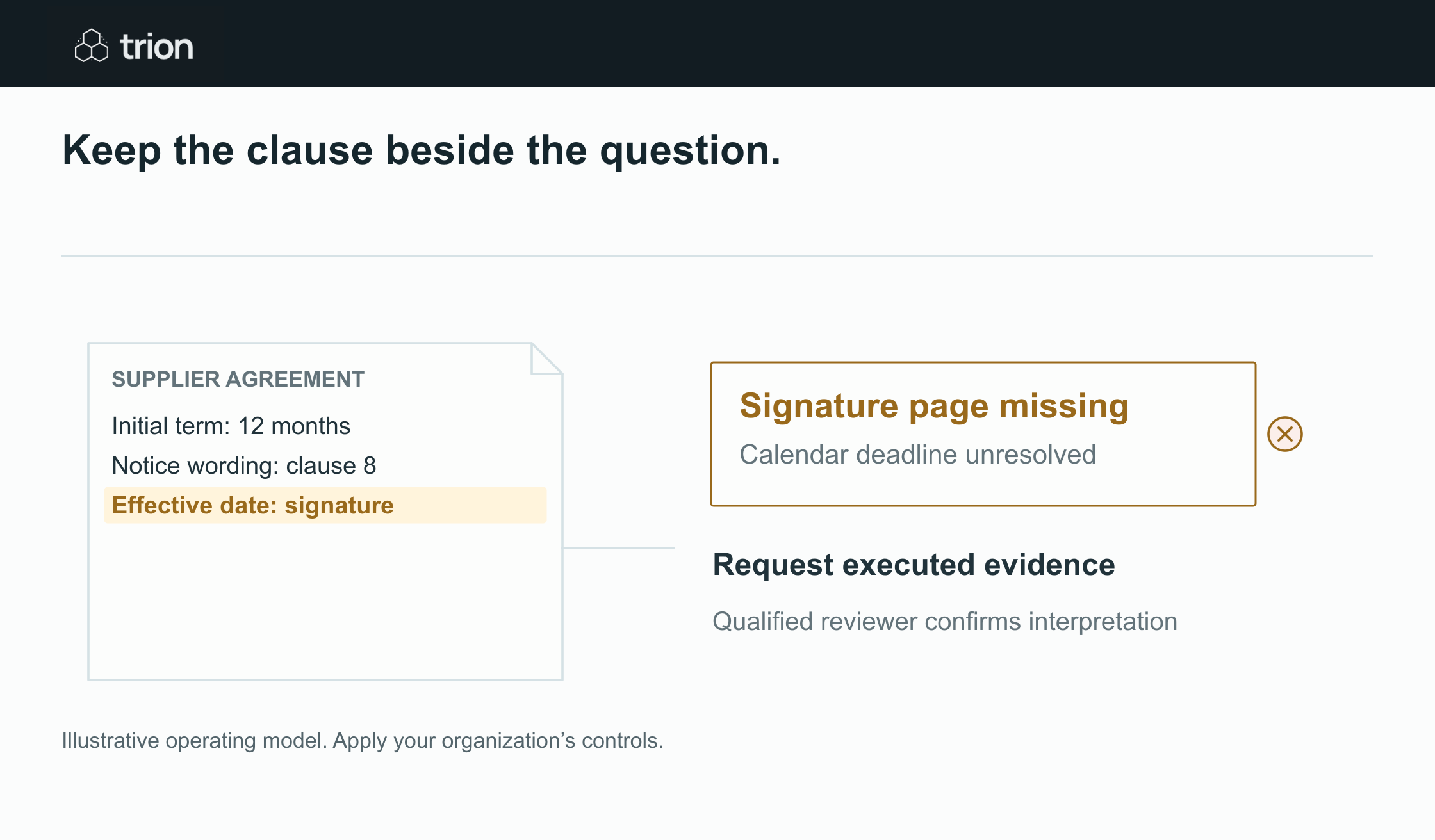

Keep the clause beside the question.
- Extract
- Propose dates and obligations
- Flag
- Mark missing or conflicting clauses
- Review
- Qualified reviewer interprets and decides
View data
| Evidence | Meaning |
|---|---|
| Extract | Propose dates and obligations |
| Flag | Mark missing or conflicting clauses |
| Review | Qualified reviewer interprets and decides |
Illustrative operating model. Apply your organization’s controls.
Download imageThe triage record lists the two clause locations, marks the effective date unresolved and asks for the executed signature page. The contract reviewer confirms the correct documents and interpretation before a deadline enters the operating calendar. The system must not use the upload date as a substitute for the missing effective date.
If an amended agreement later changes the renewal wording, keep it linked to the earlier contract. The reviewer decides which provisions apply. Extracting a newer date does not itself resolve document precedence or confirm that an amendment was executed.
Keep source text separate from interpretation
Distinguish a statement found in the document from an inferred business meaning. “The clause states 60 days” is different from “the organization may terminate by this date.” The latter may depend on definitions, related clauses, execution details and applicable law. Give those questions to the qualified reviewer.
Retain the supplied file, version, extraction method and review record. Use short excerpts sufficient to locate the issue, rather than scattering a full confidential contract across notifications. An authorized reviewer should be able to open the relevant source and correct the proposed field.
Set access and action boundaries
Agree on which documents may be processed, where they are stored and which external processing services receive them. The contract owner and IT team should verify access, retention and recovery requirements for the actual environment. A convenient upload route should not become a broad document-sharing route by accident.
The workflow can prepare a review packet and draft administrative tasks. It should not sign an agreement, accept revised terms, send a legal notice or change a supplier's contractual status without the required authority. A due-date reminder is an operational prompt for review, not proof that a legal action is permitted or complete.
Test incomplete and conflicting documents
Include a missing appendix, a scanned signature page, a definition split across sections, an unsigned draft and two conflicting amendments. Ask the reviewer to check whether each proposed answer is supported by the cited wording. Record unsupported answers as errors even if they sound plausible.
Use the readiness check to establish the review owners and the processing cost tool for volume assumptions. For purchasing changes after approval, the separate version-specific approval guide covers the operational decision record. Contract triage makes questions and evidence easier to review while keeping professional judgment explicit.