
AI in procurement helps teams interpret information, propose structured records and find patterns in purchasing work. Its usefulness depends on the task, the evidence and what happens when its suggestion is wrong.
What AI adds to a procurement workflow
A useful distinction is between interpreting information and carrying out a known rule. Reading a varied supplier description and suggesting an item category can involve AI. Multiplying an approved quantity by a unit price does not need a language model. Moving a verified record to a reviewer can use ordinary workflow automation. Mixing these jobs makes it difficult to tell which part caused an error.
IBM describes procurement uses including document analysis, spend analysis and supplier-related insights. Those are capability categories, not a promise that any particular implementation will be accurate. The practical starting point is a narrow job with an observable output. Read IBM's overview of AI in procurement.
Choose the task before choosing the model
Write down the input, proposed output, reviewer and next action. For example: the input is a supplier quotation; the output is a draft record containing item descriptions, quantities and commercial terms; the reviewer is the buyer; the next action is to correct or accept the record. This description is more useful than asking for an AI procurement agent because it tells the team what needs testing.
| Task | Useful approach | Review question |
|---|---|---|
| Suggest a category from free text | AI classification | Is the category supported by the description? |
| Calculate a line total | Deterministic calculation | Are quantity, unit and price valid? |
| Route a known exception | Explicit workflow rule | Is the owner defined by policy? |
| Recommend a supplier award | Decision support with human evaluation | Are costs, suitability and evidence complete? |
A worked pilot: categorize maintenance requests
Consider a fictional facilities team receiving 80 maintenance purchase requests each month. Staff currently assign each request to electrical, plumbing, safety equipment or an unresolved category. A pilot can suggest one category and show the text that supported it. The model must have an unresolved option; forcing every request into a category would hide uncertainty.
Use a historical sample whose correct categories have been reviewed by the team. Include short requests, misspellings, mixed requests and items that do not belong to any category. Keep some examples out of the initial configuration work so the final check tests unseen inputs. A buyer should also be able to split a request that contains both plumbing and electrical items.
Measure correct suggestions, unresolved cases, wrong confident suggestions and reviewer time. If 60 suggestions are accepted, 12 are corrected and 8 remain unresolved, report all three groups. Do not describe 60 accepted suggestions as 75% time saved. Acceptance rate and time saved answer different questions.
Define what the workflow is allowed to do
For the pilot, accepting a category might update a draft intake record. It should not silently authorize a supplier, commit spending or transmit a purchase order. Record the original request, suggested category, reviewer correction and final category. This makes a later error understandable and supplies useful examples for improving the configuration.
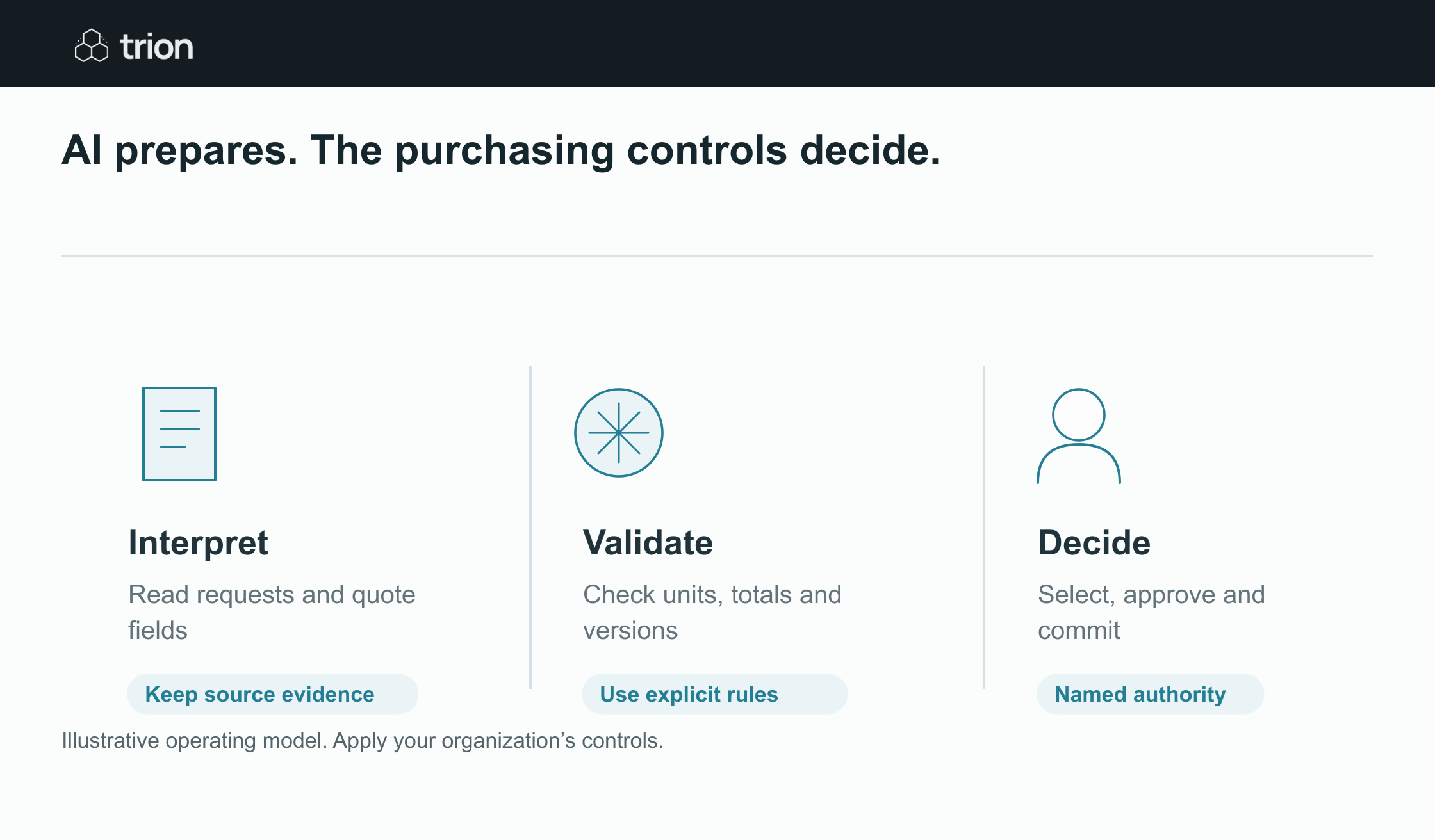

AI prepares. The purchasing controls decide.
- Interpret
- Read requests and quote fields. Keep source evidence
- Validate
- Check units, totals and versions. Use explicit rules
- Decide
- Select, approve and commit. Named authority
View data
| Evidence | Meaning |
|---|---|
| Interpret | Read requests and quote fields. Keep source evidence |
| Validate | Check units, totals and versions. Use explicit rules |
| Decide | Select, approve and commit. Named authority |
Illustrative operating model. Apply your organization’s controls.
Download imageThe process owner decides the completion rule. Procurement owns the category definitions; an operations reviewer handles uncertain requests; IT owns access and integration reliability. If nobody owns the unresolved queue, the automation merely moves work into a new place. Give that queue a review schedule and a fallback when the owner is absent.
Estimate the cost of the whole task
Include review time, retries, document processing, storage and maintaining the integration. A low model price does not establish a low cost per accepted record. Record actual pilot volumes and the time spent handling exceptions. Use the automation ROI tool for a scenario calculation, then replace assumptions with measured values.
Start with one department and one input route. Keep manual processing available when the service is unavailable or the input cannot be read. Agree on who can pause the workflow and how queued requests will be recovered. Only expand after the accepted records and exception handling behave as intended.
Where to go next
Use the readiness check to identify missing ownership, data or review rules. For a document-focused pilot, read the quotation PDF extraction guide. For the commercial decision itself, use the existing quotation comparison guide. AI should make the evidence easier to use while preserving the decisions your team needs to make.