
A supplier agreement rate is useful evidence. Turning it into a business case takes a spend base, comparable terms and the full cost of running the workflow.
Reported case. Walmart is not presented as a Trion customer.
What Walmart reported
Businessweek’s 2023 interview describes Pactum negotiating equipment such as shopping carts, rather than store merchandise. Walmart reported 3% average savings on computer-handled contracts; Darren Carithers described days rather than weeks or months. Read the interview.

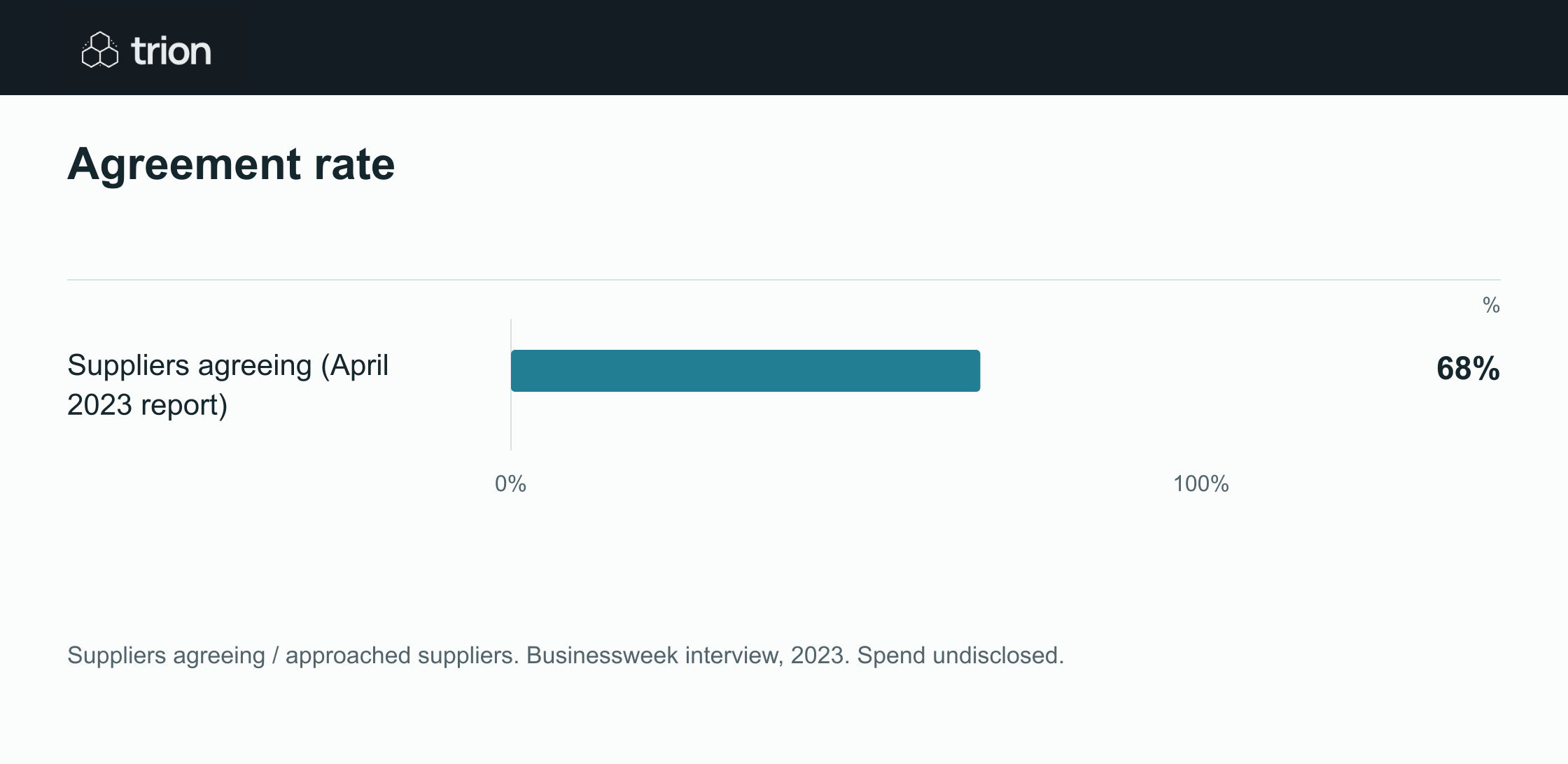
Agreement rate
Suppliers agreeing / approached suppliers
Scope, sources and data
| Observation | Value | Scope and source |
|---|---|---|
| Suppliers agreeingApril 2023 report | 68% | Approached suppliers; count basisBusinessweek interview |
Businessweek interview, 2023. Spend undisclosed.
“We set the requirements and then, at the end, it tells us the outcome.”
Darren Carithers, then Walmart’s senior vice president for international operations. Businessweek interview
The mechanism starts with commercial limits
Pactum’s 2020 announcement describes analysts mapping commercial priorities before the chatbot negotiates, then updating enterprise records. CEO Martin Rand called the principle “it’s not a zero-sum game”: the vendor’s view of trading terms, not verified mutual gains. Read Pactum’s announcement.
People define the permitted trade
- Set commercial limits
- Negotiate permitted terms
- Record the agreement
Our reading: the useful design choice is deciding what the system may exchange. A lower unit price can be offset by freight, payment timing or a longer commitment. Define permitted concessions, an escalation owner and the record that proves the accepted terms before opening supplier discussions.
Read the denominator before the headline
The chart counts suppliers; the savings figure describes contracts. They cannot produce a spend-weighted result. Multiplying them would assume compatible cohorts, equally sized deals and a known weighting method. Record the value of negotiated purchases directly.
Neither source discloses cohort size, spend, costs, a controlled comparison or an independent audit. No buyer-hour measure is given. The improvement’s size, attribution and net value remain unresolved.
Give the savings model its own assumptions
For scenario planning, let A be assumed agreed negotiated spend, r the assumed savings rate and C the total software, implementation and buyer review cost for the same period.
Gross savings G = A × r. Net savings = G − C. Break-even spend = C ÷ r, when r is positive. Keep quantities, specifications and the treatment of freight and tax comparable.
Illustrative inputs: $1,000,000 of agreed spend at 3% gives $30,000 gross savings. With $20,000 of costs, net savings are $10,000. The same assumptions break even at about $666,667 of agreed spend. These figures are not Walmart’s ROI or profit.
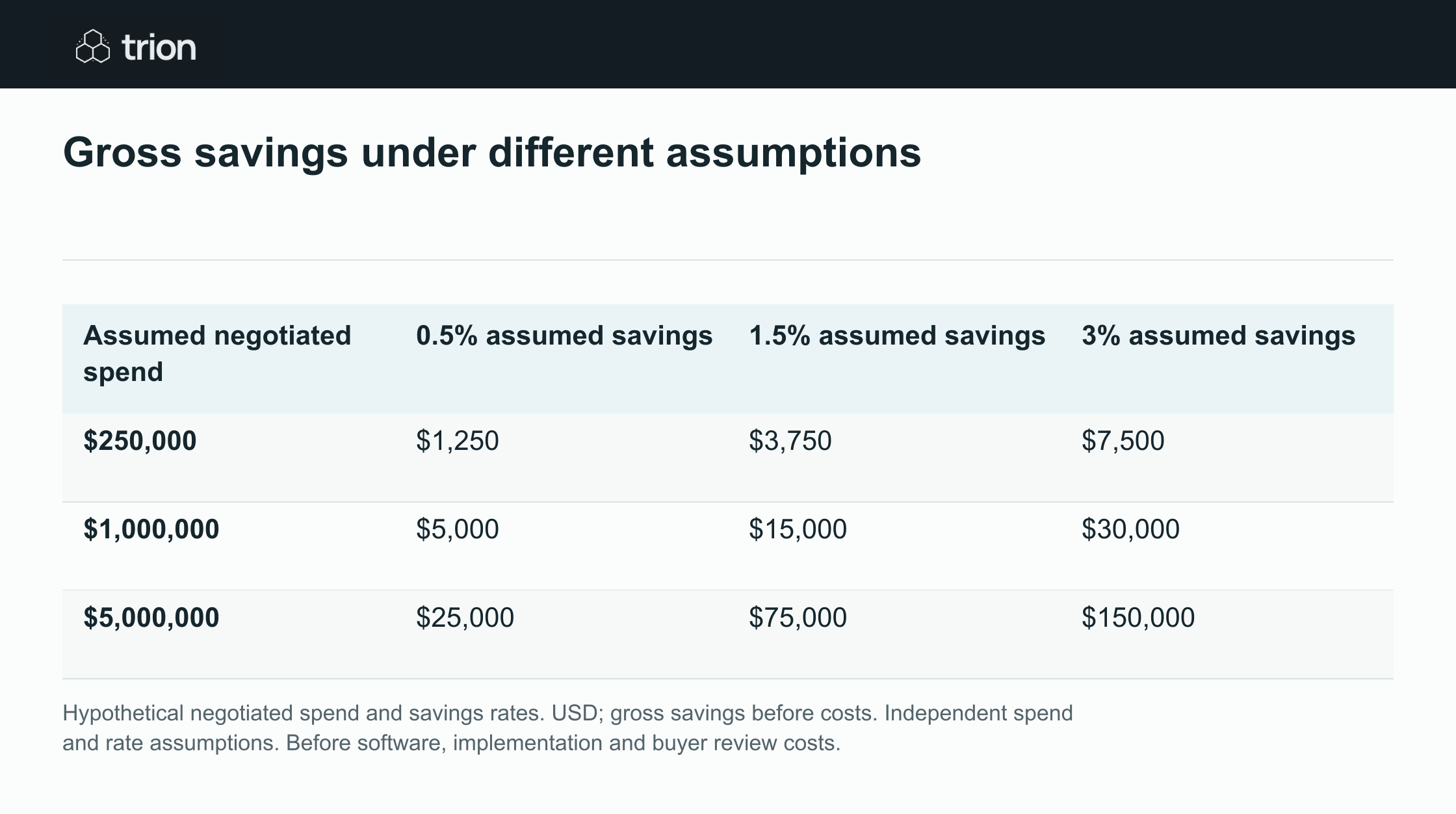
Gross savings under different assumptions
Gross savings in USD, before software, implementation and buyer review costs.
| Assumed negotiated spend | 0.5% | 1.5% | 3% |
|---|---|---|---|
| $250,000 | $1,250 | $3,750 | $7,500 |
| $1,000,000 | $5,000 | $15,000 | $30,000 |
| $5,000,000 | $25,000 | $75,000 | $150,000 |
Calculation and assumptions
Assumed negotiated spend × assumed saving rate. Independent spend and rate assumptions. Before software, implementation and buyer review costs.
Test the workflow on a defined purchase set
- Coverage: log invitations, agreements and agreed spend separately; keep declined and unanswered invitations visible.
- Value: compare equivalent delivered purchases, including concessions and review costs. Separate released buyer time from cash savings.
- Control: retain the approved limits, final terms and exceptions. Offer a human route when the purchase falls outside the permitted trade.
Use the automation ROI calculator to cost your workflow and quote comparison to check the commercial differences. A useful pilot answers how much comparable spend improved, at what cost, with which exceptions.