
A sent purchase order proves transmission, not the supplier's ability to fulfil it. Acknowledgement tracking captures the supplier's response and highlights differences while there is still time to act.
Separate acknowledgement from receipt
SAP's Manage Supplier Confirmations app manages order acknowledgements around ordered quantities and delivery dates. It treats confirmations as their own business object. That separation is useful in an email workflow: a supplier confirmation is evidence of its response, while warehouse receipt evidence records what arrived. See SAP's supplier confirmation documentation.
“Received your PO” may acknowledge the message without confirming every commercial term. Keep the source wording available. A buyer should be able to distinguish an unqualified confirmation from a proposed date change, substitution, quantity difference or price change.
Create a line-level acknowledgement register
| Field | Why keep it |
|---|---|
| PO, line and issued revision | Identify exactly which requirement the supplier answered. |
| Requested quantity and arrival date | Preserve the original requirement. |
| Confirmed quantity and arrival date | Record the response without overwriting the request. |
| Source and received timestamp | Make the interpretation reviewable. |
| Difference, owner and next action | Explain what remains unresolved. |
A message can cover multiple lines or only one schedule. “All other terms unchanged” is meaningful only when the referenced order revision is clear. If it is unclear, mark the reference unresolved and ask the supplier; the automation should not guess based on the newest attachment.
A fictional two-line order
PO-720, revision 1, requests 40 mounting brackets and 80 clamps, both arriving by 12 November. The supplier confirms all brackets for that date but offers 50 clamps on 12 November and 30 on 19 November. The message is a response received; the clamp line remains a proposed schedule difference.
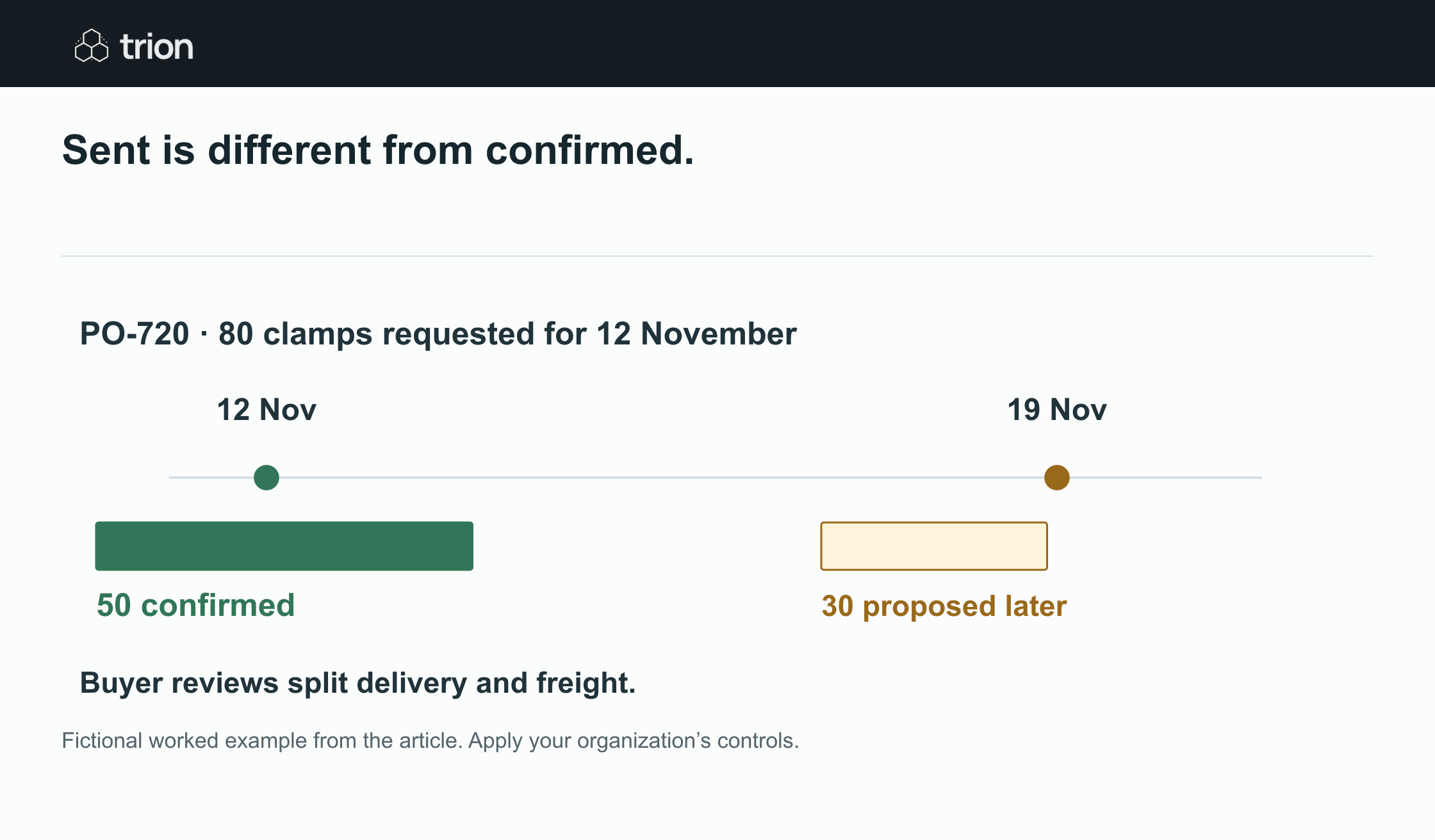

Sent is different from confirmed.
- Request
- PO-720 revision 1: 80 clamps arriving 12 November
- Supplier response
- 50 clamps on 12 November, 30 on 19 November
- Buyer check
- Review split delivery, extra freight and remaining work
View data
| Evidence | Meaning |
|---|---|
| Request | PO-720 revision 1: 80 clamps arriving 12 November |
| Supplier response | 50 clamps on 12 November, 30 on 19 November |
| Buyer check | Review split delivery, extra freight and remaining work |
Fictional worked example from the article. Apply your organization’s controls.
Download imageThe warehouse requester says the first 50 clamps support the initial installation. The buyer still reviews the split delivery, extra freight and effect on the remaining work. Only an authorized decision can accept the change or issue an amended order. A parser extracting the two dates does not make that decision.
If an amendment becomes revision 2, retain the original requirement and response, record the decision, and ask for confirmation against revision 2. A later email confirming revision 1 should not close the revision 2 task.
Use states that explain the next action
- Awaiting response: the issued order has no relevant acknowledgement.
- Response needs review: evidence arrived but its coverage or meaning is unresolved.
- Difference proposed: a quantity, date, item or term differs from the order.
- Confirmed as issued: reviewed evidence covers the applicable requirement.
- Superseded or cancelled: a recorded change makes this acknowledgement task obsolete.
Measure acknowledgement completeness per relevant line or schedule, not simply whether an email exists. An order with three lines and one vague response may still need work. Choose a policy-based response deadline and make the buyer responsible for escalation when it passes.
Automate the register and the reminder checks
A workflow can match a candidate response, extract proposed dates, prepare the register update and draft a targeted question. Require review when the PO reference is ambiguous, the supplier contact differs, units change or the message contradicts an earlier confirmation. A reminder should check current state again immediately before sending.
Keep delivery performance measurement separate. A supplier can acknowledge quickly and deliver late; another can deliver correctly while responding slowly. If you measure both, define separate denominators in the supplier scorecard guide or scorecard tool. Use the follow-up guide for cancellation and retry rules. The purpose here is to surface a commitment difference early enough for a buyer to resolve it.