
A supplier reply should join a purchase request because the evidence supports that relationship. A familiar sender or a matching subject line can help, but neither proves the match. Build the workflow so uncertainty remains visible and a reviewer can correct it before it affects a comparison or order.
Give each purchase request a stable reference
Start with a reference such as PR-1047, and include it in the request record, outbound enquiry, and supplier question log. Store the requester, supplier candidates, specification, quantity, unit, required date, and current status. A useful identifier points to one record even when its description changes.
Ask suppliers to include the reference in their reply and quotation. Expect some to omit it, copy an older subject line, or quote several requests together. The identifier improves matching; it does not remove the need to examine the rest of the evidence.
Use several signals, with different strengths
| Signal | What it contributes | Why it can fail |
|---|---|---|
| Exact request reference | A direct link to a request | An old or mistyped reference may be carried forward |
| Expected supplier identity | Supports the business relationship | A shared inbox or new sales contact may change the sender |
| Specification and quantity | Checks the reply against the requested purchase | Substitutions, pack sizes, or revisions may differ |
| Conversation context | Shows which enquiry preceded the reply | One thread may cover multiple requests |
| Dates and status | Checks whether the request is active and plausible | A late reply may concern a closed request |
Keep supplier aliases and contact changes in a reviewed record. Do not accept an unfamiliar sender solely because the display name resembles a known supplier. Likewise, the presence of a request reference does not by itself establish that the message or attachment is trustworthy.
Make confidence operational
Use three practical outcomes: a supported match, a candidate that needs review, or an unassigned message. These are workflow states. If a system also produces a numerical confidence score, test its meaning against real examples from your inbox before setting a threshold. A number such as 95 should not be presented as a 95 percent probability unless that interpretation has been validated.
A supported match might have one active request, an exact reference, the expected supplier, and consistent lines. A candidate might have a good specification match but no reference. An unassigned message might concern a new purchase or contain too little information. Conflicting strong signals should send the message to review even if several weaker signals agree.
Handle one reply covering two requests
In an illustrative case, PR-1047 requests 40 cable glands and PR-1048 requests 20 brackets. The supplier replies in the PR-1047 thread with a PDF containing both lines and a combined freight amount. Attaching the entire quote only to PR-1047 would hide the brackets and could duplicate freight if someone later copies the PDF to PR-1048.
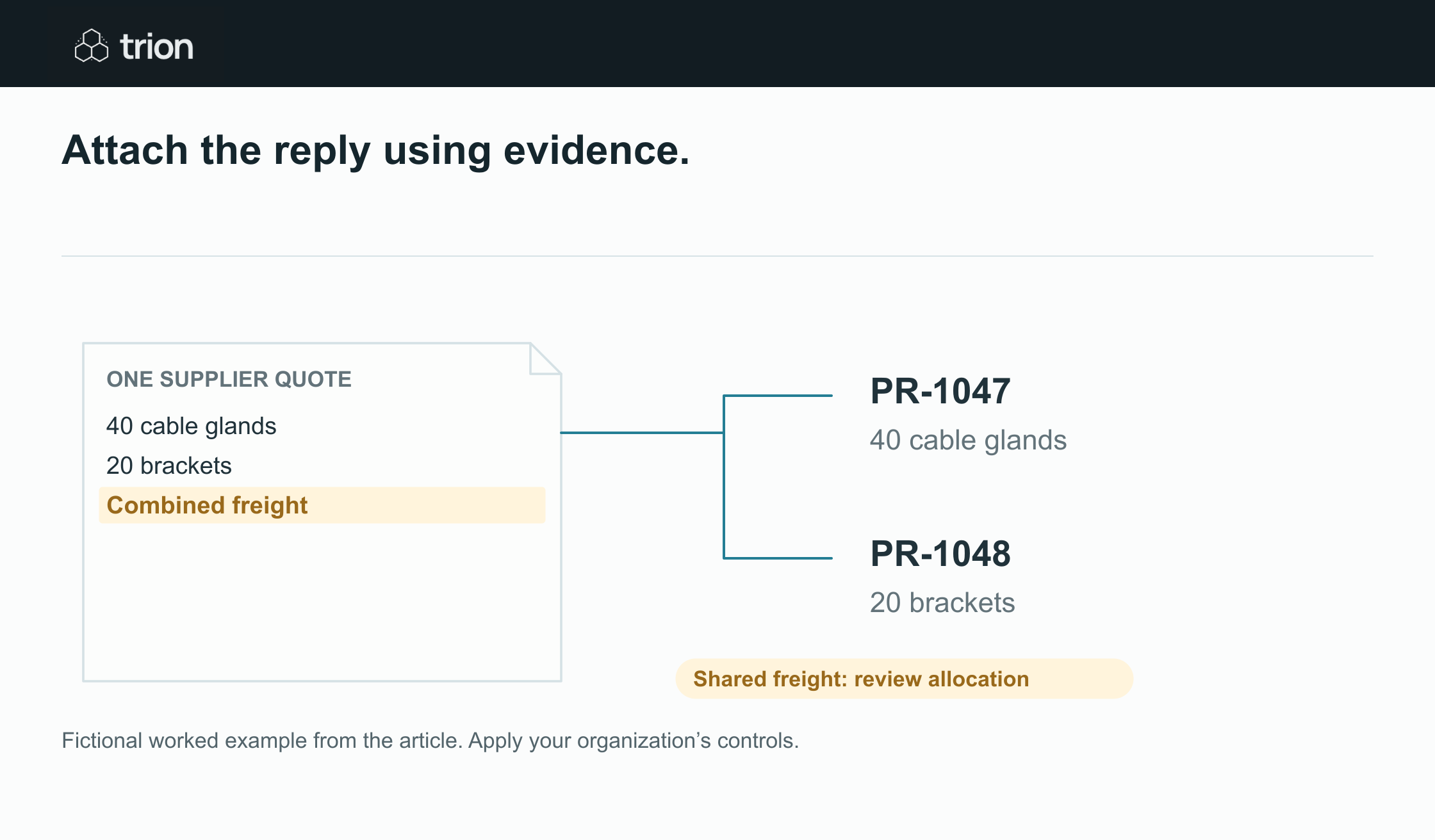

Attach the reply using evidence.
- PR-1047
- 40 cable glands
- PR-1048
- 20 brackets
- Supplier reply
- One PDF in the PR-1047 thread covers both lines with combined freight
- Review
- Identify each line and represent common freight once
View data
| Evidence | Meaning |
|---|---|
| PR-1047 | 40 cable glands |
| PR-1048 | 20 brackets |
| Supplier reply | One PDF in the PR-1047 thread covers both lines with combined freight |
| Review | Identify each line and represent common freight once |
Fictional worked example from the article. Apply your organization’s controls.
Download imageThe review action is to identify which lines belong to each request, record the shared quotation, and decide how the common freight should be represented. Preserve that decision with the quote version. If the specification or quantity is ambiguous, ask the supplier rather than choosing the closest-looking line.
Design a review queue people can resolve
Show the original message, extracted reference, candidate requests, supporting and conflicting evidence, and attachment preview. Give the reviewer explicit actions: confirm a match, select another request, split the quote, mark it unrelated, or ask a question. Record who decided and why. A corrected match should update downstream draft comparisons without erasing the previous decision.
Also define duplicate handling. A technical message identifier and an attachment fingerprint can help detect repeat ingestion, but identical attachments may legitimately appear in different messages. Preserve the source relationship and avoid treating every repeated file as a new quote version.
Pilot the rules before connecting actions
Test exact references, missing references, shared threads, forwarded attachments, closed requests, and revised quotations. Review incorrect matches and unresolved messages separately. Define what accuracy is acceptable for each action, especially where a match could affect spending.
Use the purchase request template to establish consistent request fields and the supplier question log to capture unresolved evidence. Gmail integration and extraction require access to your actual account and a scoped pilot. Keep supplier replies and purchase commitments behind the agreed human approval controls.