
Write a metric dictionary before a dashboard
For each measure, name the business question, record type, reporting period, numerator, denominator, exclusions and owner. Time-based measures also need start and stop events, timezone and calendar. Keep the definition beside the chart so its meaning survives a change of analyst.
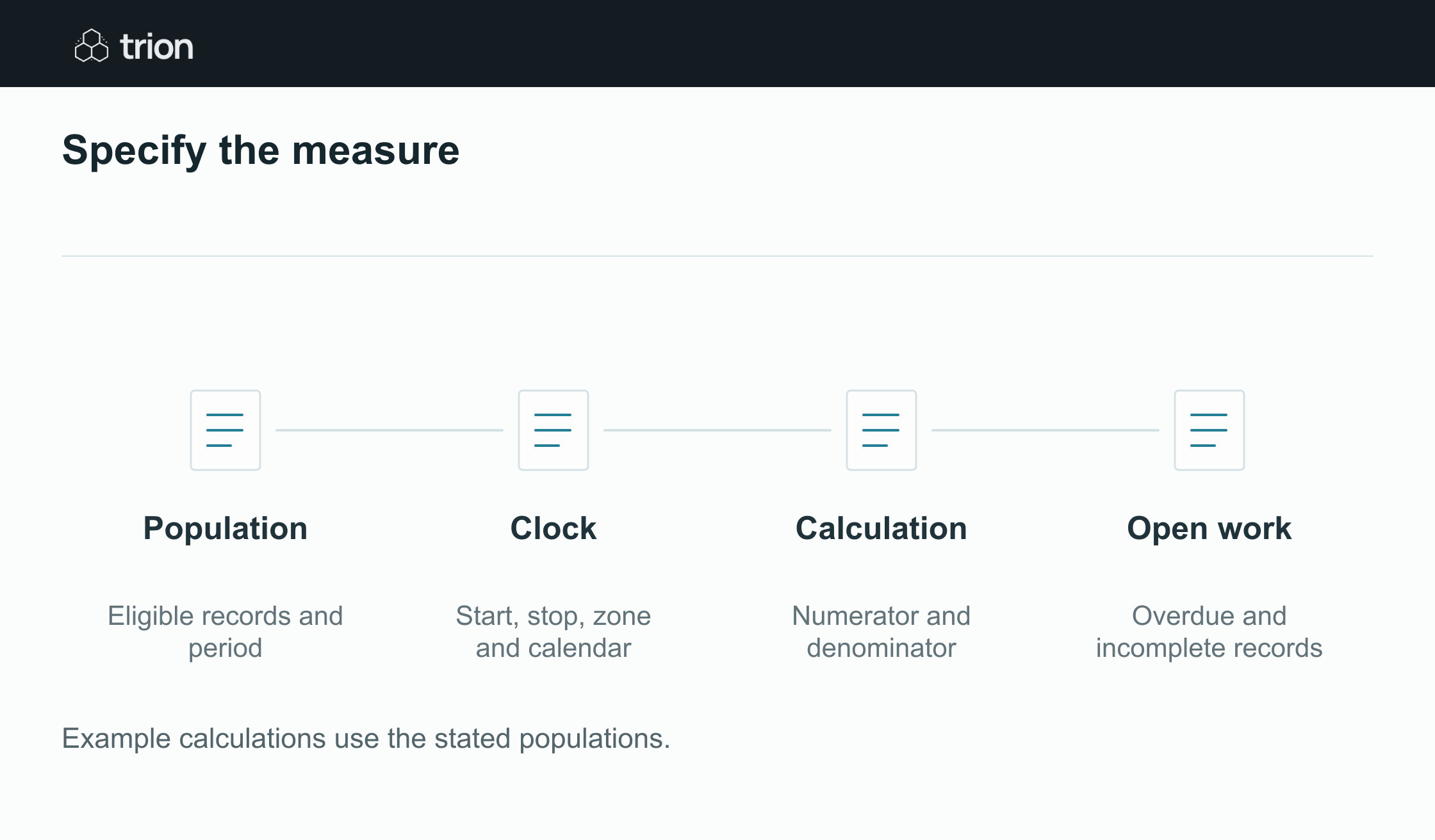

Specify the measure
- Population
- Eligible records and period
- Clock
- Start, stop, zone and calendar
- Calculation
- Numerator and denominator
- Open work
- Overdue and incomplete records
| Evidence | Meaning |
|---|---|
| Population | Eligible records and period |
| Clock | Start, stop, zone and calendar |
| Calculation | Numerator and denominator |
| Open work | Overdue and incomplete records |
Example calculations use the stated populations.
Two measures can use the same label while counting different events. SAP's documented on-time rating uses configurable delivery windows and ASN records in its described process. A metric based on actual accepted receipt is a different measure; copying a label does not copy its underlying definition.
Agree which record is counted: order, line, delivery schedule, invitation or invoice. A five-line order and a one-line order should not switch between equal weight and quantity weight without a stated reason.
Include overdue open schedules in delivery performance
Consider ten delivery schedules due during a month. Eight arrive in full within the defined window, one arrives late and one remains overdue at month end. The on-time result for the due cohort is 8 ÷ 10, or 80%. Counting only received schedules would produce 8 ÷ 9, about 88.9%, while hiding the overdue schedule.
Define whether “in full” means ordered quantity, approved revised quantity or accepted usable quantity. Preserve original and revised commitments separately. A supplier-requested delay should not silently reset the original date and make lateness disappear.
Show outstanding schedules alongside completed outcomes. A late schedule received next month can update its recorded outcome without quietly moving to a new denominator. State whether historical reports are snapshots or restated results.
Track cancellations and buyer-approved date changes explicitly. Decide how they affect eligibility before calculating a score, and show the count removed from the original cohort. Otherwise a report can improve through exclusions that have nothing to do with supplier performance.
Separate replies from usable quotations
Suppose an RFQ invites 20 suppliers: 12 reply and nine provide usable quotations. Response coverage is 12 ÷ 20, or 60%. Usable-quote coverage is 9 ÷ 20, or 45%. Among respondents, usable quotes represent 9 ÷ 12, or 75%.
These percentages answer different questions. A supplier asking for a specification clarification has responded without submitting a quotation. A decline is also a response, but does not add a comparable offer. Count distinct invitations and responding suppliers, not messages: five emails from one supplier must not count as five responses.
| Measure | Numerator | Denominator |
|---|---|---|
| Response coverage | Invited suppliers with a relevant response | Eligible invitations |
| Usable-quote coverage | Invited suppliers with a complete comparable quote | Eligible invitations |
| Quote usability | Respondents with a usable quote | Relevant responding suppliers |
Define the clock using real events
A request-to-order clock can begin at request creation or at a reviewed, complete requirement. Both are useful, but they describe different delays. Record missing-information time separately if your question is whether purchasing itself is slow.
Microsoft's DAX DATEDIFF counts interval boundaries. Crossing midnight from 23:55 to 00:05 crosses one day boundary while only ten minutes elapse. Choose elapsed duration or calendar-boundary counting deliberately, and test the calculation around midnight and daylight-saving changes.
Report completed cycle-time distributions with sample counts and the age of still-open requests. Excluding unfinished work can make an overloaded queue look faster. Define business hours only when you have a maintained calendar; do not assume that removing weekends captures every operational closure.
Show invoice quality without dropping incomplete intake
Suppose 20 invoices arrive, 15 contain the evidence required for processing, and 12 of those pass review without correction. First-pass acceptance among processable invoices is 80%. Acceptance across all received invoices is 60%. Show the five incomplete records separately, with their missing evidence and owner.
Include versioned metric definitions in Trion’s reporting scope so policy changes remain visible in comparisons.
Use the lead-time guide for individual intervals and the scorecard guide to combine reviewed observations.