
Three-way matching checks an invoice against the approved purchase order and receiving evidence. Its value comes from keeping an unexplained difference visible until the right person resolves it.
What are the three documents?
The purchase order records what was ordered. The receipt records what arrived. The invoice records what the supplier asks to be paid. Oracle distinguishes two-way matching of order and invoice quantities, three-way matching that also includes receipt quantities, and four-way matching that adds inspection acceptance. These comparisons operate within configured tolerances. See Oracle's match approval definitions.
A practical workflow can also check price, currency, item references and separately recorded charges. The organization's finance and purchasing policies decide the acceptance rules. A matching calculation supplies evidence; it does not create new payment authority.
Match the line, not just the invoice total
An invoice total can equal the order total even when the lines differ. One item may be overcharged while another is omitted. Match using the purchase order reference and line identity, then compare compatible quantities and units. A box of ten and a single unit cannot be compared until the pack relationship is established.
Keep original document values alongside calculated differences. If a source is missing, report missing evidence. Treating the missing receipt as zero received can be useful as a provisional flag, but it must not be presented as proof that nothing arrived. Receiving staff need to confirm the actual record.
A worked example: complete delivery, wrong price
A fictional order requests 30 replacement motors at $120 each. The receiving team records all 30 motors, with the correct item reference. The supplier invoice charges $124 per motor. Quantity agrees across all three records, but the billed goods total is $3,720 against the order's $3,600. The difference is 30 × $4 = $120.
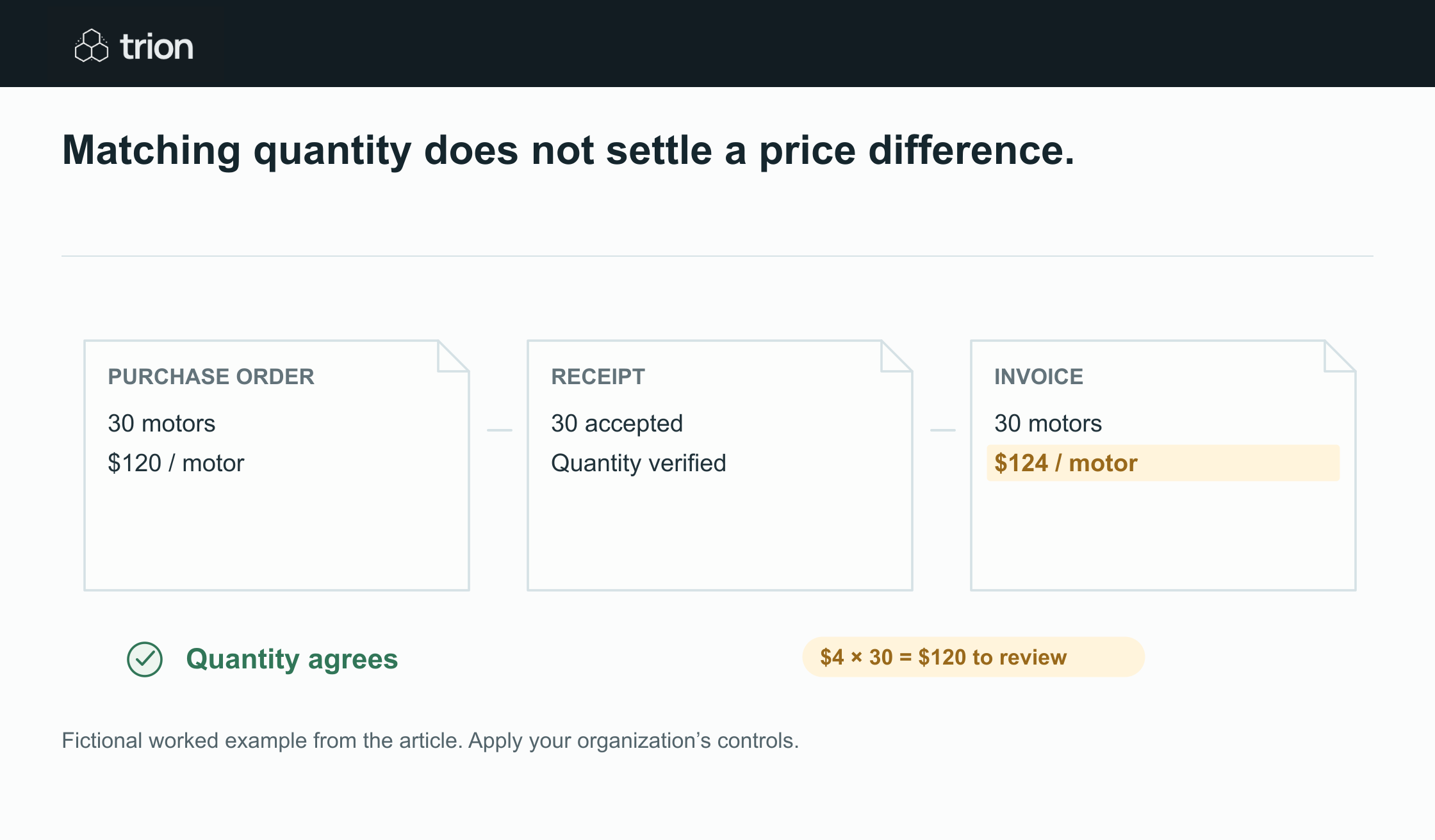

Matching quantity does not settle a price difference.
- Purchase order
- 30 motors at $120 per motor
- Receiving evidence
- 30 motors accepted; quantity agrees
- Invoice
- 30 motors at $124 per motor
- Price exception
- $4 per motor × 30 = $120 to review
View data
| Evidence | Meaning |
|---|---|
| Purchase order | 30 motors at $120 per motor |
| Receiving evidence | 30 motors accepted; quantity agrees |
| Invoice | 30 motors at $124 per motor |
| Price exception | $4 per motor × 30 = $120 to review |
Fictional worked example from the article. Apply your organization’s controls.
Download image| Check | Evidence | Outcome |
|---|---|---|
| Item | Same motor reference | Matches |
| Quantity | 30 ordered, received and invoiced | Matches |
| Unit price | $120 ordered; $124 invoiced | $120 total difference |
| Freight and tax | Reviewed separately | Cannot infer from the goods match |
Accounts payable assigns the price exception to the buyer, who checks whether an authorized amendment exists. If the price changed without approval, the supplier may need to correct the invoice. If an amendment was approved, the reviewer links that evidence and reruns the comparison against the valid order record. Neither outcome should be invented by the matching system.
Define tolerances with the owners
A tolerance is a policy choice, not a convenient way to make exceptions disappear. Define whether it applies to unit price, extended amount, quantity or a specific charge, and whether both an absolute amount and percentage limit apply. Record the currency and rounding rule. Test exactly at the threshold and just above it.
For example, an illustrative policy might permit a rounding difference of up to $1 on a line after the units and tax basis agree. That does not authorize a $120 unit-price difference. Do not apply an invoice-wide percentage to every exception unless the policy explicitly says so.
Route different exceptions to different people
Receiving staff own missing or incorrect receipt quantities. Buyers own specification and order-price questions. Accounts payable owns invoice identity, duplicate checks and the finance review queue. Quality staff may own inspection acceptance where it is required. An unavailable owner should trigger the agreed escalation path, not a silent release.
Duplicate invoice checking is a separate control. A duplicate can match the same order and receipt perfectly. Likewise, a quantity comparison must consider quantities already invoiced against the line; matching each new invoice against the full receipt independently can miss cumulative overbilling. Preserve the earlier invoice references and any reversals.
Test the explanation, not only the result
Use the three-way matching tool to explore differences. In a real pilot, include a clean match, a wrong price, an unknown unit, a missing receipt, a duplicate invoice and a credit adjustment. The reviewer should be able to reproduce the result from the three source records.
For orders arriving in several shipments, read the separate partial receipt guide. Here the focus is the matching method: identify the documents, compare the correct lines and preserve the explanation for every exception.