
A purchase request explains what someone needs and seeks the organization's decision to buy it. A purchase order records the order issued to a supplier. Keeping their purposes separate makes the handoff easier to control.
The practical difference between PR and PO
People use purchase request and purchase requisition in slightly different ways, so define the terminology in your own process. SAP describes a purchase requisition as an internal request to purchasing for a quantity of material or a service at a required time. Its buying overview describes a purchase order as the document sent to the supplier with the items, quantities and prices. See the requisition definition and the procurement overview.
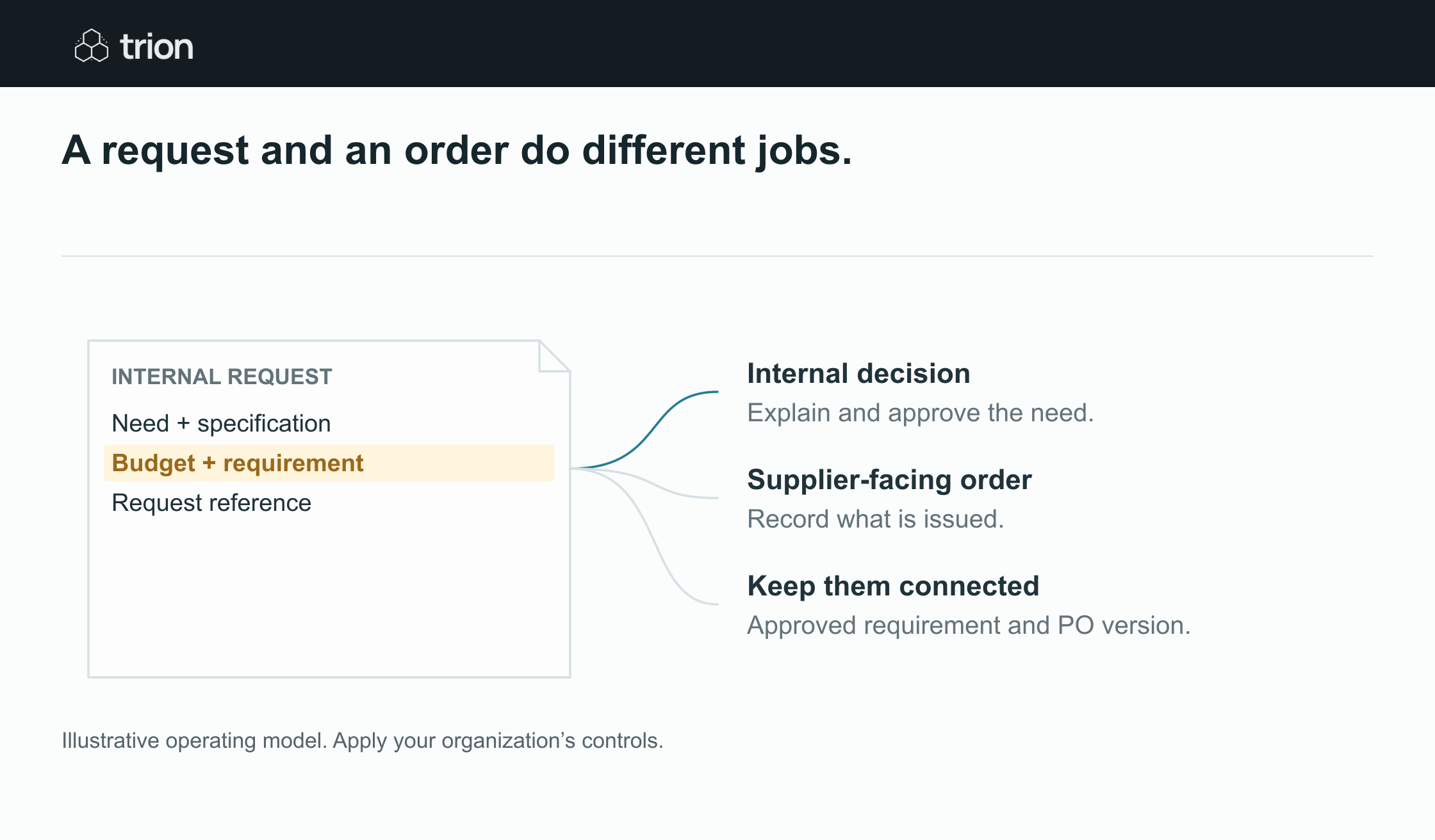

A request and an order do different jobs.
- Audience
- Internal team / The supplier
- Purpose
- Explain and approve the need / Record the issued order
- Keep connected
- Requirement and request ID / Approved version and PO ID
View data
| Evidence | Meaning |
|---|---|
| Audience | Internal team / The supplier |
| Purpose | Explain and approve the need / Record the issued order |
| Keep connected | Requirement and request ID / Approved version and PO ID |
Illustrative operating model. Apply your organization’s controls.
Download imageThis is an operational distinction, not a statement about the legal effect of a particular document. Your organization's purchasing and contract rules determine what may be issued, who can issue it and what additional terms apply.
| Question | Purchase request | Purchase order |
|---|---|---|
| Primary purpose | Explain and authorize the need internally | Communicate the approved order to the supplier |
| Typical owner | Requester and internal approver | Authorized buyer |
| Price basis | Estimate or proposed quote | Reviewed order price |
| Key references | Request ID and budget owner | Order ID, supplier and request link |
What belongs in a purchase request?
Capture requester, business reason, item or service specification, quantity, unit, needed-by date, delivery location and budget owner. If there is a proposed supplier or quotation, attach it as supporting information. A suggested supplier should not become an approved supplier merely because the requester entered a name.
Describe the acceptance criteria for a service. “Consulting” gives the reviewer little to assess; “configure the intake form and deliver an administrator handover” supplies a more concrete requirement. Keep estimates marked as estimates and record whether freight, tax or other charges are included in the budget basis.
What changes before an order is issued?
The buyer confirms the selected supplier, agreed quantities, prices, delivery and commercial terms. The order has its own reference and points back to the approved request. The system also needs the evidence that the outgoing action was reviewed by an authorized person.
A request can result in more than one supplier order. An order can also consolidate compatible requirements if policy permits. Preserve line-level links rather than assuming the PR and PO relationship is always one to one. Otherwise an order change can become difficult to trace to the affected requester.
A worked example: an estimate becomes an order
A fictional office team requests 24 cable trays, estimated at $35 each, with a $1,000 budget before tax. The request's goods estimate is $840. The buyer obtains a quotation that adds $55 freight, producing $895 before tax. The requester confirms the specification; the authorized approver reviews the complete proposed cost basis.
The approved order records the actual supplier and $55 freight as a separate charge. It does not overwrite the original estimate and pretend the requester originally knew it. The order reference links to the request and the reviewed quote, allowing the receiving team and accounts payable to follow the chain.
Use states that describe the handoff
A request may be draft, submitted, awaiting clarification, approved, rejected or cancelled. An order may be prepared, reviewed, issued, acknowledged or changed. Define these states for your own platform. An approved request is not automatically proof that an order was transmitted, and a prepared order should not be marked issued before a successful outcome is recorded.
Handle withdrawal and changes explicitly. If the requester cancels after an order has been issued, the buyer must review the supplier-facing next step. Deleting the request does not withdraw the order. If price or quantity changes before issue, check whether the current approval still applies under policy.
Make the next document easy to create correctly
Use the request template to collect a consistent need and the approval matrix tool to name the decision owner. Test a request split across two suppliers, a rejected request, a cancelled draft and an issue attempt with an uncertain outcome.
For changes to an approved quote, continue with the version-specific approval guide. This article establishes the document roles; that guide explains how to keep the approval connected to the exact order basis reviewed.