
Recurring purchases need a way to reuse agreed terms while keeping individual orders visible. A blanket arrangement can help, provided the team defines what is authorized, what consumes its limit and who approves exceptions.
Start with the document your system actually uses
Oracle describes a blanket purchase agreement as covering known goods or services and negotiated prices when detailed delivery schedules are not yet known. It also notes that organizations may rename purchasing documents. Check your own system and policy before treating “blanket PO” as a precise document type. Read Oracle's purchasing document distinctions.
In this guide, an agreement stores the approved commercial scope; a release means a specific order placed against that scope. This is an operating model to adapt, not a statement about a document's legal effect. A blanket agreement's approval should not be interpreted as permission for unlimited purchases.
Build two connected records
| Agreement record | Individual release record |
|---|---|
| Reference and approved revision | Release reference and agreement revision used |
| Supplier, permitted items and units | Actual supplier site, item, quantity and unit |
| Prices, terms and validity period | Price and terms verified for this release |
| Limit and the rule for consuming it | Amount counted against that limit |
| Buyer and exception authority | Requester, reviewer and issued-order evidence |
Keep approved, issued, cancelled and received amounts distinguishable. Decide whether a draft release reserves headroom. Decide when a cancelled order restores it and how credits are treated. These are policy choices that must be explicit before automation calculates a remaining balance.
A fictional release-limit calculation
Agreement BA-440 covers warehouse labels for January through June. The team has approved a $5,000 limit excluding tax but including freight. Issued releases count against the limit; draft releases reserve capacity separately. This rule is fictional and is not an Oracle default.
Two issued releases consume $1,200 and $1,600. A third request would consume $2,100, bringing issued plus proposed spending to $4,900 and leaving $100. A $200 draft reservation for another request makes the available capacity insufficient for both. The buyer must resolve the reservation or seek an authorized limit change before issuing the new release.
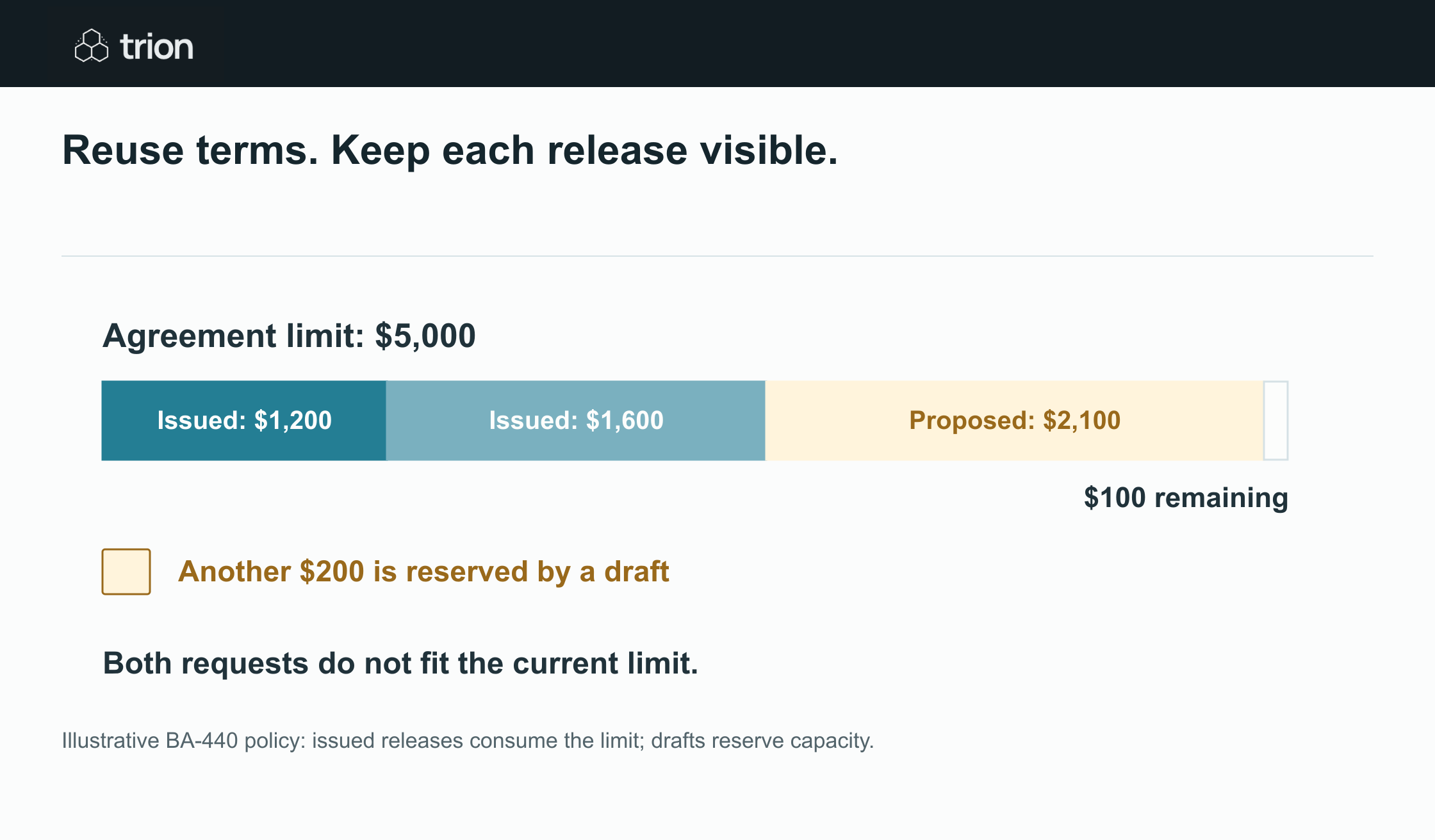

Reuse terms. Keep each release visible.
- Limit
- $5,000 excluding tax and including freight
- Issued releases
- $1,200 + $1,600 = $2,800
- Proposed release
- $2,100
- Issued plus proposed
- $4,900, leaving $100
- Separate draft reservation
- $200, insufficient capacity for both requests
View data
| Evidence | Meaning |
|---|---|
| Limit | $5,000 excluding tax and including freight |
| Issued releases | $1,200 + $1,600 = $2,800 |
| Proposed release | $2,100 |
| Issued plus proposed | $4,900, leaving $100 |
| Separate draft reservation | $200, insufficient capacity for both requests |
Illustrative BA-440 policy: issued releases consume the limit; drafts reserve capacity.
Download imageChecking only paid invoices would miss commitments already issued. Checking both an order and its matching invoice as separate consumption would count the same purchase twice. Choose one defined consumption event and keep the related records connected.
Review each release against the scope
- Is the agreement valid for the intended ordering date and purchase?
- Does the item, supplier site and unit match the approved scope?
- Is the price applicable to this quantity and date?
- Are freight, taxes and other charges handled under the agreed limit rule?
- Does the delivery schedule meet the current requirement?
- Are other issued releases and reservations included in the capacity check?
A changed specification, unexpected surcharge or expired term belongs in an exception queue. Do not repair a failed check by silently switching to a different agreement. Retain the failed condition, supporting evidence and reviewer decision.
Control simultaneous requests and amendments
Two buyers can each see enough headroom before either release is recorded. The final check and capacity reservation therefore need one controlled process, with a fresh balance check before issuance. If a send operation has an uncertain outcome, establish whether the supplier already received the order before retrying.
An amendment should retain its effective date and approved scope. Keep prior releases linked to the revision they used, then decide how outstanding releases are affected. Procurement owns the terms and releases; finance defines the spending measure; the authorized approver handles cap and scope exceptions.
Use a blanket arrangement only when it fits
Stable recurring requirements can benefit from agreed terms. Unclear specifications, volatile prices or uncertain supplier suitability may need another sourcing approach. Write the release checklist first, map the authority with the approval matrix, and use the revision approval guide when terms change. The worksheet should make each purchasing decision visible, even when the surrounding terms are reused.