
Define the tail using your own records
Start with transaction frequency, supplier count, category and buyer effort. Your “tail” might mean low annual supplier spend, small individual requests, or purchases outside managed agreements. Those definitions overlap, but they are not interchangeable. Name the one you use before comparing results.
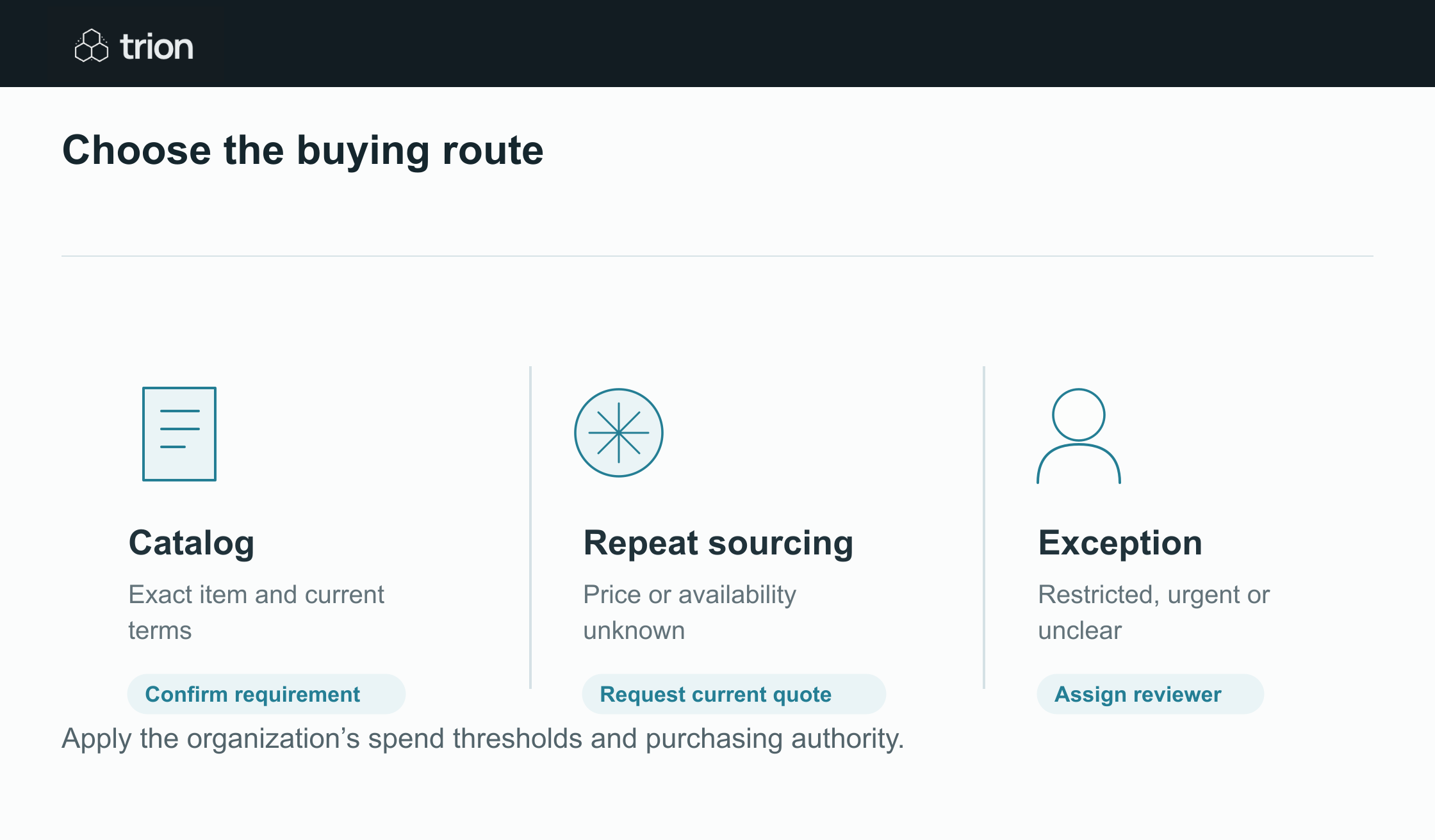

Choose the buying route
- Catalog
- Exact item and current terms. Confirm requirement
- Repeat sourcing
- Price or availability unknown. Request current quote
- Exception
- Restricted, urgent or unclear. Assign reviewer
| Evidence | Meaning |
|---|---|
| Catalog | Exact item and current terms. Confirm requirement |
| Repeat sourcing | Price or availability unknown. Request current quote |
| Exception | Restricted, urgent or unclear. Assign reviewer |
Apply the organization’s spend thresholds and purchasing authority.
SAP's public TailSpend Management sample illustrates preferred suppliers, category and region mapping, and sourcing-event rules. It is reference code rather than proof of realized savings. The useful idea is routing a requirement to an appropriate buying path, rather than giving every small request the same treatment.
Do not adopt a universal percentage or threshold because it looks tidy on a slide. Use your purchasing policy and actual records. A low-value calibration service or software access request may need more specialist review than a much larger order of an established consumable.
Use three routes with explicit entry checks
The catalog route works when the requested item, pack, location, supplier and terms match a current reviewed entry. The repeat-sourcing route handles a recognizable requirement whose current price, delivery or supplier availability still needs confirmation. The exception route catches restricted items, unclear specifications and situations requiring an authorized decision.
| Route | Required evidence | Reason to stop |
|---|---|---|
| Catalog | Exact item, effective terms and valid delivery coverage | Substitution, expired price or missing pack conversion |
| Repeat sourcing | Reviewed requirement and eligible contacts | Unresolved specification or conflicting supplier response |
| Exception | Issue, business impact and named owner | Missing authority for the proposed commitment |
Route selection is a recommendation until the business has approved the rules and execution boundary. An AI label should not issue a purchase order merely because an amount sits below a configured number.
Example month of small requests
Consider 60 requests: 35 exactly match current catalog entries, 15 need refreshed quotations, and 10 need exception review. Report those three groups, then record where buyers changed the suggested route. The counts describe workload distribution; they do not establish that 35 requests could be ordered without approval.
Two requests each cost $80. One is a replenishment of reviewed gloves for the usual warehouse. The other provides access to a new external software service. The amounts are identical, but the item identity, data exposure and review ownership differ. A price-only rule would erase that distinction.
A requester asks for an alternative glove because the approved pack is unavailable. The workflow should show a substitution question to the responsible person. It should not convert “similar description” into “equivalent item,” even when the alternative is cheaper.
Consolidate demand without hiding deadlines
Repeated requests may be worth combining when specifications, delivery needs and authority align. Group the demand as a proposal, preserving each requester's quantity and required date. One urgent order should not disappear into a monthly bundle whose arrival would be too late.
Check whether consolidation changes freight, minimum quantity, storage or cancellation exposure. A lower unit price can create unwanted stock. Also check for requests that appear split to avoid a policy threshold; route that pattern for review rather than automatically combining or approving it.
Maintain the catalog itself. Each entry needs an effective period, responsible owner and a way to retire stale terms. A fast buying route built on an expired quotation simply moves the mistake earlier.
Measure accepted requests and repeat work
Capture buyer handling time on a defined sample, including corrections and exception review. Compare equivalent request types before and after a change. Report the percentage accepted without rerouting, unresolved cases, and time to an authorized outcome. Do not turn every avoided minute into a cash saving.
Start a Trion pilot with one repetitive category, a catalog owner and reviewed routing rules before enabling consequential writes.
Use the item and pack guide when a repeat request changes its quantity basis.