
Separate item identity from the purchasing unit
Give the internal item a stable identifier and reviewed specification. Then attach supplier references, manufacturer part numbers and packaging as related records. One internal item may have several eligible suppliers; one supplier may sell several sizes or grades under similar descriptions.
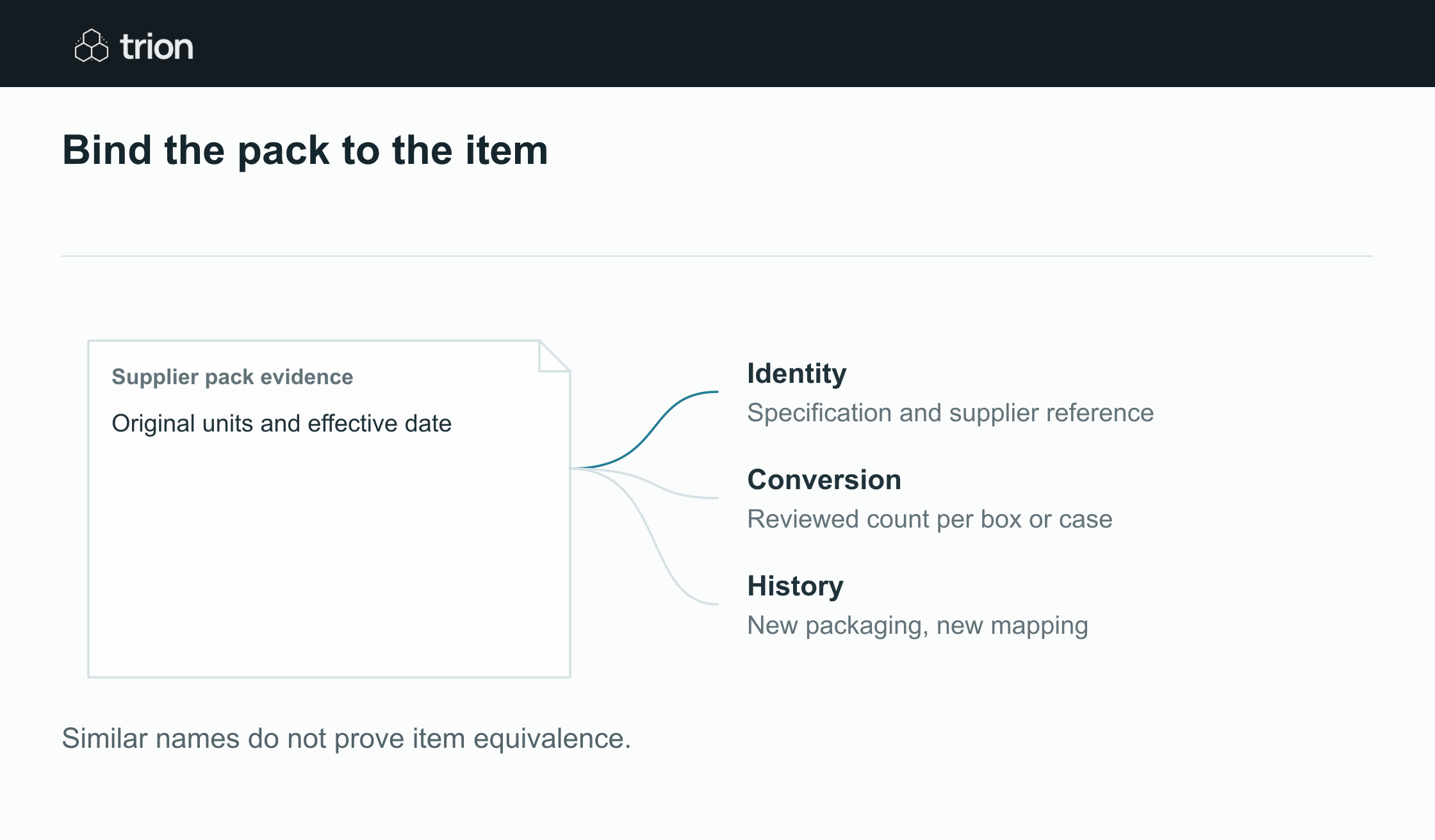

Bind the pack to the item
- Identity
- Specification and supplier reference
- Conversion
- Reviewed count per box or case
- History
- New packaging, new mapping
| Evidence | Meaning |
|---|---|
| Identity | Specification and supplier reference |
| Conversion | Reviewed count per box or case |
| History | New packaging, new mapping |
Similar names do not prove item equivalence.
Oracle's item documentation distinguishes primary units, item-specific conversions and standard conversions. That distinction matters in a supplier catalog: “one case” has no universal count. A conversion needs the identified item and its actual packaging evidence.
Keep the raw supplier description rather than replacing it with a cleaner name. AI can suggest that an abbreviation refers to an existing item. A technical mismatch in size, material, rating or compatibility should prevent acceptance even when the names are almost identical.
Build a mapping with an effective period
| Mapping field | Why it matters |
|---|---|
| Internal item and specification | Identify the requirement the supplier item can satisfy. |
| Supplier and manufacturer references | Separate a reseller code from the underlying product. |
| Quoted, ordered and stocking units | Explain which unit each quantity and price uses. |
| Pack factor and source | Convert only from reviewed evidence. |
| Effective dates and reviewer | Keep changed packaging from rewriting previous orders. |
A barcode can help identify a trade item, but it should not replace the specification check. GS1's pack/case rule requires a new GTIN at the affected higher packaging level when its count changes. Keep the level clear: the identifier of an individual item and that of its case answer different packaging questions.
Record exact supplier wording when the pack is unclear. “Box” without a count should remain unresolved. Do not infer a factor from an unrelated previous order simply because the supplier reused a description.
Example glove catalog
Suppose a reviewed size-L glove box contains 100 individual gloves, equivalent to 50 pairs. A quotation for five boxes at $12 per box is $60 for 500 gloves or 250 pairs. Its normalized price is $0.12 per glove or $0.24 per pair. Keep the quotation's box price visible beside either derived value.
A case of this item contains four boxes, so one case contains 400 gloves. Another glove item ships in cases of six boxes. A global “case equals four boxes” rule would understate the second item's quantity. The mapping belongs to the item and packaging version.
If a new quotation says 80 gloves per box, create a new effective mapping after review. At the same $12 box price, the normalized price becomes $0.15 per glove. Do not overwrite the old 100-glove factor and make historical orders appear to have bought fewer gloves.
Do not confuse conversion with equivalence
Two box prices can be normalized arithmetically while the products remain unsuitable substitutes. Size, protective rating, material and intended use may differ. Send that distinction to the requester or technical owner rather than collapsing both products into one catalog row.
Some conversions are straightforward counts. Others need product-specific physical information or a measurement basis. A volume unit and a mass unit cannot be converted from the label alone. Ask for the necessary specification instead of letting a model invent it.
Use deterministic arithmetic after the reviewer accepts the identity and factor. Check that converting the ordered quantity into the stocking unit and back reproduces the original within your defined rounding rule. Flag fractional packs where the supplier only sells whole packs.
Test the mappings at their boundaries
Include a changed pack, a missing manufacturer reference, two near-identical descriptions and an obsolete supplier code in the test set. Known clean items show the normal path; the difficult cases reveal whether the workflow stops at the right point.
Require reviewer and validity-period checks before Trion’s catalog mappings feed replenishment or matching.
Capture unclear pack wording with the quotation extraction guide; use the item-mapping guide when invoice descriptions differ.