
Classify a line, not a supplier name
One supplier may sell gloves, cleaning materials and machine parts. Giving every transaction the supplier's most common category hides that mixture. Choose a classification unit first: usually a transaction line with its own description, amount and source reference. Keep supplier-level reporting as a separate view.
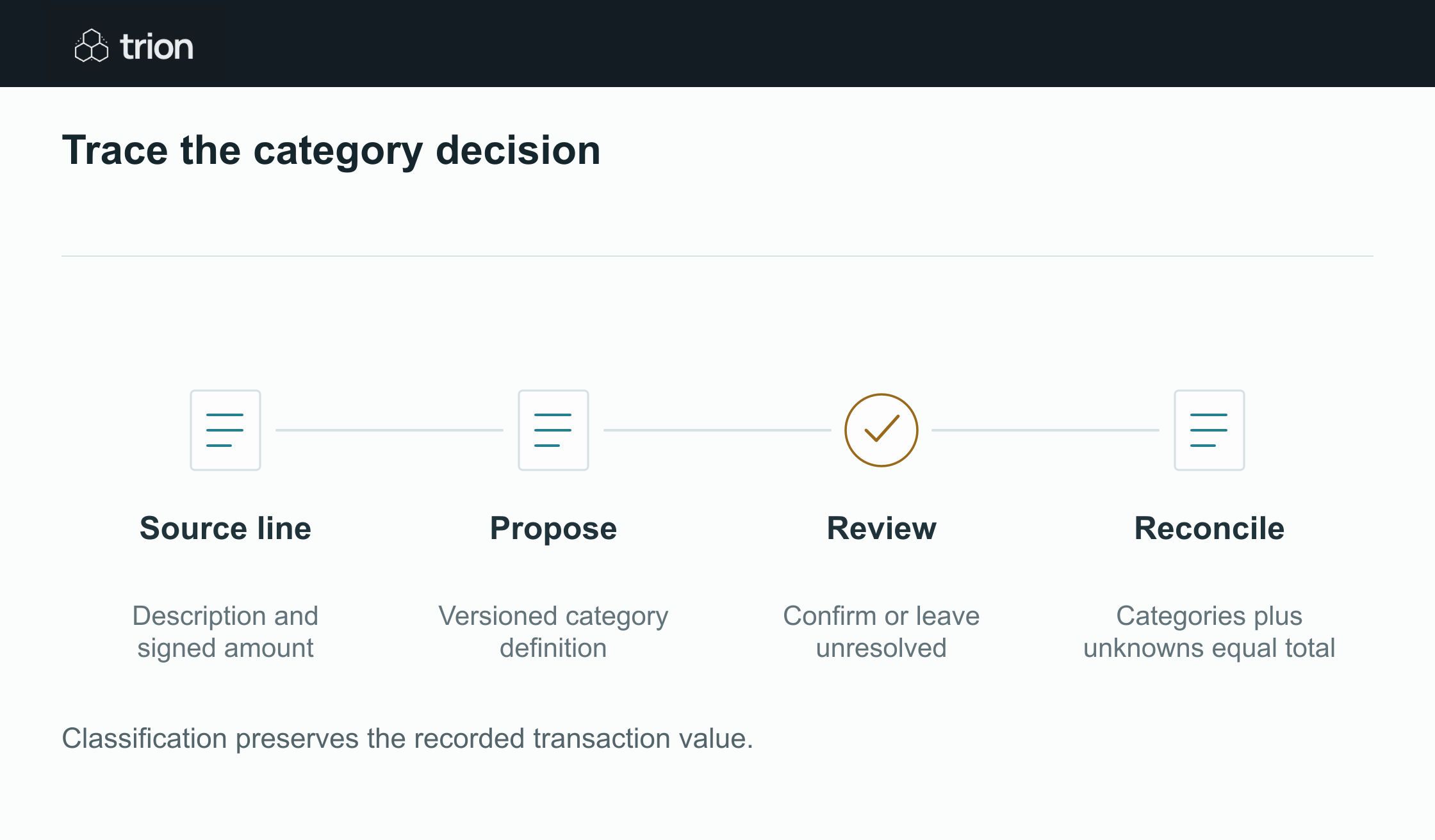

Trace the category decision
- Source line
- Description and signed amount
- Propose
- Versioned category definition
- Review
- Confirm or leave unresolved
- Reconcile
- Categories plus unknowns equal total
| Evidence | Meaning |
|---|---|
| Source line | Description and signed amount |
| Propose | Versioned category definition |
| Review | Confirm or leave unresolved |
| Reconcile | Categories plus unknowns equal total |
Classification preserves the recorded transaction value.
SAP's September 2026 announcement describes spend mapping to UNSPSC and an organization's own taxonomy. Those alternatives reveal a practical design choice: a standard classification supports comparison, while an internal category can reflect how your buying team organizes responsibility. Preserve both when needed, with a named version for each.
Write definitions before asking a model
A useful category definition contains an inclusion rule, an exclusion rule and examples that buyers agree on. “Maintenance” alone is too broad if a bearing, an inspection service and a cleaning chemical require different sourcing owners. Distinguish a commodity category from an accounting code; they answer different questions.
Give the model only valid categories and ask for one proposed label, the supporting source text and a reason. Provide an unresolved option. A vague description such as “monthly supply” should remain unresolved until another document identifies it. A confident-sounding explanation does not replace evidence. Known, reviewed item mappings can take a deterministic route before any model call.
Keep category changes versioned. If the business splits one category into two, record the effective date and the rule used to restate historical reporting. Do not quietly replace old labels and then interpret the changed chart as changed purchasing behavior.
Reconcile the money before judging the labels
Take one source system and one period for the first exercise. Establish the signed total, including credits, before classification. Avoid counting an order and its resulting invoice as two independent purchases. Decide how header charges enter this dataset; allocating freight to lines and also retaining it as a separate amount would duplicate spend.
| Record field | Purpose |
|---|---|
| Source and line ID | Find the original transaction and prevent repeated intake. |
| Original description and amount | Keep the classification separate from financial evidence. |
| Proposed category and taxonomy version | Explain which definition produced the suggestion. |
| Reviewed category, owner and date | Record the accepted interpretation. |
| Unresolved reason | Show missing information instead of forcing a label. |
Report classified and unresolved spend together. Their signed totals should equal the source total. A coverage chart that drops unknown transactions can look precise while concealing the largest gaps.
Example review batch
Suppose a team tests 120 lines. Buyers accept 96 proposed labels, correct 14 and leave 10 unresolved because the source descriptions are insufficient. Accepted proposals cover 80% of all lines. Among the 110 lines that could be resolved, 96 accepted suggestions represent about 87.3%. Neither figure alone describes the full result.
Now suppose the 14 corrected lines contain a large equipment purchase. Count-based accuracy may hide a material category error. Show the spend value affected by corrections alongside the line count. Review high-value and operationally sensitive items individually rather than treating every error as equally consequential.
Keep a second, previously unseen batch for evaluation. A classifier that remembers the examples used to prepare its category definitions has not demonstrated performance on new records.
Turn corrections into controlled learning
Group corrections by cause: missing specification, supplier-name shortcut, ambiguous taxonomy or a genuine model mistake. Fixing a definition can be more useful than changing a prompt. Recheck affected records after an approved rule change, preserving both decisions and the reason for the revision.
Require source-line references and an exception register in the acceptance criteria for Trion’s spend classification workflow.
Use the migration guide to reconcile source totals and field-evidence checks for uncertain prices or quantities before classifying them.