
Start with a completion definition
A generated comparison, an accepted comparison and an issued order are different outcomes. Choose the one the workflow is supposed to deliver and identify who accepts it. Count a task only when that definition is satisfied. Work that remains unresolved still creates cost, but should not make the completion total appear larger.
OpenAI’s optimization guide discusses reducing requests and tokens, choosing an appropriately sized model and using asynchronous processing options. These affect execution economics. Whether they improve the complete business task depends on quality, deadlines and the effort required after generation. Keep the operational acceptance check in place when experimenting with a cheaper configuration.
Choose a consistent accounting boundary
Include model and tool charges, repeated runs, relevant allocated access costs and human review or repair. Record operating support separately enough that the owner can see it, then state whether it is included in the task measure. Keep one-time implementation costs distinct from recurring operating costs; both may matter to a broader investment assessment.
Use the same period and task population for cost and completion. Do not divide this month’s full spending by a convenient subset of successful cases, or count work completed in a different period without explaining the treatment.
Calculate an assumed month
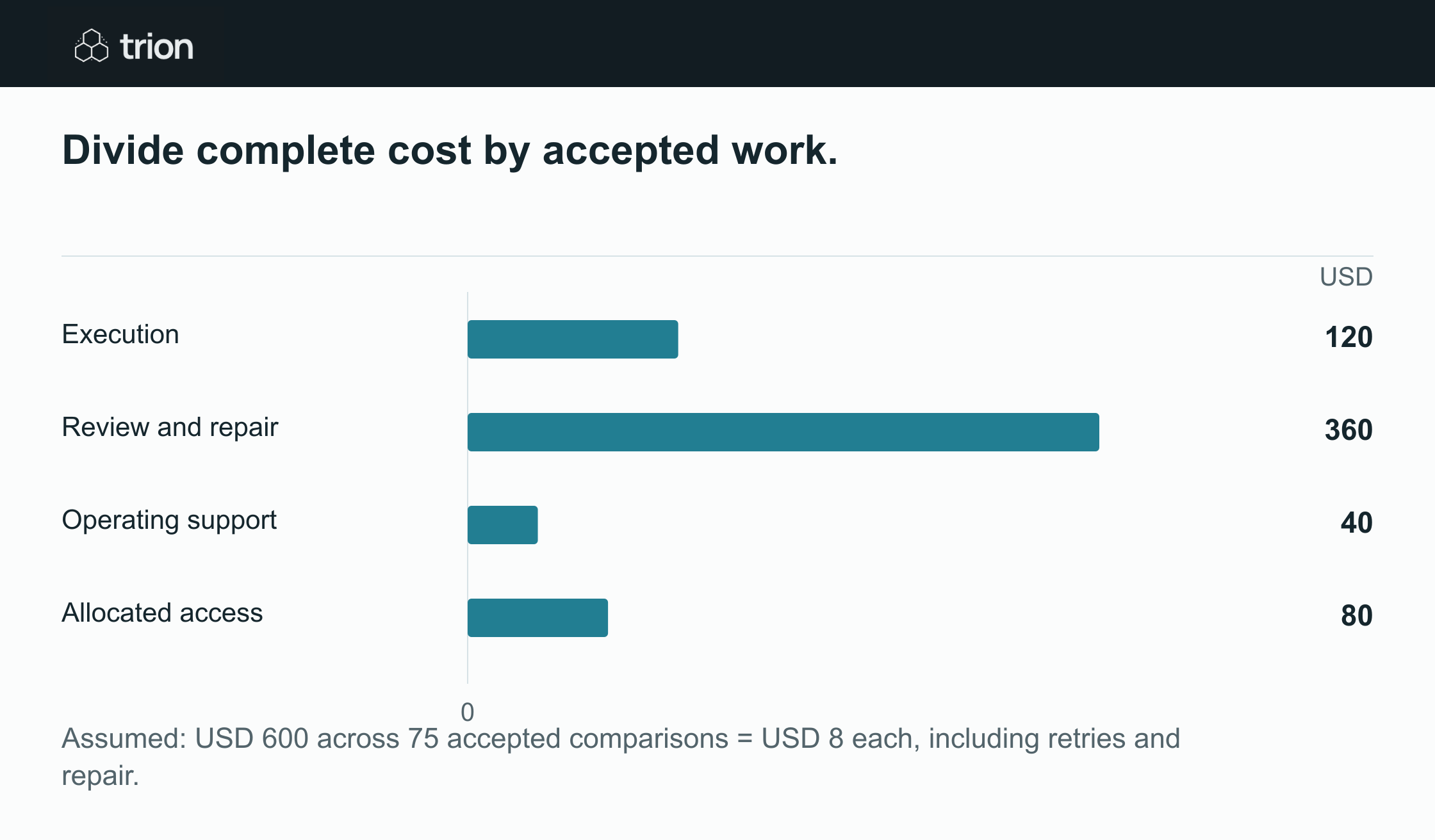
Assume 100 quotation-preparation attempts produce 75 distinct, accepted comparison tasks during one month, using the costs below. Attempts include retries: count each completed task once, while retaining the cost of every attempt and all repair work, including costs attached to unresolved tasks.

Divide complete cost by accepted work.
| Item | USD |
|---|---|
| Execution | 120 USD |
| Review and repair | 360 USD |
| Operating support | 40 USD |
| Allocated access | 80 USD |
Assumed: USD 600 across 75 accepted comparisons = USD 8 each, including retries and repair.
| Cost category | Assumed amount |
|---|---|
| Model and tool execution | 120 |
| Review and repair effort | 360 |
| Recurring operating support | 40 |
| Allocated access cost | 80 |
| Included total | 600 |
The assumed cost per accepted comparison is USD 600 ÷ 75 = USD 8. Execution charges per attempt are USD 120 ÷ 100 = USD 1.20, a separate measure that excludes review and operating costs.
Inspect the expensive exceptions
Group the work by relevant difficulty: ordinary quotations, revisions, missing prices and unreadable attachments. Compare completion and review effort within each group. An aggregate average can conceal a narrow exception that consumes most of the repair work. Its next improvement may be better source preparation or a clearer clarification path rather than a model change.
Retain unresolved cases so the team can see whether they eventually complete or become abandoned work. Avoid classifying every manual correction as a model failure; some source documents are genuinely incomplete. Distinguish missing supplier evidence from incorrect interpretation, technical failure and an approval that simply has not arrived.
Compare improvements without assuming savings
- Keep the same completion rule and evaluation cases.
- Change one meaningful configuration or workflow step.
- Record execution charges and human effort using the same method.
- Check whether accepted output and important errors changed.
- Compare the complete measure, including failed attempts.
A shorter prompt can remove a condition needed for review. A slower asynchronous path may suit overnight preparation but miss an urgent deadline. Check these effects alongside the cost change.
Use the measure for an operating decision
Compare the accepted-task cost with the manual process under the same boundary. Report released capacity separately from cash savings, and explain assumed workload changes. Use the complete worksheet in an automation review with Trion.
Revisit the measure when input volume, source quality, model configuration or review burden changes. Keep actual charges and assumptions distinguishable.