
The useful distinction is who chooses the next step. A defined workflow follows a designed sequence and decision rules. An agent can select actions within a goal and available tools. Many business processes benefit from a combination, with a fixed outer workflow and a narrowly bounded agent inside it.
The terms describe a spectrum
AWS distinguishes LLM-augmented workflows, whose paths are largely deterministic, from autonomous agents that use tools and reasoning loops. It also notes that real systems can combine both and recommends increasing agency only when task complexity requires it. Terminology varies, so ask a vendor how the system chooses actions rather than relying on the word agent. AWS’s agentic AI guidance.
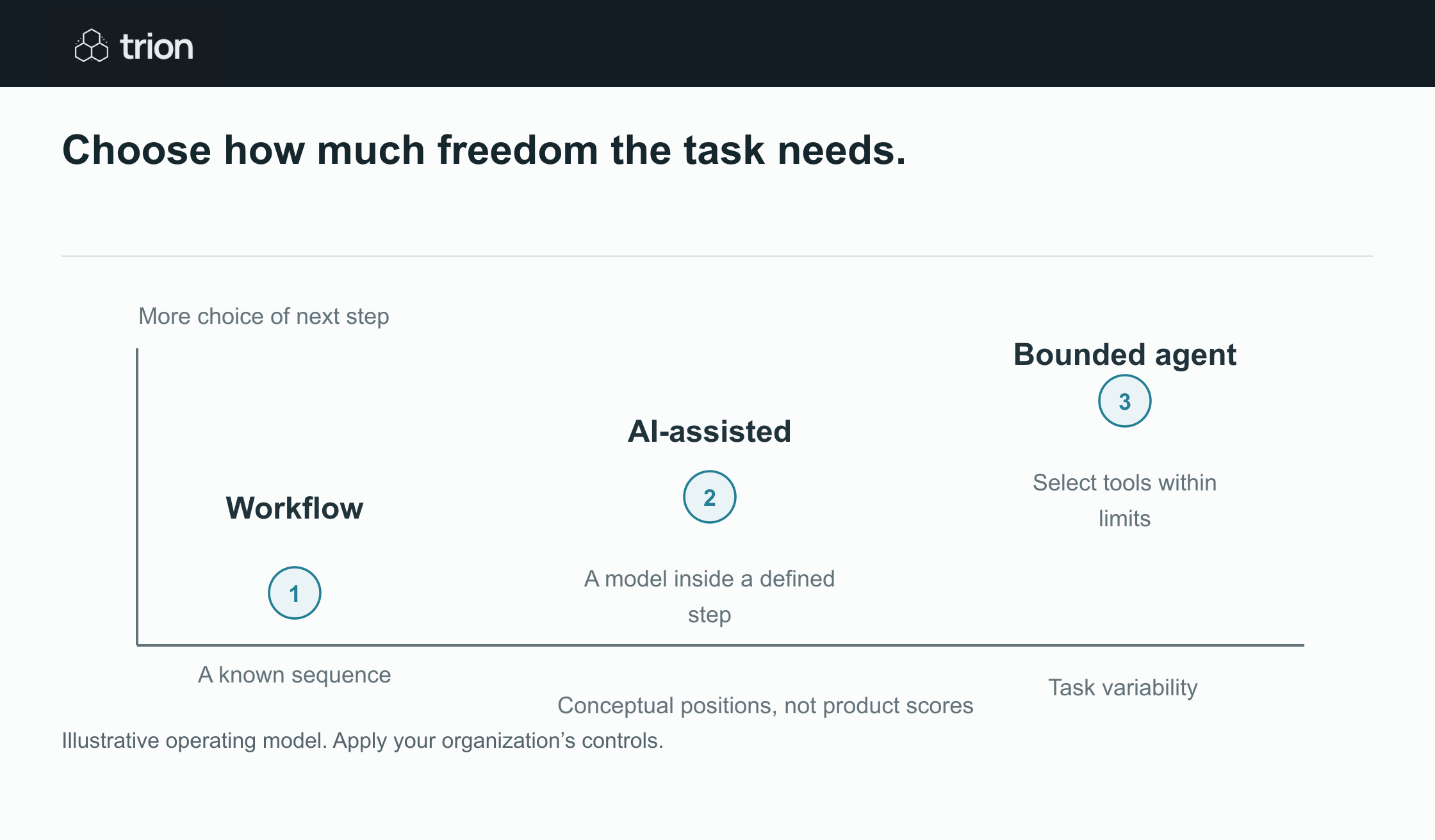

Choose how much freedom the task needs.
- Workflow
- A known sequence. Stable steps
- AI-assisted
- A model inside a defined step. Variable inputs
- Bounded agent
- Select tools within limits. Variable next steps
View data
| Evidence | Meaning |
|---|---|
| Workflow | A known sequence. Stable steps |
| AI-assisted | A model inside a defined step. Variable inputs |
| Bounded agent | Select tools within limits. Variable next steps |
Illustrative operating model. Apply your organization’s controls.
Download imageA workflow can contain AI without letting AI control the sequence. For example, a model can extract fields, after which ordinary validation and routing rules determine the next step. An agent design introduces another responsibility: checking whether the selected sequence of actions is appropriate.
Compare designs against the same task
| Question | Defined workflow | Bounded agent |
|---|---|---|
| Who chooses the next action? | Designed sequence and explicit branches | Model-guided choice within permitted tools |
| What variation can it handle? | The input and branches you designed for | Variation it can interpret within the supplied context |
| What must be evaluated? | Outputs, branches, and actions | Outputs plus chosen actions, stopping behavior, and tool use |
| How is work limited? | Defined steps, timeouts, and queue rules | Those controls plus action, iteration, and cost budgets |
This table is a design comparison, not a claim that every product implements these controls. Confirm actual behavior with the platform and account setup you plan to use.
Use a fixed path when the business rule is stable
Suppose a complete request must enter a manager’s queue when its confirmed amount exceeds a threshold. The branch is explicit. An agent does not need to deliberate about it. A rule is easier for the business owner to inspect, update, and test against boundary values.
The same applies to mandatory fields, allowed status transitions, calculation formulas, and approval requirements. AI can help prepare the data used by those rules, but an inferred amount should not be treated as confirmed simply because a routing decision requires one.
Use a bounded agent for variable investigation
Consider an illustrative internal research task: investigate why a service request cannot be scheduled. The information may be spread across a client record, team calendar, and a message history. A bounded agent could choose which approved read-only source to inspect next, then produce an evidence-linked explanation.
Define its permitted sources, the client reference, maximum investigation time, and required output. Exclude tools that send messages or change bookings during this stage. If it cannot locate decisive evidence, its output should state what remains unresolved. The agent is preparing an investigation, not creating permission to act.
Design the hybrid boundary explicitly
A practical hybrid starts with a validated request, lets the agent investigate within a narrow tool set, then returns to a fixed review step. The reviewer receives the findings, source references, proposed action, and unresolved questions. An approved action enters a controlled execution path.
- Validate the request identity before giving the agent access to records.
- Separate retrieved evidence from the agent’s interpretation.
- Validate the proposed output against required fields and allowed actions.
- Require approval for external communication or changes to business records.
- Stop on repeated failure or exhausted budget with a visible handoff.
Evaluate behavior, not just the final answer
A correct answer reached by accessing an unrelated client’s record is still an unacceptable result. Review action traces as well as outputs. Include cases with missing records, contradictory evidence, unavailable tools, and instructions embedded in source documents that attempt to redirect the task.
Measure unnecessary tool calls, unresolved cases, review corrections, completion time, and cost per useful outcome. Do not compare one successful agent demonstration with an entire month of workflow failures. Use the same representative case set and outcome criteria.
Make the choice with a small comparative pilot
Write down which variation a defined workflow cannot reasonably handle. If none is evident, begin with that simpler design. If the task requires variable investigation, test a bounded agent inside a controlled outer process. Use the readiness tool to document uncertainty and the processing cost tool to explore usage assumptions before account access and pilot testing confirm them.