
An automation estimate should show its assumptions. Volume multiplied by handling time can describe effort, but it cannot prove a cash saving. Include the time people still spend reviewing outputs, resolving exceptions, and supporting the workflow before calculating payback.
Measure comparable work
Choose one completed business outcome, such as a request ready for review. Measure active handling time for that outcome before and during the pilot. Include corrections, duplicate checks, and unresolved cases. Do not compare manual completion with automated extraction alone when a reviewer still does the remaining work.
Microsoft’s Copilot Studio documentation describes savings estimates per run or per tool compared with another method. These are estimates based on entered comparison assumptions. They are useful inputs to a business case, not proof that a company has realized a cash saving. Microsoft’s savings estimation guidance.
Calculate capacity released first
Use this formula: eligible monthly cases × average handling minutes reduced ÷ 60. The average after automation should include review and exception effort across the same case mix. If only half the workload is covered, do not apply the result to every case.
For an illustrative calculation, assume 900 cases per month, nine minutes of manual handling per case, and three minutes after automation including review. The reduction is six minutes per case, or 90 hours per month. At an assumed loaded labor value of $30 per hour, the capacity value is $2,700. These are invented planning inputs, not observed Trion results.
Subtract recurring operating costs
| Cost | Assumption | What to check |
|---|---|---|
| Platform and hosting | $240 | Actual entitlement, environments, and hosting scope |
| AI or document processing | $120 | Measured input size, reruns, and model usage |
| Support and maintenance | $240 | Monitoring, corrections, access changes, and updates |
| Total recurring cost | $600 | Costs attributable to this workflow |
Subtracting $600 from the $2,700 capacity value gives a $2,100 monthly net capacity value. If setup costs $8,400, simple capacity-based payback is $8,400 ÷ $2,100, or four months. Label that result clearly. It is not automatically a four-month cash payback.
Distinguish capacity from avoidable expense
Freed hours can help the team absorb more work, improve turnaround, or reduce a backlog. Those outcomes may matter even if payroll does not change. Cash savings require an expense the business can actually avoid, such as a planned contractor cost or overtime that will no longer be needed.
Suppose only 40 percent of the illustrative labor value translates into avoidable expense. That is $1,080 per month. After the same $600 recurring cost, net cash benefit is $480, giving a simple cash payback of 17.5 months. Record the operational decision supporting that 40 percent assumption; it should not be chosen merely to make the case attractive.
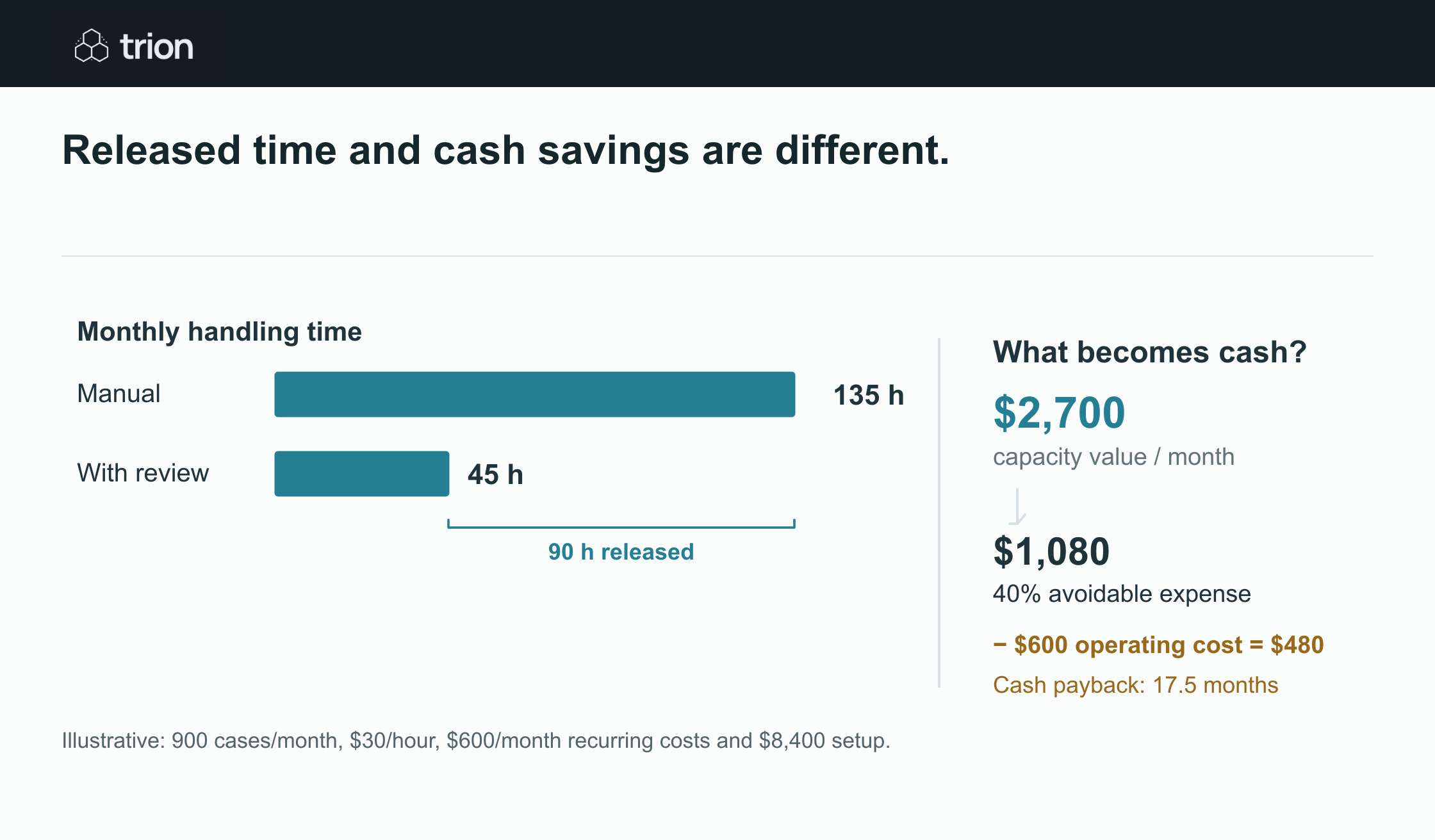

Released time and cash savings are different.
- Manual handling
- 900 cases × 9 minutes = 135 hours/month
- After automation
- 900 cases × 3 minutes, including review = 45 hours/month
- Capacity released
- 90 hours/month × $30/hour = $2,700 capacity value
- Recurring cost
- $600/month
- Cash assumption
- 40% × $2,700 = $1,080 avoidable expense
- Net cash
- $1,080 − $600 = $480/month
- Setup and payback
- $8,400 ÷ $480 = 17.5 months
View data
| Evidence | Meaning |
|---|---|
| Manual handling | 900 cases × 9 minutes = 135 hours/month |
| After automation | 900 cases × 3 minutes, including review = 45 hours/month |
| Capacity released | 90 hours/month × $30/hour = $2,700 capacity value |
| Recurring cost | $600/month |
| Cash assumption | 40% × $2,700 = $1,080 avoidable expense |
| Net cash | $1,080 − $600 = $480/month |
| Setup and payback | $8,400 ÷ $480 = 17.5 months |
Illustrative: 900 cases/month, $30/hour, $600/month recurring costs and $8,400 setup.
Download imageShow the ROI definition you use
Define your horizon and denominator. One transparent first-year formula is: (first-year benefit minus first-year total costs) ÷ first-year total costs. Using capacity value in the example, benefit is $32,400 and costs are $8,400 setup plus $7,200 recurring, or $15,600. The capacity-based first-year ROI is approximately 108 percent.
That calculation assumes immediate full usage for twelve months and does not discount future amounts. A staged rollout changes the result. An alternative formula may be valid for your finance team, but comparisons only make sense when the definition and benefit type are consistent.
Test the assumptions that can overturn the case
- Lower volume: what if only 600 eligible cases arrive each month?
- More review: what if the post-automation average is five minutes?
- Higher support: what if monthly operating cost reaches $900?
- Slower adoption: when will the intended users move their work into the process?
- Rework: are correction costs included in the measured average?
Keep uncertain error avoidance and revenue claims separate from the base calculation unless you have evidence to quantify them. Do not count the same time reduction as both labor value and an additional productivity benefit.
Replace the estimate with pilot evidence
Use the automation ROI tool to compare scenarios and the processing cost tool to explore variable usage. Before committing to rollout, replace guessed handling times, case coverage, and support effort with measured pilot results. Keep the benefit category visible so the decision maker can see whether the project improves capacity, reduces expense, or does both.