
The first automation project should have a clear boundary and a measurable outcome. A large department problem is usually too broad to test. Break it into tasks, then choose one where the team can explain the input, the correct result, and what happens to exceptions.
Start with a task, not a department
“Automate procurement” contains intake, sourcing, comparison, approval, ordering, receipts, and invoices. Each has different inputs and consequences. A testable starting point might be preparing a complete request record from an internal form, or preparing a daily queue of outstanding supplier questions.
Microsoft’s Well-Architected guidance recommends prioritizing procedural tasks with a useful lifespan and notes that a process can benefit from automation while keeping human decision points. That is a useful starting principle, not a substitute for examining your own workload. Microsoft’s automation recommendations.
Observe the work before estimating the opportunity
Collect a representative sample across normal and busy periods. Record case count, active handling time, waiting time, rework, and exceptions. Ask the people doing the task to show the last difficult case, not only the clean example they use for training.
Separate effort from delay. A request may take three days to complete while requiring ten minutes of staff work. The delay might come from a supplier or an absent approver. A faster extraction step will not automatically remove that waiting time.
Use an evidence-based screening table
| Factor | Evidence to gather | Reason to pause |
|---|---|---|
| Frequency and effort | Observed case count and handling minutes | Rare work with little recurring effort |
| Stable rule | A policy owner can state the correct result | Every case relies on an undocumented judgment |
| Input quality | Samples cover formats and missing fields | Critical inputs cannot be accessed or validated |
| Integration path | Required read and write actions are testable | Account access or supported operations are unknown |
| Consequences | Incorrect actions can be detected and contained | An error can commit spending before review |
| Exception ownership | A named person can resolve unresolved cases | The proposed queue has no owner |
Use a simple ordinal score only to structure discussion. It is not a statistical prediction of success. A task with a high score can still be unsuitable if one necessary condition, such as authorized access, is absent. Keep disqualifying conditions separate from weighted preferences.
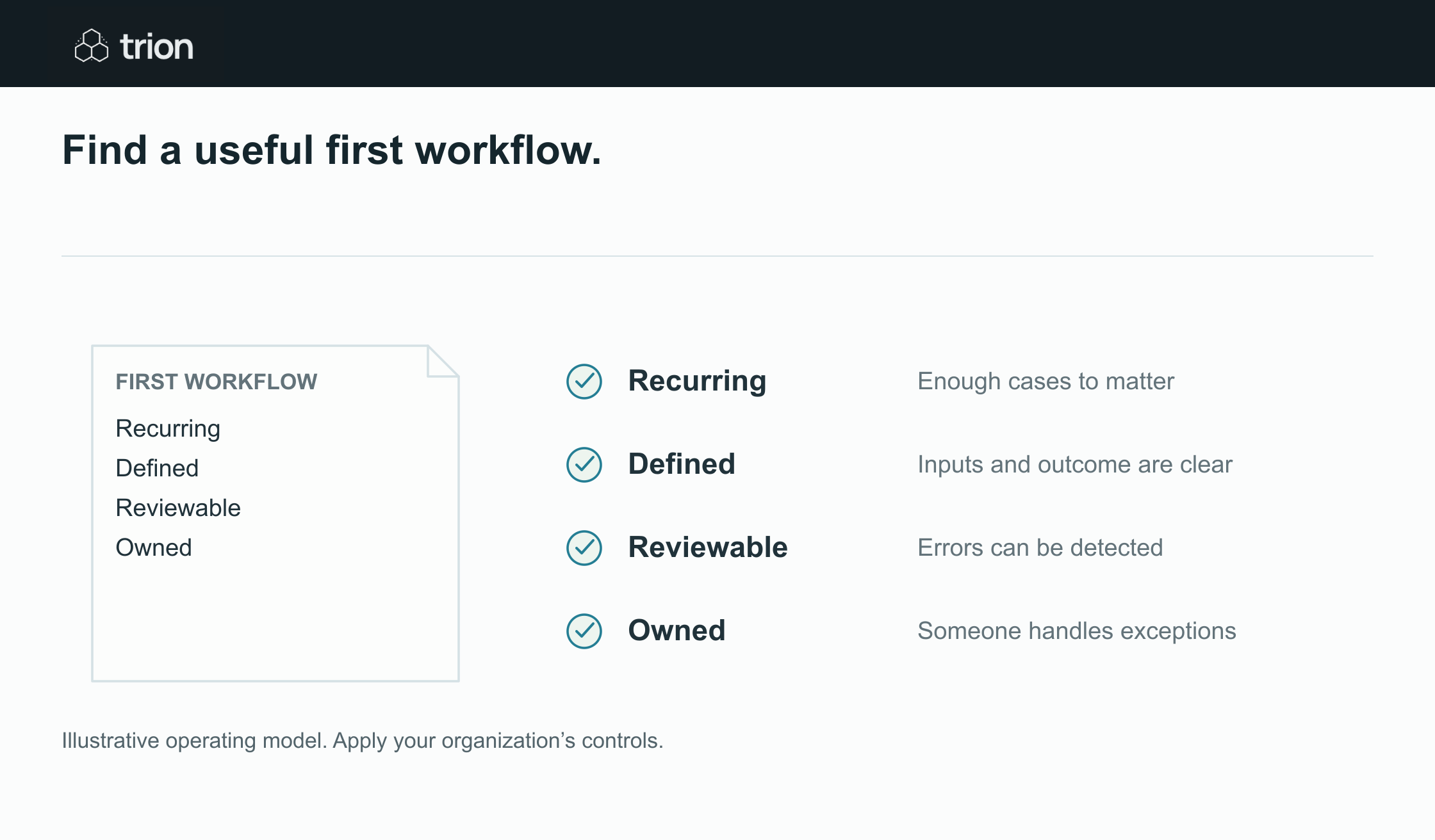

Find a useful first workflow.
- Recurring
- Enough cases to matter
- Defined
- Inputs and outcome are clear
- Reviewable
- Errors can be detected
- Owned
- Someone handles exceptions
View data
| Evidence | Meaning |
|---|---|
| Recurring | Enough cases to matter |
| Defined | Inputs and outcome are clear |
| Reviewable | Errors can be detected |
| Owned | Someone handles exceptions |
Illustrative operating model. Apply your organization’s controls.
Download imageCompare three concrete candidates
In an illustrative operations team, three candidates are a weekly status report, incoming request classification, and payment authorization. The report has known source records and stable formatting. Classification has variable language but can produce suggestions for review. Payment authorization has significant consequences and depends on authority checks.
The team might pilot the report first if producing it consumes meaningful repeated effort. It might pilot classification if routing delays are the larger problem and a reviewer can validate suggestions. It should not treat the payment step as the default first project simply because it has the largest monetary figure attached.
Document the reason for the choice and the evidence that could change it. For example, the reporting task may prove less valuable if the source data requires manual correction every week. That discovery is useful, because it identifies the prerequisite rather than disguising it as implementation trouble.
Remove avoidable work before automating it
Ask whether a duplicate report can be retired, a required field can move into the intake form, or an unnecessary approval can be removed by the policy owner. An automation that reproduces an obsolete step can make it faster while keeping the wrong process in place.
Do not remove controls merely to improve the proposed savings. Preserve the decision owner’s requirements and show where those requirements add review effort. Process simplification and authorization are separate discussions.
Write the pilot boundary in operational language
A useful scope reads: “Prepare a reviewable internal routing record for incoming project enquiries from this mailbox, excluding complaints and payment-related messages.” It identifies the trigger, output, included cases, and excluded cases. Add the reviewer, exception path, and success measure.
Use the workflow readiness tool to record the evidence and gaps. Then model time, review, support, and setup assumptions in the ROI tool. Choose a project only after the process owner can explain how the pilot will distinguish a useful result from a polished demonstration.