
Keep the trace and the business record distinct
The OpenAI Agents SDK tracing guide describes traces and spans covering agent activity, including model generation and tool calls. It also explains sensitive-data capture and export configuration. A technical event record can help diagnose a workflow, but a successful generation span does not establish that a purchase record or customer task reached its accepted outcome.
Define the business states independently: preparing, awaiting review, applying, confirmed, unresolved or failed, as appropriate to the process. Connect the events that explain a state change without letting the trace infer that change from activity alone.
Connect spans to a stable business identity
Use a case or task identity that remains stable across model calls, review and retries. Include source and proposal versions where they matter to the decision. Keep technical attempt identities separate so repeated attempts can be investigated without becoming separate business tasks. The operator should be able to move from an affected record to the relevant attempt history.
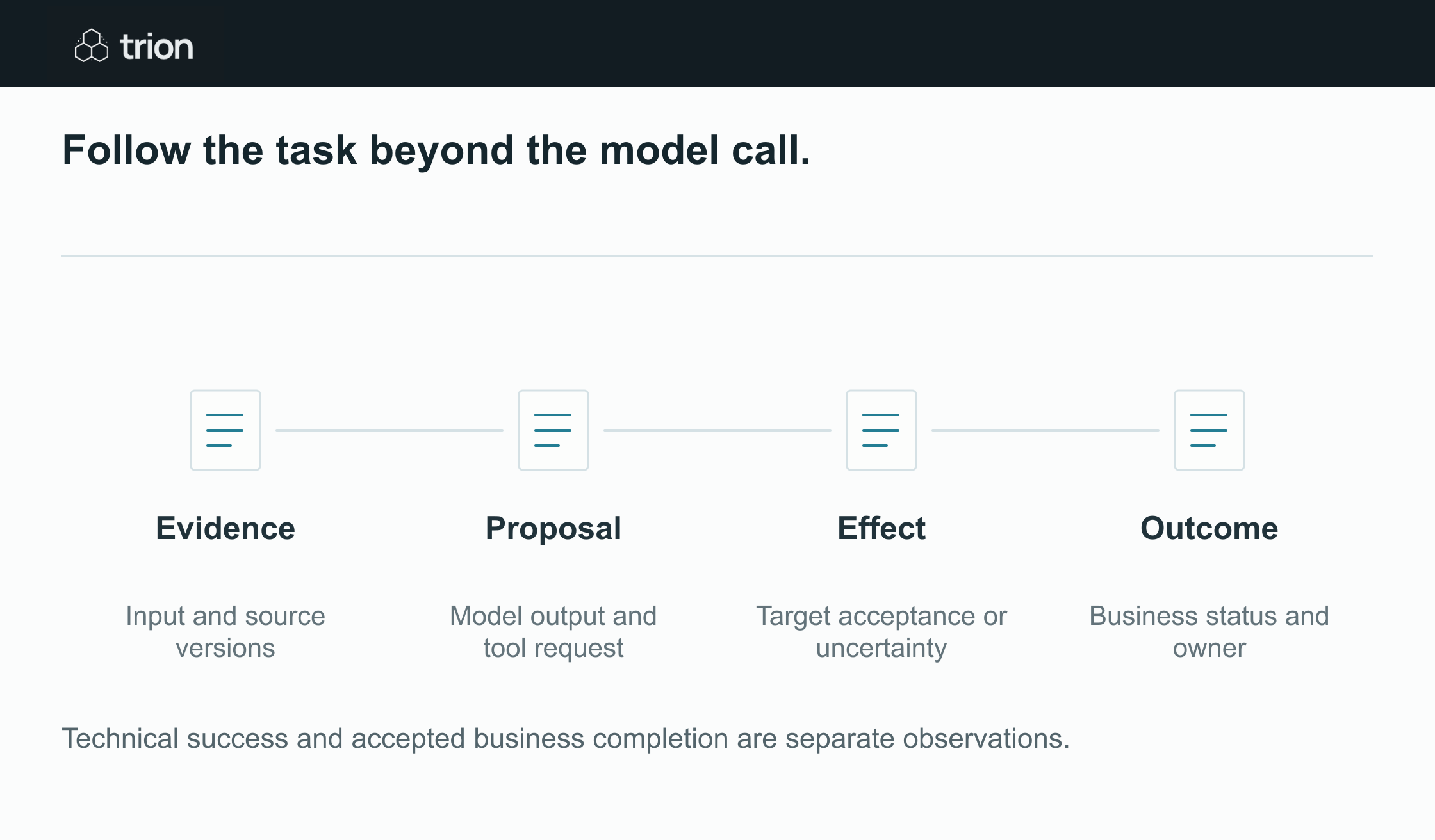

Follow the task beyond the model call.
- Evidence
- Input and source versions
- Proposal
- Model output and tool request
- Effect
- Target acceptance or uncertainty
- Outcome
- Business status and owner
| Evidence | Meaning |
|---|---|
| Evidence | Input and source versions |
| Proposal | Model output and tool request |
| Effect | Target acceptance or uncertainty |
| Outcome | Business status and owner |
Technical success and accepted business completion are separate observations.
Choose correlation metadata that does not reveal unnecessary sensitive information. A safe internal identifier is often more appropriate than a customer’s name or a complete email subject. Enforce access to the trace and its linked evidence. The ability to diagnose a failure should not become a second, less restricted route to the underlying business records.
Work through an uncertain document-registration result
Consider a workflow in which an agent reads a delivery note, proposes a receipt record and submits an authorized registration request. The network response times out. The model call and extraction succeeded, but the target may or may not have accepted the receipt. Marking the task complete or blindly repeating registration would hide that uncertainty.
| Event | What it establishes | What remains |
|---|---|---|
| Extraction returned | A proposed record exists. | Field and source review. |
| Registration requested | An operation was attempted. | Target acceptance. |
| Response timed out | The response is unknown. | Reconciliation before retry. |
| Target record confirmed | The identified effect exists. | Any separate remaining business task. |
The operator follows the task identity to the request and supported target lookup. If the receipt exists, the workflow records its identity instead of inserting another one. If no effect was accepted and a retry is permitted, the new attempt remains attached to the same task.
Record enough to explain the failure
Capture stage, duration, configuration identity, outcome category and relevant correlation IDs. Use appropriate error categories rather than only a free-text exception. Distinguish unavailable evidence, model failure, denied permission, uncertain write and target rejection. These differences determine the recovery path and the person who can resolve the issue.
Review capture and export deliberately
The SDK guide notes that generation and function spans can contain sensitive inputs and outputs, and provides configuration to control capture. Inspect the version and settings used by your application before sending traces to a destination. Decide what is necessary for diagnosis, who can read it and how long it should remain available.
Check redaction and delivery together, including failure behavior. Adding a diagnostic observer does not necessarily replace an existing exporter. In an observability pilot with Trion, document permitted destinations for each event field.
Turn events into actionable measures
Measure accepted-task completion, time spent waiting for review and recurring recovery categories alongside technical latency. A low error rate for model calls can coexist with frequent target mismatches. Assign owners to the failures the dashboard exposes and verify that each can reach the relevant permitted evidence and recovery action.