
Define the job before considering models
Anthropic’s model-selection guide recommends testing actual prompts and data, examining accuracy, output quality and edge cases, then weighing cost tradeoffs. Those are useful selection dimensions across providers. A published benchmark can suggest a candidate, but it cannot establish whether your input population and acceptance rules will produce the same result.
Write the output the team needs and the errors it cannot tolerate. An email category, an extracted commercial record and a recommendation based on competing sources are different tasks. State whether the workflow can ask for clarification, who reviews uncertain cases and which operations remain outside its authority.
Compare configurations under the same task contract
Use the same source inputs, required output and review rubric for each candidate. Record prompt versions, model settings and tools available during the trial. If one configuration receives extra evidence or a different repair step, explain that difference. You may be comparing useful workflows, but the result should not be presented as an isolated model comparison.
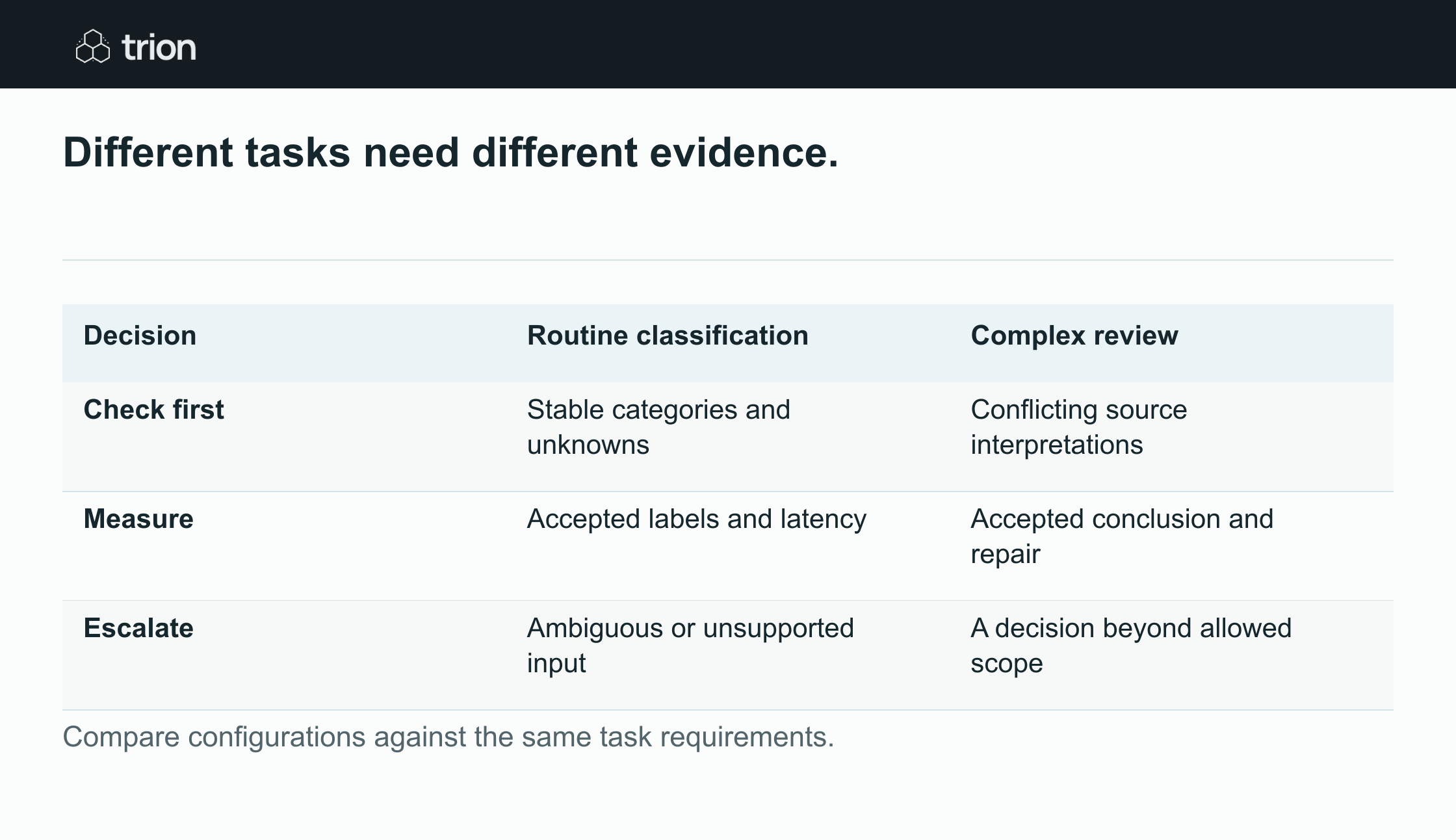

Different tasks need different evidence.
- Check first
- Routine classificationStable categories and unknowns
- Complex reviewConflicting source interpretations
- Measure
- Routine classificationAccepted labels and latency
- Complex reviewAccepted conclusion and repair
- Escalate
- Routine classificationAmbiguous or unsupported input
- Complex reviewA decision beyond allowed scope
| Decision | Routine classification | Complex review |
|---|---|---|
| Check first | Stable categories and unknowns | Conflicting source interpretations |
| Measure | Accepted labels and latency | Accepted conclusion and repair |
| Escalate | Ambiguous or unsupported input | A decision beyond allowed scope |
Compare configurations against the same task requirements.
Evaluate the features required by the application, including supported input formats and structured output behavior. Check deployment, access and data-handling requirements with the current provider documentation and your system owner. A candidate that performs well in a demonstration may still be unsuitable for the actual environment in which the team will operate it.
Work through two jobs in one inbox
Consider a procurement inbox with a routine classification step and a separate quotation-revision review. Classification assigns a message to a known category while retaining uncertain cases. Revision review compares price, delivery and payment evidence across versions. Putting both tasks behind one undifferentiated model choice can obscure the quality needed at each step.
| Task | Acceptance evidence | Exception path |
|---|---|---|
| Classify a message | Correct category and purchase identity. | Clarification for ambiguous references. |
| Compare a revision | Consequential changes with source versions. | Review conflicting or missing terms. |
| Prepare a follow-up | Draft asks only unresolved questions. | Buyer checks recipient and commitment. |
Trial a configuration for each bounded task and examine the complete handoff between them. A classification mistake can send the revision reviewer the wrong purchase, so component quality alone is insufficient. Retain stable identities and make uncertainty visible rather than allowing a later step to inherit an unsupported assumption.
Measure useful output and repair
Record whether the result was accepted unchanged, accepted after correction or left unresolved. Include the time spent reconstructing a source, correcting a value and handling failures. A cheaper first response can become a more expensive accepted result if it creates repeated review work. A more capable model can also be unnecessary where a simpler configuration satisfies the written checks.
Design escalation as a separate decision
If a routine step escalates harder cases, define the trigger and the information passed onward. Missing evidence, conflicting sources and out-of-scope actions require different responses. Some cases need a different model configuration; others need a human decision or a new supplier answer. Escalation should not mean repeatedly asking increasingly expensive models to guess the same missing fact.
Test whether difficult cases reach the correct escalation path. Keep the accepted source versions and prior work available to the next reviewer. Use these task records to scope model routing with Trion.
Keep the selection revisitable
Save the case set, settings and decision record so a later model or provider change can be evaluated against the same expectations. Recheck materially changed inputs and features, and name the owner responsible for reassessment.