
AI workflow automation services
Turn unstructured input into validated, source-linked work.
Scoped pilot · Access agreed · Human approval
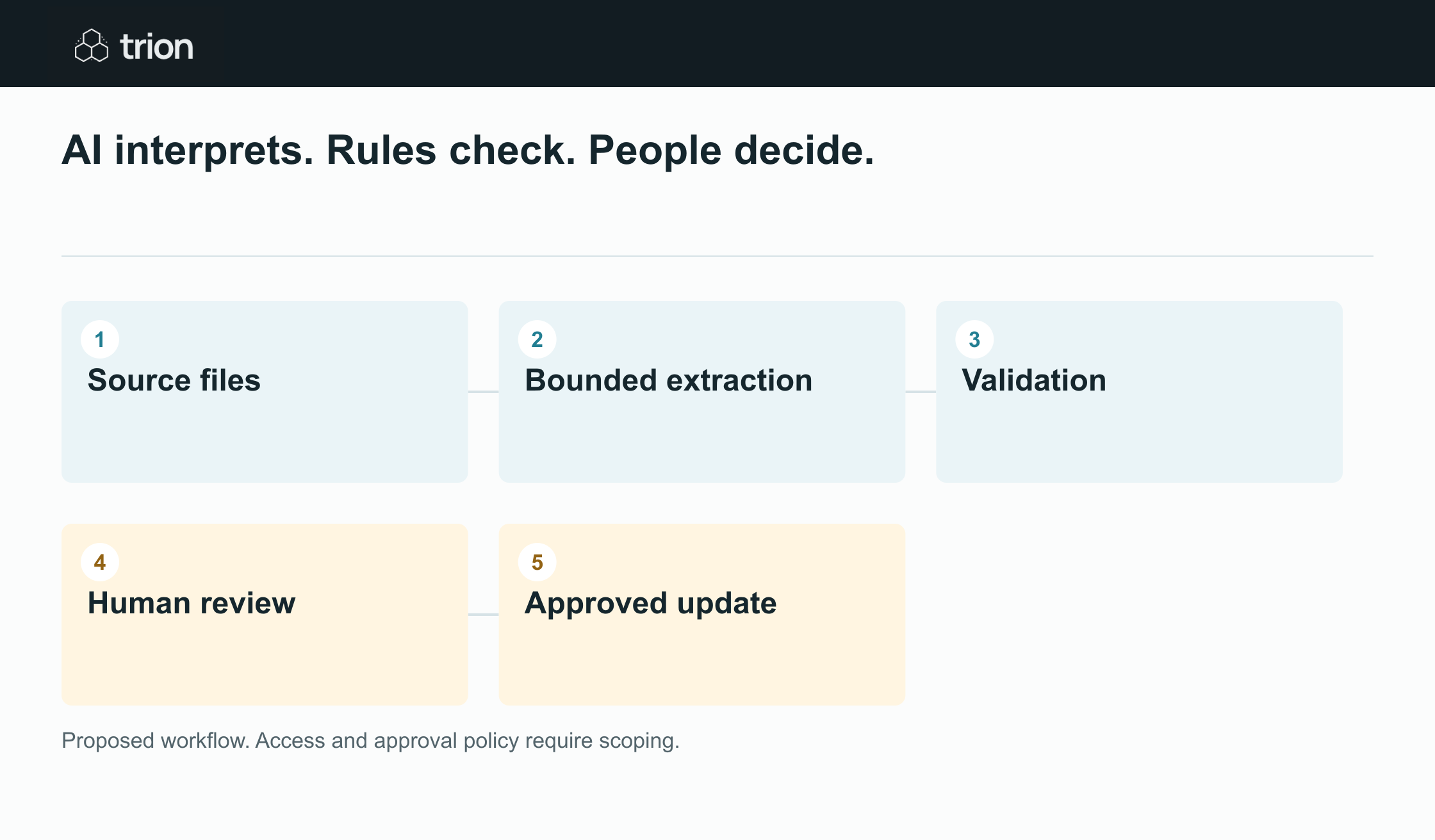
The working route
- Source files
- Bounded extraction
- Validation
- Human review
- Approved update
How each step works
Map the event and expected outcome
Define the incoming request, accountable team, required fields and the system that owns the final record. Use representative documents and difficult exceptions.
Keep interpretation separate from execution
Use a model for a bounded task such as classification or extraction. Preserve source evidence, validate structured output and keep unresolved values visible.
Design the review controls
Specify which decisions require a person, what evidence they see and how rejected or corrected output returns to the workflow.
Connect the approved action
Prepare a draft or a system update from validated values. Check permission boundaries and duplicate protection before committing an approved action.
Evaluate the whole workflow
Measure handling time, review workload, field errors, failures and cost per completed case. Compare with the manual baseline and document recovery.
AI interprets. Rules check. People decide.
- Quantity
- 24 boxes
- Freight
- Unknown
- Evidence
- Page 1
Deliverables & scope
- Input contract
- Evaluation cases
- Exception queue
- Reviewed actions
- Recovery notes
Full deliverables and scope
Trion can design AI-assisted workflows around the inboxes, documents and applications your team already uses. The useful boundary is specific: which information the model interprets, which rules validate it, and which action a person approves. We scope and test that boundary before connecting production systems.
Deliverables
- A defined input and output contract.
- Representative evaluation cases and extraction checks.
- A source-linked exception queue.
- Reviewed drafts or bounded integration actions.
- Monitoring, recovery and handover documentation.
Controls and limitations
- AI output is evaluated against your actual examples, not treated as inherently accurate.
- The pilot defines access, data handling and who can approve each consequential action.
- A proposed integration is validated before a production capability is claimed.
- Model, hosting and review costs depend on the actual workload.
Common questions
Does every automation need AI?
No. A stable rule, calculation or supported integration is often the right choice for structured inputs. Add a model where interpretation is useful and can be evaluated.
Can we start with one inbox or document type?
Yes. A bounded pilot is easier to measure, test and hand over than a broad promise to automate an entire department.
Can the workflow run without anyone checking it?
The allowed actions and review policy are agreed during scoping. Uncertain records and consequential commitments should have explicit controls and accountable owners.