
Enterprise workflow automation services
Connect systems with clear ownership and a recovery route.
Scoped pilot · Access agreed · Human approval
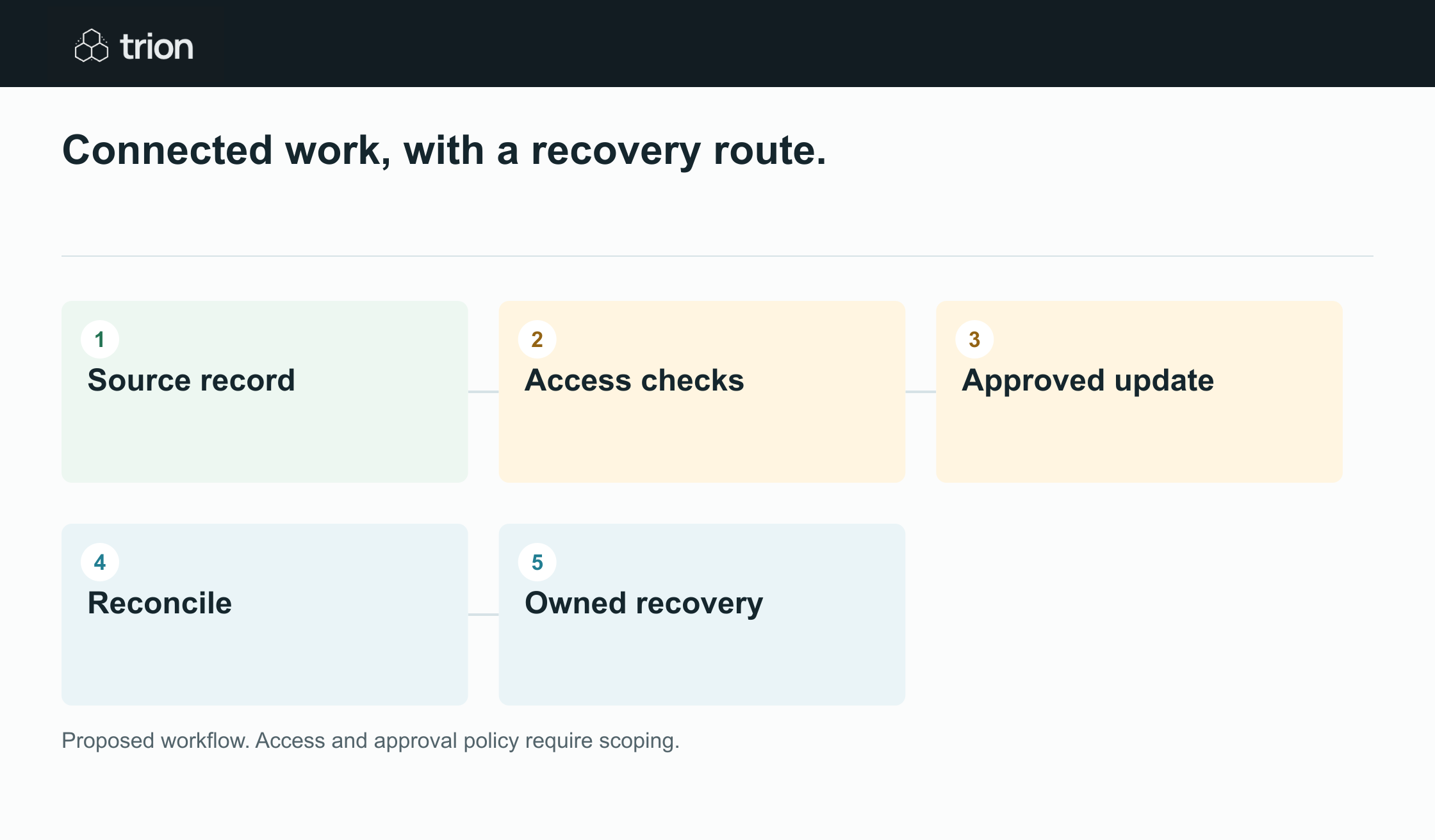
The working route
- Source record
- Access checks
- Approved update
- Reconcile
- Owned recovery
How each step works
Agree on the authoritative records
Define stable identifiers, data ownership, allowed changes and the applications that remain the source of truth. Keep reconciliation rules explicit.
Confirm integration and access
Check supported APIs, account permissions, authentication, licensing dependencies and service limits with the responsible system owners.
Build a recoverable process
Identify irreversible actions, duplicate protection, retry boundaries and reconciliation checks. Keep a human recovery route for unresolved failures.
Make approvals traceable
Record the decision, approver, input version and resulting action. Separate role permissions from a generic approved status.
Test and hand over
Use failure, duplicate, stale-record and permission scenarios. Document monitoring, escalation, service ownership and the acceptance criteria for rollout.
Connected work, with a recovery route.
Recovery is agreed with the system owners.
Deliverables & scope
- Ownership map
- Access inventory
- Recovery plan
- Approval route
- Handover checks
Full deliverables and scope
An enterprise workflow is more than a chain of successful API calls. Trion can scope an integration around system ownership, approval authority and operational recovery. We start with one measurable cross-team process, document the dependencies, and test what happens when a service is unavailable or a record changes.
Deliverables
- Workflow and system ownership map.
- Access and integration dependency inventory.
- Recovery and duplicate handling design.
- A traceable approval and exception route.
- Pilot tests, monitoring plan and operational handover.
Controls and limitations
- A local demonstration is not a claim of enterprise certification or a production deployment.
- Your organization defines its security, retention, approval and operating policies.
- Integration feasibility depends on the target systems and available account access.
- A wider rollout follows evidence from a scoped pilot.
Common questions
Do we have to replace our ERP or CRM?
The starting point is the existing systems. The scope determines what can be connected through supported integrations and where a new structured record is needed.
How are failed updates handled?
The design should distinguish safe retries from actions requiring reconciliation. A named operator needs the source record, failure reason and recovery action.
How do we evaluate a pilot?
Agree measurable checks such as correctly processed cases, duplicate handling, unresolved exceptions and handling time before implementation begins.