
Define the promised outcome first
Consider a service team that wants a complete client packet reviewed within two business days. The clock starts when the defined required material is available and stops when an authorized reviewer records an accepted packet or a reasoned rejection. Receiving an upload is not the endpoint. Starting a workflow run is not the start of the customer’s wait.
Write down eligibility, start, finish, calendar and exclusions. An incomplete application may enter an intake queue before entering the review commitment. Keep both intervals visible. Otherwise, moving work between queues can improve the reported number without improving the experience.
Google’s SRE guidance identifies latency, traffic, errors and saturation as useful technical monitoring signals. The monitoring chapter supports measuring demand and performance together. The operational measures below adapt those signals to business work.
Keep the open cases in view
| Measure | Question it answers |
|---|---|
| Eligible arrivals | How much new work entered the defined commitment? |
| Confirmed completions | How many cases reached the agreed business outcome? |
| Open-case age | What is still waiting, and for how long? |
| Overdue open cases | Which commitments have already been missed? |
| Reopened cases | How often did a recorded completion need further work? |
A completion-time chart includes only finished cases. Add an age distribution for open cases and name the oldest unresolved item. Report its owner and blocking reason. This prevents a system that clears easy work from looking healthy while difficult work quietly accumulates.
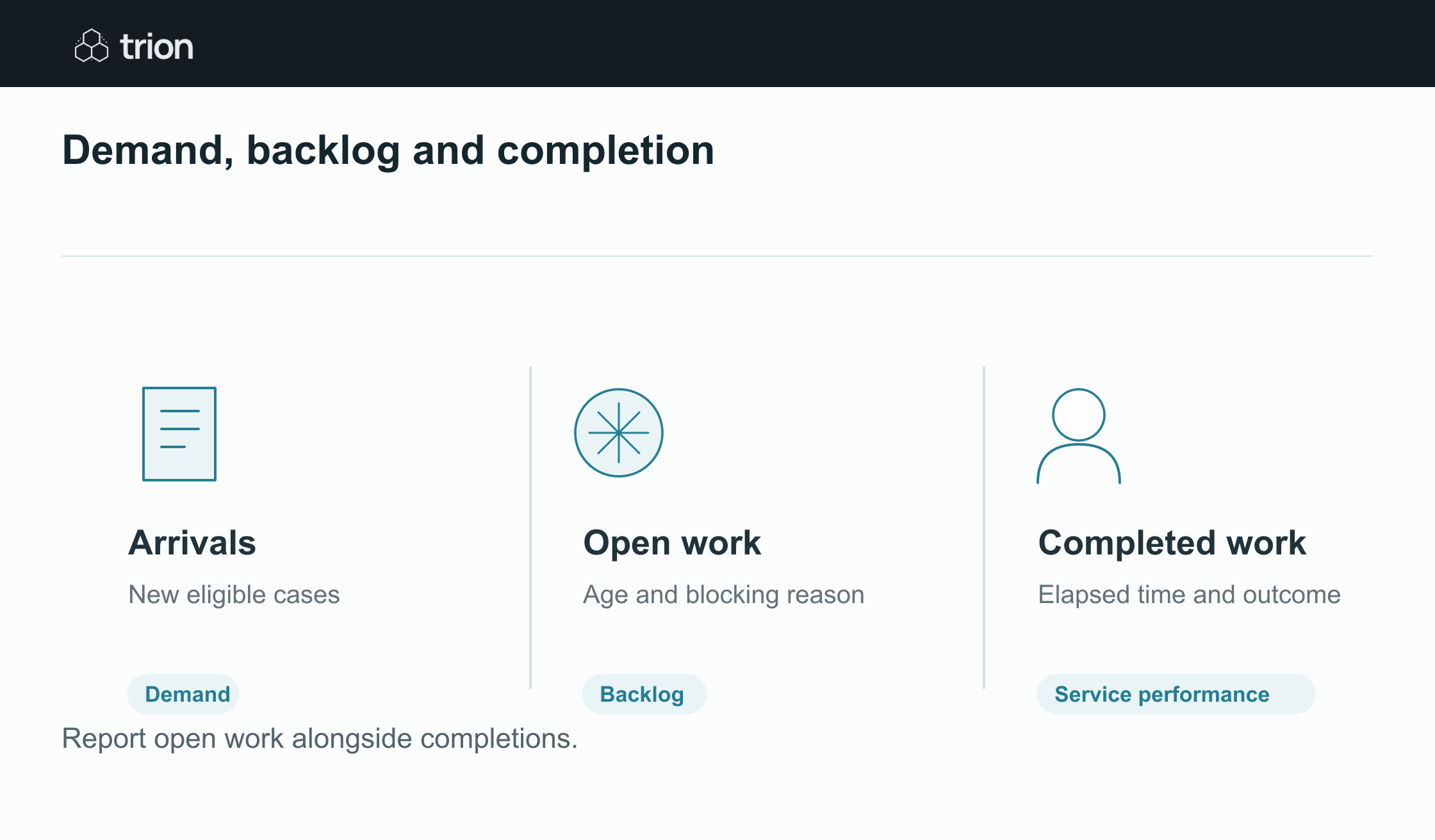

Demand, backlog and completion
- Arrivals
- New eligible cases. Demand
- Open work
- Age and blocking reason. Backlog
- Completed work
- Elapsed time and outcome. Service performance
| Evidence | Meaning |
|---|---|
| Arrivals | New eligible cases. Demand |
| Open work | Age and blocking reason. Backlog |
| Completed work | Elapsed time and outcome. Service performance |
Report open work alongside completions.
Distinguish internal review, external waiting and technical failure. A missing supplier answer needs a different response from an access error. The headline backlog can include all three, but the operating view must expose their separate causes.
Reconcile the backlog with simple arithmetic
For example, 40 cases are open on Monday, 30 arrive, 25 complete and 5 are cancelled under the agreed rule. The closing backlog is 40 + 30 − 25 − 5 = 40. Its size did not improve even though 25 cases completed.
If the actual Friday register contains 43 open cases, investigate the difference before trusting a trend. Three reopened cases, duplicate arrivals or delayed status events might explain it. Store case identifiers so the totals can be traced to individual records.
Split completed, cancelled and transferred work in the report. A transferred case may still be unresolved for the business. A cancellation is not a service delivery. Showing both as ordinary completion would distort the meaning of the promised outcome.
Choose the denominator before reporting success
Suppose 18 of 20 cases completed this week met the target. That is 90% of this week’s completions. It does not establish that 90% of all cases due this week met their commitment, because overdue cases may remain open.
For a due-date measure, identify the cohort whose commitments fall within the reporting period and count on-time outcomes in that cohort. Include overdue open cases as missed outcomes. For a completion-time measure, state that the sample consists of completed cases and show the open backlog beside it.
Use medians and a high percentile when the sample supports them, with sample size and period visible. A mean alone can hide a small group waiting much longer. Do not interpret a percentile based on a handful of cases as a stable service guarantee.
Make pause rules observable
If the policy permits an external-wait pause, record its start, end, reason and owner. Keep total customer elapsed time alongside the adjusted service clock. A reviewer should be able to reconstruct both without guessing which days were removed.
Use the organization’s working calendar, holidays and named time zone. Decide what happens when a packet becomes complete after hours. Document the rule once and calculate it consistently; an arbitrary subtraction of weekends cannot account for every calendar.
Turn the report into an operating decision
Each exception should lead to a specific response: assign an unowned review, request missing evidence, reconcile an uncertain write or fix a broken connector. Alert an accountable person when an actionable commitment is approaching or missed. Avoid notifying everyone about every ordinary waiting case.
Define the completion event and reporting cohort in Trion’s workflow scope before estimating savings with the ROI calculator.