
Choose the decision and the cost boundary
Decide whether the model supports a quotation question, a make-or-buy comparison or a change in order quantity. Those decisions need different boundaries. A unit manufacturing estimate cannot answer a whole-life question if installation, maintenance and disposal are outside its scope.
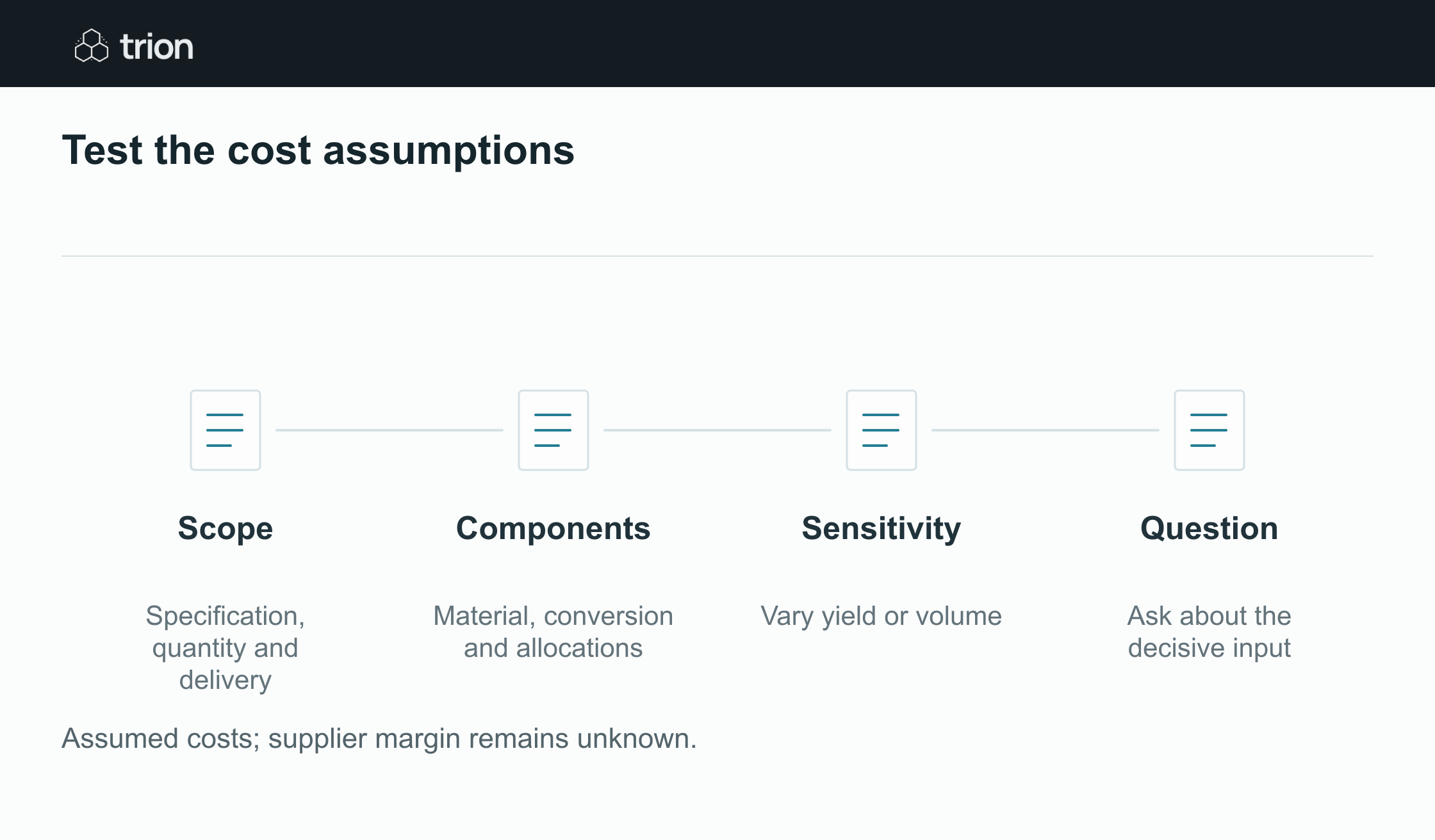

Test the cost assumptions
- Scope
- Specification, quantity and delivery
- Components
- Material, conversion and allocations
- Sensitivity
- Vary yield or volume
- Question
- Ask about the decisive input
| Evidence | Meaning |
|---|---|
| Scope | Specification, quantity and delivery |
| Components | Material, conversion and allocations |
| Sensitivity | Vary yield or volume |
| Question | Ask about the decisive input |
Assumed costs; supplier margin remains unknown.
The UK Sourcing Playbook uses should-cost modeling to examine expected whole-life costs across delivery options. Its public-sector context is specific. The transferable practice is making cost assumptions explicit so different options can be challenged on a consistent basis.
For a purchased component, record the drawing revision, quality requirement, quantity, delivery location and pricing period. Mark the included costs. If tooling is charged separately, do not also allocate the full tooling amount into every unit without explaining the treatment.
Example bracket cost model
Assume an order for 1,000 brackets. Each finished bracket contains 0.5 kg of material. An assumed 80% material yield means 0.625 kg of purchased input per good part. At an assumed $4 per kg, material costs $2.50 per bracket.
| Component | Assumed basis | Per bracket |
|---|---|---|
| Material | 0.5 kg ÷ 80% × $4/kg | $2.50 |
| Labor | 0.1 hour × $18/hour | $1.80 |
| Machine time | 0.05 hour × $24/hour | $1.20 |
| Packaging | Assumed unit allocation | $0.40 |
| Setup | $300 ÷ 1,000 units | $0.30 |
| Overhead | Separate assumed allocation | $0.80 |
| Profit allowance | Assumed fixed amount, not a margin claim | $0.60 |
| Freight | Assumed unit allocation | $0.40 |
| Modeled total | All listed components | $8.00 |
A $10 quotation does not prove that $2 is removable profit. The assumed process, rates, overhead or freight may be wrong; the quotation may include costs your model omitted. Use the difference to identify questions rather than announce a saving.
Test the assumptions that move the result
At 500 units, the same $300 setup adds $0.60 per bracket instead of $0.30. Keeping every other assumption unchanged gives $8.30 per bracket. At 2,000 units, setup falls to $0.15 per bracket and the modeled total becomes $7.85. This holds all inputs except setup allocation constant.
Change yield from 80% to 70% at the original quantity. Material becomes about $2.86 per bracket, bringing the total to about $8.36. This sensitivity suggests that yield evidence might matter more than a small packaging adjustment. Ask about the manufacturing route and waste treatment before assuming the lower material input is achievable.
Do not vary all inputs at once and then attribute the result to volume. Keep a base scenario, one-input changes and a combined scenario clearly labeled. A buyer should be able to reproduce the calculation without reading a model's explanation.
Separate sourced inputs from estimates
Give every input a source field: supplier explanation, reviewed internal estimate, public reference or unresolved assumption. Record its unit and effective period. A wage estimate from another geography or a metal index without the relevant specification is not a directly applicable production rate.
Ask for the specific input that would change the decision. “Please explain the setup allocation at 500 and 1,000 units” is more actionable than “AI says your price is too high.” Avoid presenting speculative calculations as confidential knowledge about the supplier's operations.
Keep a revision log for the worksheet. When a supplier clarifies a process assumption, update that input and identify which conclusions changed. An old estimate should not remain attached to a newly revised quotation as though both share the same basis.
Turn the model into a negotiation brief
Summarize the quoted basis, modeled range, most sensitive assumptions and unanswered questions. Include operational constraints such as maximum stock, technical approval for alternatives and required arrival. A larger order that lowers modeled unit cost can still be a poor choice when it creates unused inventory.
Scope Trion’s cost worksheet around editable assumptions, deterministic arithmetic and buyer-reviewed questions.
Align delivered-cost scope with the bid-leveling guide before turning the sensitive assumptions into a negotiation email.