
Set one comparison basis before converting money
Write the required item revision, quantity, unit, arrival location and needed date at the top of the worksheet. Then record each supplier's quoted basis unchanged. Normalize quantity before comparing totals: ten cases and ten individual items are different demands even when the numbers match.
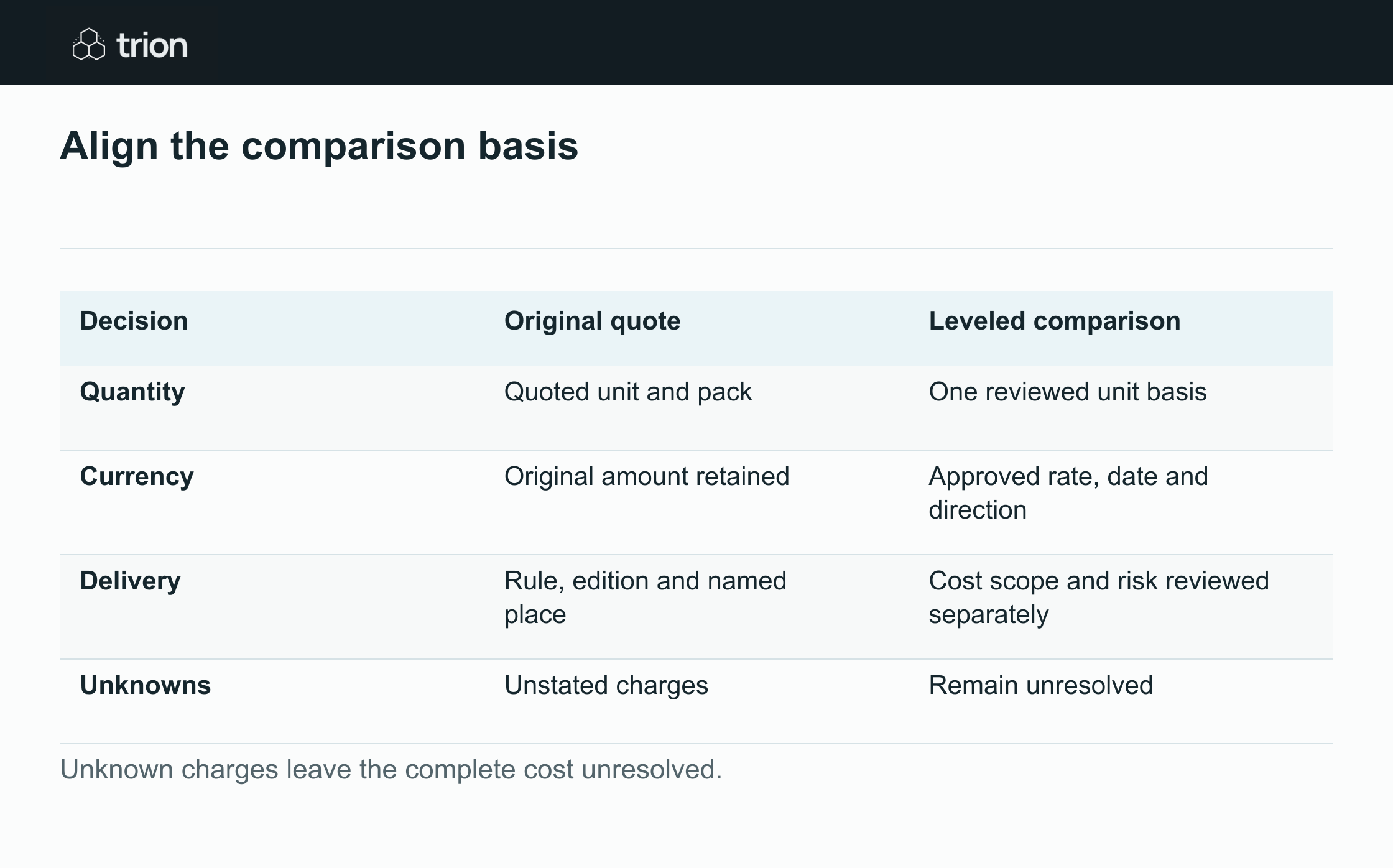

Align the comparison basis
- Quantity
- Original quoteQuoted unit and pack
- Leveled comparisonOne reviewed unit basis
- Currency
- Original quoteOriginal amount retained
- Leveled comparisonApproved rate, date and direction
- Delivery
- Original quoteRule, edition and named place
- Leveled comparisonCost scope and risk reviewed separately
- Unknowns
- Original quoteUnstated charges
- Leveled comparisonRemain unresolved
| Decision | Original quote | Leveled comparison |
|---|---|---|
| Quantity | Quoted unit and pack | One reviewed unit basis |
| Currency | Original amount retained | Approved rate, date and direction |
| Delivery | Rule, edition and named place | Cost scope and risk reviewed separately |
| Unknowns | Unstated charges | Remain unresolved |
Unknown charges leave the complete cost unresolved.
Keep the original currency amount beside the converted comparison. Record the rate source, effective date, direction and approval owner. A cell containing “1.10” is insufficient unless it states which currency buys which. Distinguish a planning comparison from the actual payment cost.
The ECB describes its reference rates as information-only and discourages using them for transactions. That makes the purpose of a rate important. Your finance team should determine the basis appropriate to the comparison and the separate payment decision.
Read delivery terms as more than a freight label
The ICC's Incoterms 2020 explanation distinguishes obligations, risk and costs. It also explains that the rules do not specify matters such as payment currency, payment method or transfer of ownership. Do not fill those fields from a three-letter delivery label.
Capture the rule, edition and named place exactly as offered. Keep cost inclusion separate from the event where risk transfers. If the location is vague or the supplier's freight line conflicts with its stated delivery basis, ask for clarification. The person responsible for shipping or contract review should resolve the interpretation.
A familiar label should not cause the workflow to invent a charge, assume an import treatment or declare every responsibility settled. Preserve the quotation wording and make unresolved responsibilities visible in the comparison.
Example currency comparison
Suppose two suppliers quote the same reviewed quantity. Supplier A offers goods for $1,000 and freight for $150. Supplier B quotes €950 including freight to the agreed comparison point. Assume €1 equals $1.10 for the comparison. B's known subtotal converts to $1,045, compared with A's $1,150.
| Comparison field | Supplier A | Supplier B |
|---|---|---|
| Original quoted amount | $1,000 goods + $150 freight | €950 including freight |
| Known subtotal in USD | $1,150 | $1,045 at the assumed rate |
| Other relevant charges | Not yet confirmed | Not yet confirmed |
| Conclusion available | Compare known subtotals; complete delivered-cost scope remains unresolved. | |
The $105 difference compares known subtotals; it is not an established saving while relevant charges remain unconfirmed. An incomplete cost comparison cannot establish a winner.
Show sensitivity when the currency can change the choice
Keep the same quotations and assume a second rate of €1 to $1.25. B's subtotal becomes $1,187.50, now $37.50 above A. Nothing about the underlying offer changed; the reporting assumption changed the ordering.
The decision depends on exchange-rate exposure. Show the scenario basis and ask finance which assumptions belong in the approval. Avoid mixing a current conversion for one supplier with an old conversion for another.
Apply the same discipline to quote validity and escalation terms. If one offer expires before the planned decision, a neatly normalized table still does not contain two available offers. A refreshed quote needs its own source and version.
Save the complete comparison scenario with its inputs. Reproducing an approved table later should use the reviewed rate and charges, rather than silently fetching new values into an old decision.
Keep commercial differences beside the cost
Display payment timing, warranty, arrival commitment, substitutions and unresolved responsibilities with the normalized totals. A cheaper known subtotal can come with an advance payment or an unsuitable schedule. Define which differences require a buyer, technical requester or finance decision.
Assign owners for unresolved delivery and payment fields in Trion’s quotation comparison scope.
Use the comparison tool for arithmetic and the approval guide when an offer changes.