
Do not use the filename as the version
Suppose a client uploads “scope-final.pdf”, then replaces it with another file of the same name. The second document changes the implementation dates. If the workflow stores only the filename and a generic Approved flag, an operator cannot tell which dates were accepted.
Use the repository’s file identity and version information where available. Preserve the exact original content needed for later review, under the organization’s storage and retention rules. A display name helps people recognize the document; it is not sufficient evidence of its content.
Microsoft’s SharePoint Server guidance distinguishes major and draft versions and explains how content approval controls publication. Read the versioning and approval model. Those settings describe that platform; verify the actual repository configuration rather than assuming every shared folder has equivalent behavior.
Keep four identifiers connected
| Record | What it identifies |
|---|---|
| Business document | The client scope or supplier quotation across revisions |
| Evidence version | The exact repository revision or retained original reviewed |
| Interpretation | Extracted fields, source locations and reviewer corrections |
| Decision | Actor, accepted evidence and permitted consequence |
Keep extraction version separate from document version. Reprocessing the same PDF with a new model can produce different proposed values without changing the PDF. Record the extraction method and accepted corrections so an improvement to the parser cannot silently rewrite an earlier business decision.
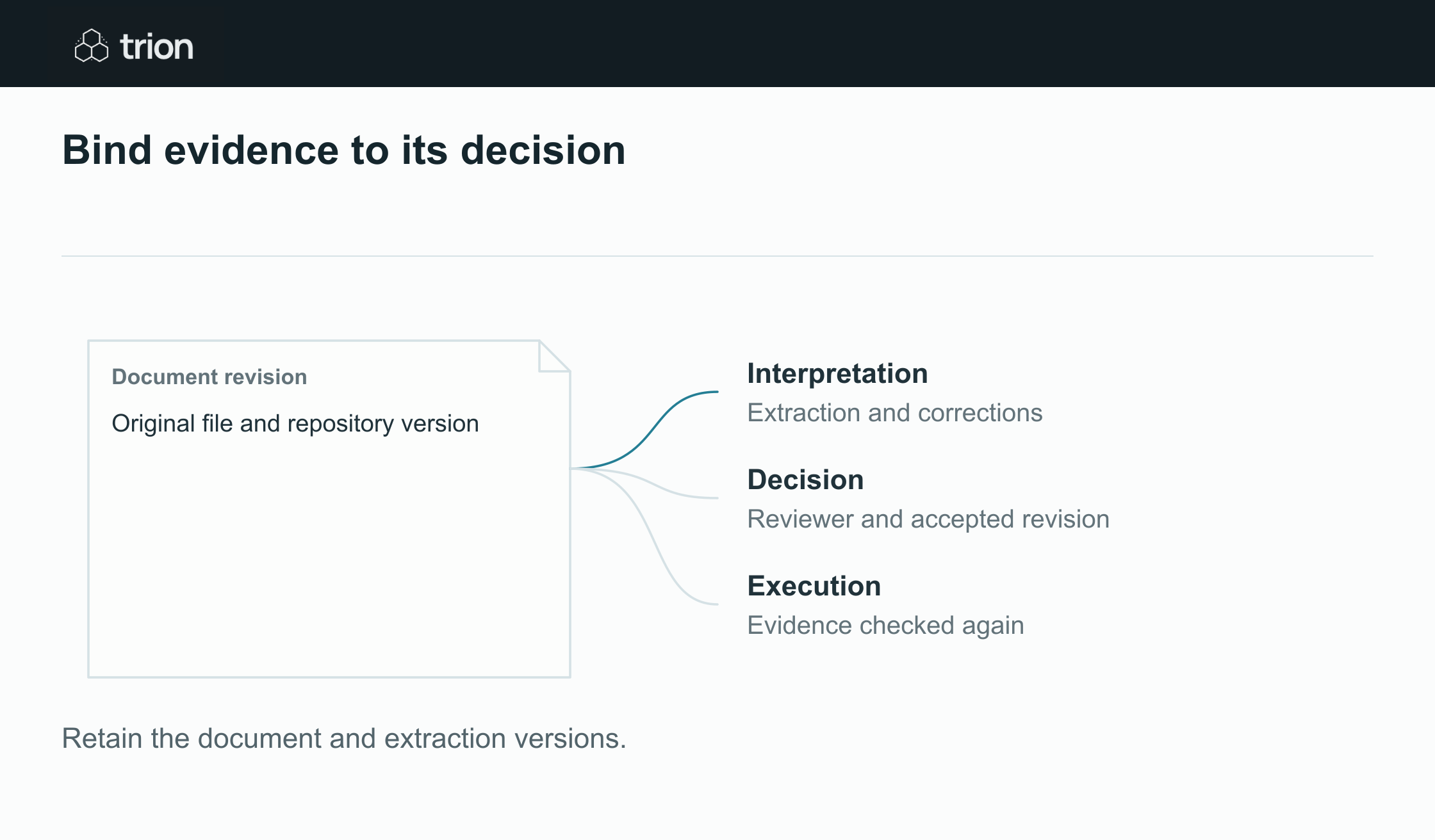

Bind evidence to its decision
- Interpretation
- Extraction and corrections
- Decision
- Reviewer and accepted revision
- Execution
- Evidence checked again
| Evidence | Meaning |
|---|---|
| Interpretation | Extraction and corrections |
| Decision | Reviewer and accepted revision |
| Execution | Evidence checked again |
Retain the document and extraction versions.
A content digest can help identify byte-for-byte repetitions. It does not prove that two different files express different commercial terms. A rescan, format conversion or changed metadata can alter the bytes while preserving the wording. Use the digest for identity checks and a reviewed comparison for meaning.
Decide what a revision invalidates
In this example, revision 1 of a service schedule is accepted for a 1 December start. Revision 2 changes the start to 15 December. The intake system should show the change and the prior acceptance, then request the appropriate review before scheduling work from the new date.
A correction to an unrelated contact detail may have a narrower effect under policy. Define which fields affect which decisions and record that rule. Do not have an AI model decide on its own that a change is immaterial and carry approval forward.
Show current, superseded, withdrawn and rejected evidence distinctly. The newest uploaded file is not necessarily the approved one. Preserve a clear accepted-version pointer and make unresolved newer material visible beside it.
Check again at execution time
A reviewer can accept a document while another person submits a revision. The workflow may then wait several hours before creating an order or activating a service. Before that consequence, check that the decision still applies to the intended evidence and that no relevant withdrawal or replacement occurred.
Use a version condition when updating the local case so concurrent workers cannot overwrite one another’s decisions. If the check fails, keep the attempted transition pending with its reason. Do not repair it by attaching the old acceptance to the new version.
For a target that cannot accept a version condition, identify the remaining race and choose a controlled review or reconciliation step. A local database check cannot guarantee that an unrelated repository stays unchanged during an external call.
Make the comparison useful to the reviewer
Lead with consequential differences: dates, quantity, payment, scope or missing pages. Keep previous and current source references available. Separate a detected text difference from a verified business change, especially for scanned files and imperfect extraction.
Place a correction alongside its source location and preserve the original proposed value. A reviewer seeing “15 December” needs to know whether that date came from the document, an extraction correction or a manual scheduling decision.
Test replacement and recovery cases
Use a same-name replacement, duplicate original, rescan, withdrawn document, changed extraction and revision arriving after approval. Verify that accepted history remains accessible, the current review does not inherit an unsupported approval and blocked actions explain the missing decision.
Specify the accepted-version check in Trion’s document workflow scope, using the approval matrix to assign authority for consequential revisions.