
Include configuration in the change
Consider a purchasing workflow that changes the threshold requiring additional approval. Its code is unchanged, but its business behavior is different. Connector credentials, field mappings, prompts, model settings, recipient lists and policy tables can also change the effective workflow.
Record the released combination rather than versioning only a script. Name the problem, intended behavior, affected cases, reviewer and planned recovery. An operator should be able to identify which combination handled a particular decision after the release.
Microsoft’s Power Platform ALM guidance includes testing, change management, deployment and operation, with source control and solutions forming part of its platform model. Read the ALM overview. Apply the operating discipline to your chosen system while checking its specific packaging and environment requirements.
Create a regression set from business decisions
| Case | Expected observation |
|---|---|
| Below the threshold | Correct permitted owner and no unsupported escalation |
| Exactly at the threshold | Documented boundary comparison applied |
| Different currency | Defined conversion evidence or an unresolved check |
| Revised approved quote | Old approval not applied to changed evidence |
| Uncertain order write | Reconciliation instead of another creation |
Keep expected outcomes reviewed independently of the new implementation. A test that copies the same threshold formula from the workflow can reproduce the same mistake. Include cases from the previous accepted release and add cases covering the specific defect or behavior change.
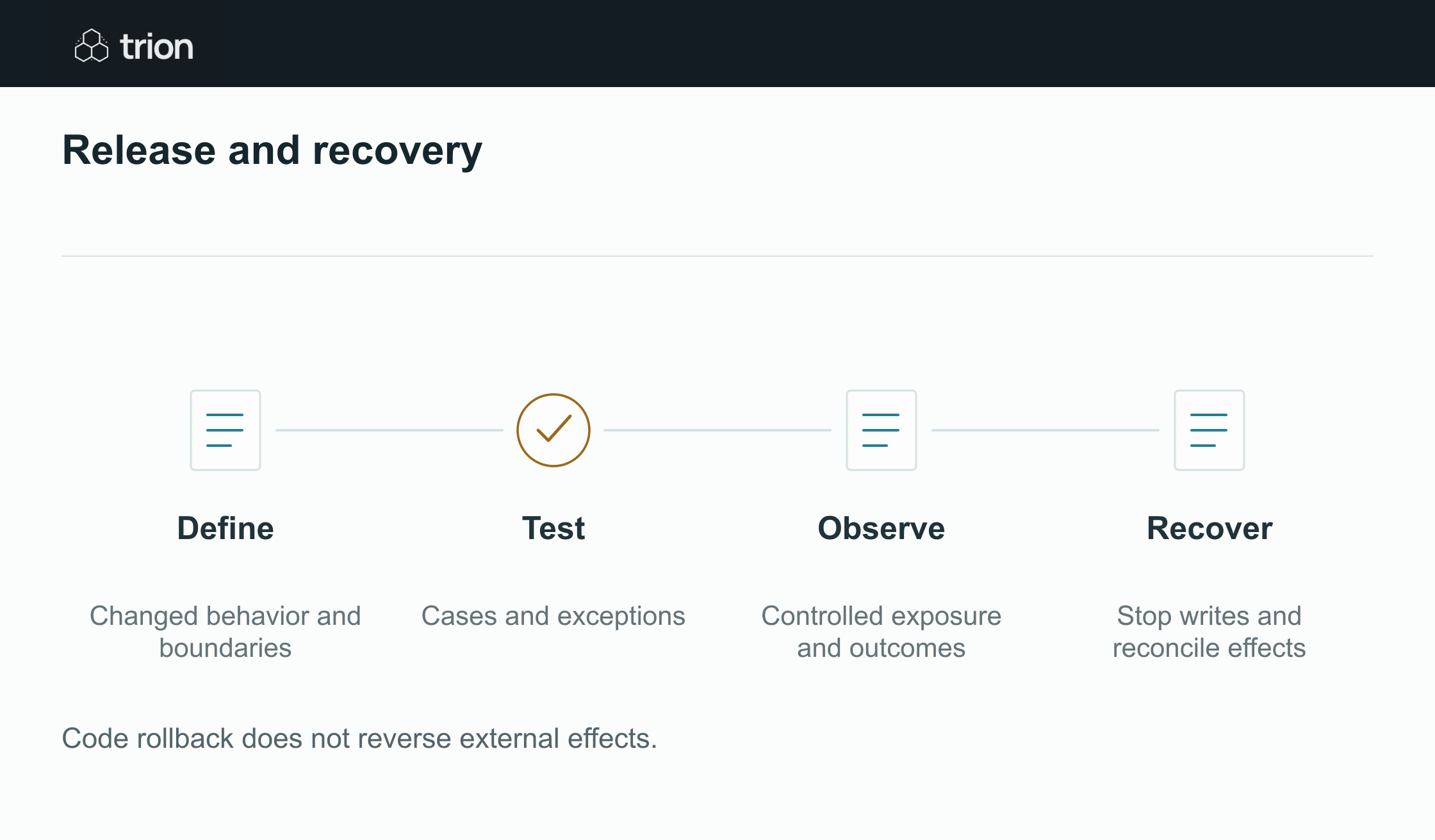

Release and recovery
- Define
- Changed behavior and boundaries
- Test
- Cases and exceptions
- Observe
- Controlled exposure and outcomes
- Recover
- Stop writes and reconcile effects
| Evidence | Meaning |
|---|---|
| Define | Changed behavior and boundaries |
| Test | Cases and exceptions |
| Observe | Controlled exposure and outcomes |
| Recover | Stop writes and reconcile effects |
Code rollback does not reverse external effects.
Use permitted prepared or suitably controlled records. Prevent test connectors from sending real invitations, issuing orders or updating live accounts. A dry run needs enforced boundaries; a note telling the operator to be careful is insufficient.
Evaluate AI changes with the same case set
A prompt improvement can raise extraction accuracy on familiar documents while worsening a less common layout. Retain accepted, corrected and unresolved cases. Evaluate required fields, evidence references, abstention behavior and downstream policy decisions, not just whether the generated explanation sounds clear.
Record the model and settings used for the evaluated release. If a dependency changes without your control, detect the effective change and rerun the relevant checks. A previously reviewed score is not evidence for an untested new combination.
Different outcomes are not all failures. A new rule may deliberately escalate more cases. Label expected changes in advance so reviewers can distinguish the desired difference from an accidental regression.
Observe a controlled release
Google’s SRE workbook describes canarying as exposing a limited part of a service to a change, evaluating it and deciding whether to continue. Read Canarying Releases. Its lesson is to evaluate a bounded change against observable results, rather than assuming deployment itself establishes success.
For a business workflow, an initial observation mode can prepare proposals without performing consequential writes. Compare old and new decisions on the same eligible cases. Where a controlled live cohort is authorized, define its scope, support owner and stop criteria before enabling it.
Do not run both versions’ external effects for the same case as an informal comparison. Two good-looking drafts can become duplicate messages or orders if the execution boundary is unclear. Keep proposal comparison separate from the single authorized executor.
Plan rollback and business recovery separately
Returning to old code stops future use of the change. It does not unsend messages or undo orders already accepted by another system. Record the affected operation identifiers and plan reconciliation, corrections or authorized compensation for completed effects.
Decide what happens to waiting cases. They may remain on their original rule version or require a recorded migration. Changing the approval threshold beneath an already waiting case should not silently reinterpret a decision that someone made under different rules.
Keep a switch or controlled procedure to pause new consequential writes while investigation continues. Preserve intake where safe so work is not lost, but show its unresolved state and owner. Restarting execution requires confirmation that the recovery conditions are met.
Close the change with operational evidence
Review confirmed outcomes, corrections, unresolved cases and operator feedback over the agreed observation period. Include sample size and differences from the baseline. A quiet error log is not proof that the new policy routed work correctly.
Assign release and recovery ownership in Trion’s maintenance scope; use the approval matrix when a change alters decision authority.