
Start with the question the record must answer
Imagine an equipment request approved on Monday and revised on Tuesday. An order appears on Wednesday. The important question is whether Wednesday’s order used the approved configuration. A line saying “workflow completed” cannot answer it. You need references connecting the requested version, approval, attempted write and target order.
OWASP recommends recording when, where, who and what for application events, with an interaction identifier connecting related activity. It also distinguishes audit and transaction trails from security logs because their purposes differ. Its logging guidance is a useful starting point, rather than a ready-made business retention policy.
Build the event contract
| Field | Example and purpose |
|---|---|
| Case and event | PR-318; event EV-812; connects this change to the purchase. |
| Actor and executor | Budget owner authorized; integration account executed. |
| Evidence | Request revision 4 and approval AP-77. |
| Operation and attempt | Create order; logical operation OP-61; attempt 2. |
| Result | Confirmed; target order PO-592; recorded confirmation time. |
Keep event time separate from the time your system received the event. Delayed imports and disconnected devices can otherwise make the history appear out of order. Use a stable event identifier to recognize repeated deliveries. A retry is another attempt at one logical operation; it is not another approval.
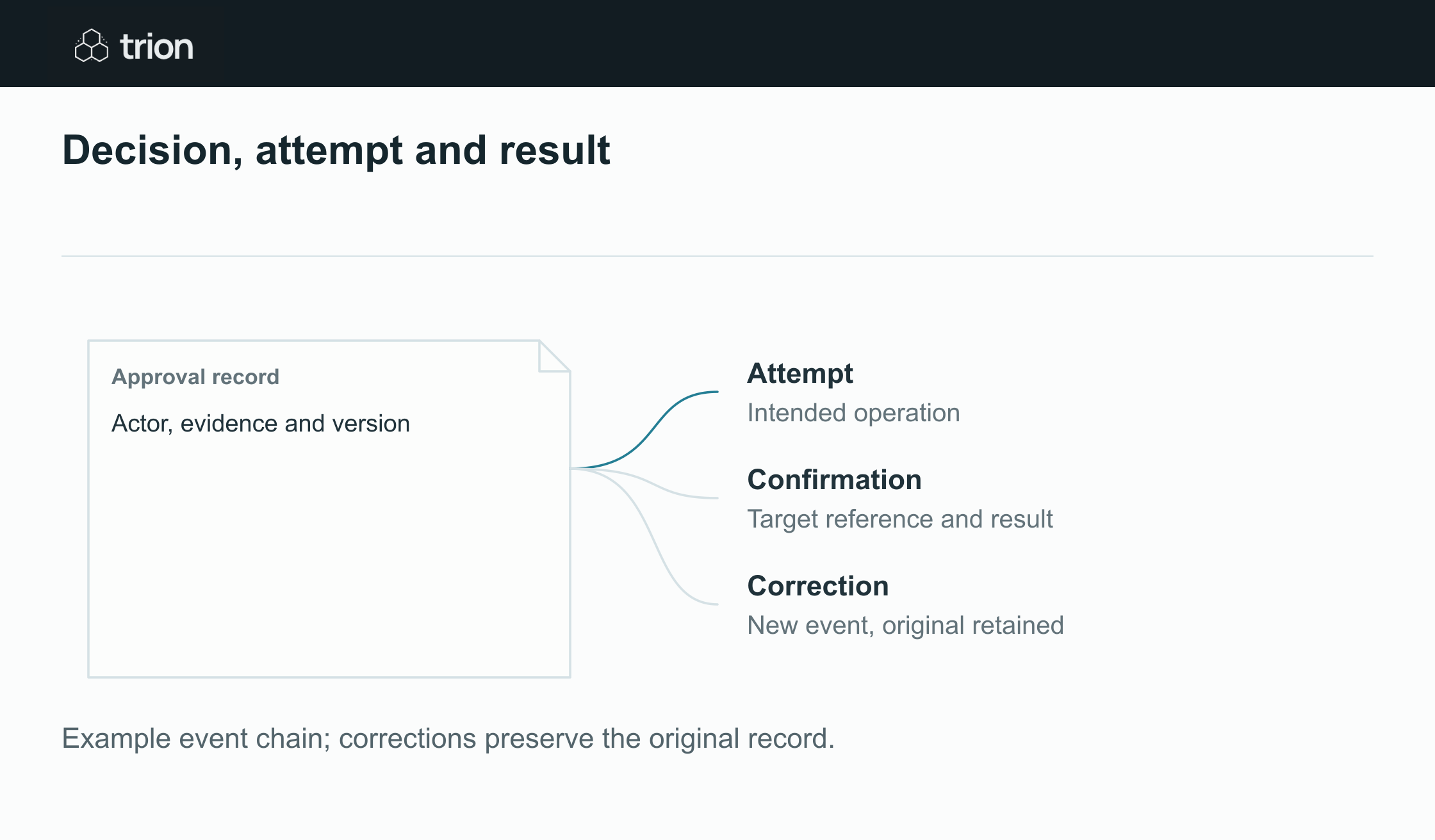

Decision, attempt and result
- Attempt
- Intended operation
- Confirmation
- Target reference and result
- Correction
- New event, original retained
| Evidence | Meaning |
|---|---|
| Attempt | Intended operation |
| Confirmation | Target reference and result |
| Correction | New event, original retained |
Example event chain; corrections preserve the original record.
Record the workflow and rule versions too. “Approved because below the limit” is incomplete if nobody can identify which limit applied. Keep a reference to the effective policy and the values used, rather than relying on today’s settings to explain yesterday’s decision.
Represent intent and outcome separately
A reviewer clicking Approve creates decision evidence. A request sent to an API creates attempt evidence. A response or reconciled target record creates outcome evidence. These events can happen at different times and have different failure conditions.
When an order request times out, record the outcome as uncertain. Preserve the intended operation and its reference while an owner checks the target system. Do not convert uncertainty into “not created” because the client lacked a response. The eventual confirmation belongs in a new event linked to that attempt.
For a partly completed workflow, show confirmed steps and unresolved steps individually. An order can exist while its accounting handoff remains blocked. A complete-looking case label should never replace the evidence explaining that distinction.
Add corrections without erasing the original
Suppose the receiving clerk records 18 accepted units, then checks the delivery and corrects the count to 16. Retain the original event and append a correction containing the revised quantity, reason, actor and original event reference. The current view can show 16 while the history explains why it changed.
A correction must respect its own authority rules. Changing a description and changing an accepted financial amount may require different reviewers. If later actions used the old value, list those dependent records for review rather than silently rewriting them.
Protect evidence without copying everything into logs
Store source documents in their controlled repository and reference them from events. OWASP advises excluding secrets such as access tokens and passwords from ordinary logs. Apply that principle to business evidence too: an investigator may need a document reference without needing every bank detail repeated across diagnostic systems.
Define who can read, append and export the trail. Agree retention and correction requirements with the relevant policy owners. Restricted write access and backups improve integrity, but neither automatically proves that a record is immutable or meets a particular legal standard.
Test one investigation from end to end
Choose a prepared case containing a revision, rejection, resubmission, timeout and correction. Ask a reviewer who did not build the workflow to explain its final state using only the event history and authorized source links. Missing references will become obvious quickly.
Also test a repeated event, a late confirmation and a logging outage. Decide which consequential actions must stop when required evidence cannot be recorded. A recoverable diagnostic failure and a missing approval record should not receive the same treatment.
Include an independent investigation exercise in the acceptance criteria for a Trion workflow.