
OpenClaw connects skill discovery with recoverable agent work
A larger library of agent capabilities can create a smaller usability problem: finding the right one. OpenClaw’s October release addresses discovery alongside app-based work and recovery, bringing attention to the operating environment around the model.
What the release adds
The official 2026.10.1 release was published on 10 October. Its detailed notes describe searching installed skills without loading the entire library into a conversation. Compatible, opt-in MCP Apps can provide forms and workspace-file interactions beside chat. Full backups can now use external storage or Cloudflare R2 and restore into a fresh staging directory.
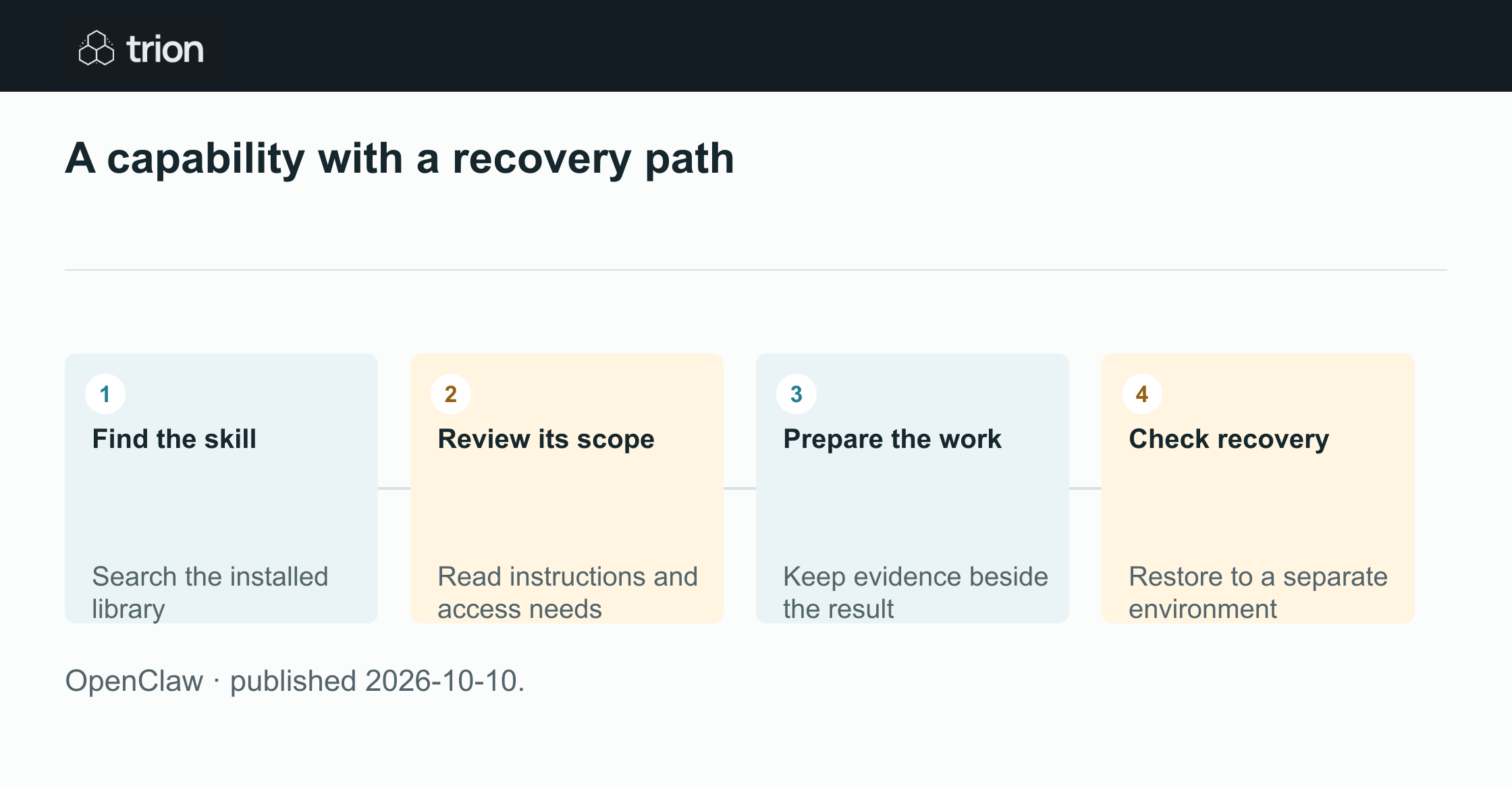

A capability with a recovery path
- Find the skill
Search the installed library
- Review its scope
Read instructions and access needs
- Prepare the work
Keep evidence beside the result
- Check recovery
Restore to a separate environment
- Find the skillSearch the installed library
- Review its scopeRead instructions and access needs
- Prepare the workKeep evidence beside the result
- Check recoveryRestore to a separate environment
OpenClaw · published 2026-10-10.
Discovery follows the agent’s existing read permissions; finding instructions does not grant permission to execute them. Scheduled backups are optional. These are specific capabilities and configuration choices, rather than a promise that every connected workflow is recoverable automatically.
Use discovery to reduce setup work
Consider a buyer preparing a quotation comparison. The buyer should describe the intended result, while the system locates a relevant, approved procedure. That procedure still needs to preserve source versions, missing costs and the person responsible for acceptance. A matching skill name alone says little about those requirements.
A practical evaluation starts with a familiar task and a deliberately similar alternative. Can the agent choose the right procedure and explain what it needs? Give it an incomplete quotation too. The useful response identifies the missing freight amount rather than selecting another capability merely to produce a complete-looking total.
Make recovery part of the trial
The following checks are a proposed evaluation, not a report of tests performed by Trion. Use a disposable environment with non-sensitive records. Recovery should be demonstrated before the workflow becomes difficult to replace.
Keep a recognizable starting point
Prepare one request, two source files and a comparison with a known unresolved item. Record the configuration needed to reproduce it. Avoid using a successful chat response as the only record of what the environment contains.
Restore separately
Restore a backup into a separate location and inspect the recovered records before activation. Check file versions, credentials and outstanding work. Keep any external actions disabled during this inspection so a recovery exercise cannot contact a supplier.
Ask another person to continue
Have a colleague identify the accepted inputs and the remaining question. If they must reconstruct the original conversation, improve the working record. A restored system is useful when someone can resume the business task accurately.
Original sources
- OpenClaw: original release notesgithub.com
- OpenClaw: 2026.10.1 detailed release notesdocs.openclaw.ai