
OpenClaw beta focuses on work that survives a restart
An agent that continues working after a restart needs more than a reassuring progress indicator. OpenClaw’s new beta makes recovery a visible release theme, offering a concrete reason to test what survives an interrupted session.
A prerelease with continuity changes
OpenClaw published 2026.10.5-beta.1 on 11 October as a prerelease. Its notes describe resuming interrupted turns and deferred tasks after a Gateway restart. The beta also adds an X mentions channel with streaming and API cost limits, plus voice-call briefs, reports, callbacks and voicemail detection.
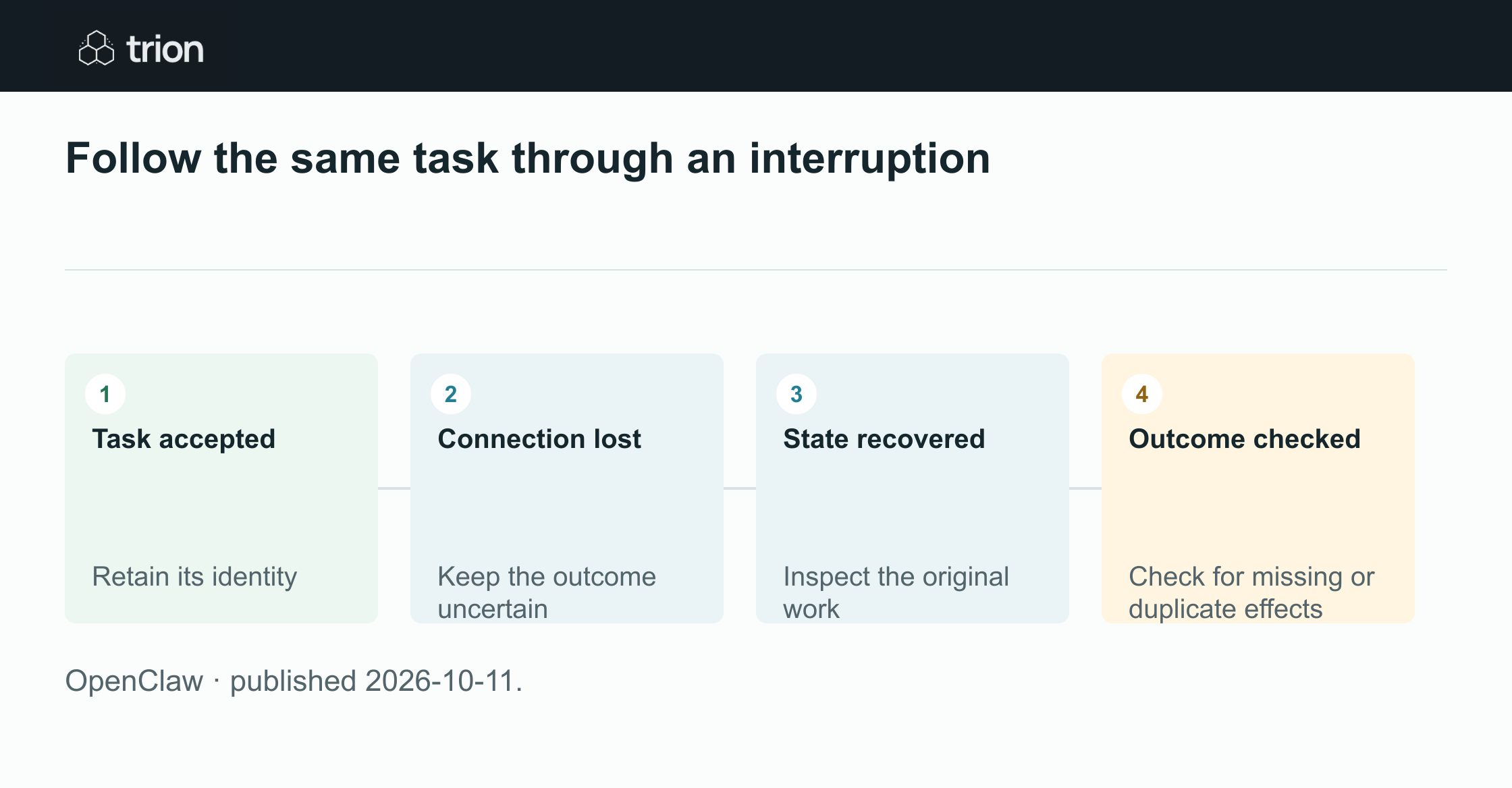

Follow the same task through an interruption
- Task accepted
Retain its identity
- Connection lost
Keep the outcome uncertain
- State recovered
Inspect the original work
- Outcome checked
Check for missing or duplicate effects
- Task acceptedRetain its identity
- Connection lostKeep the outcome uncertain
- State recoveredInspect the original work
- Outcome checkedCheck for missing or duplicate effects
OpenClaw · published 2026-10-11.
These are release-note claims for beta software, not evidence that a particular business process will recover correctly. Treat the prerelease as an evaluation candidate in an isolated setup. Keep any decision to adopt it separate from the availability of its new features.
The difficult case is a missing acknowledgement
Imagine an assistant preparing a supplier follow-up. The connection disappears after the receiving service accepts the request but before the interface displays confirmation. Repeating the request could send a duplicate. Declaring it failed could hide a successful action. The correct starting point is uncertainty about that specific operation.
A dependable workflow needs a task identity, the last confirmed state and a way to inspect the receiving system. The interface should distinguish lost contact from cancelled work. A person checking progress should see what is known, what remains uncertain and which action would resolve that uncertainty.
Try the recovery path before live work
This suggested test uses harmless local outputs rather than real messages or orders. It evaluates continuity around the agent; it does not assume the beta implements every safeguard described here.
Define an observable result
Ask for a small report with a unique task reference in a disposable workspace. Record the expected output and where it should appear. Keep a separate count of accepted tasks and resulting files so duplicate work is detectable.
Interrupt at different moments
Restart during preparation, during execution and after an output appears. On reconnection, inspect the original task before submitting anything again. Record whether progress resumes, stops with an explanation or remains uncertain.
Inspect the whole outcome
Check the final file, the task history and any repeated operation. Include a deliberate cancellation: stopped work should not quietly return as a new task. Have another reviewer identify the result without relying on the original operator’s memory.
Original sources
- OpenClaw: original release notesgithub.com