
Agent Knock Knock adds native Codex task control
Agent Knock Knock is an independent open source project for controlling existing coding-agent sessions. Its October release offers a useful case study in a deceptively difficult problem: knowing which task an automation actually started.
Control stays attached to the original task
The project’s 0.14.0 changelog, dated 10 October, documents native control of loaded Codex CLI conversations and supported desktop conversations. It describes durable submission identity, task-specific monitoring and no automatic resend after an uncertain submission. Desktop writes in that release require a specifically reviewed macOS build. This is a third-party project update, not an OpenAI release.
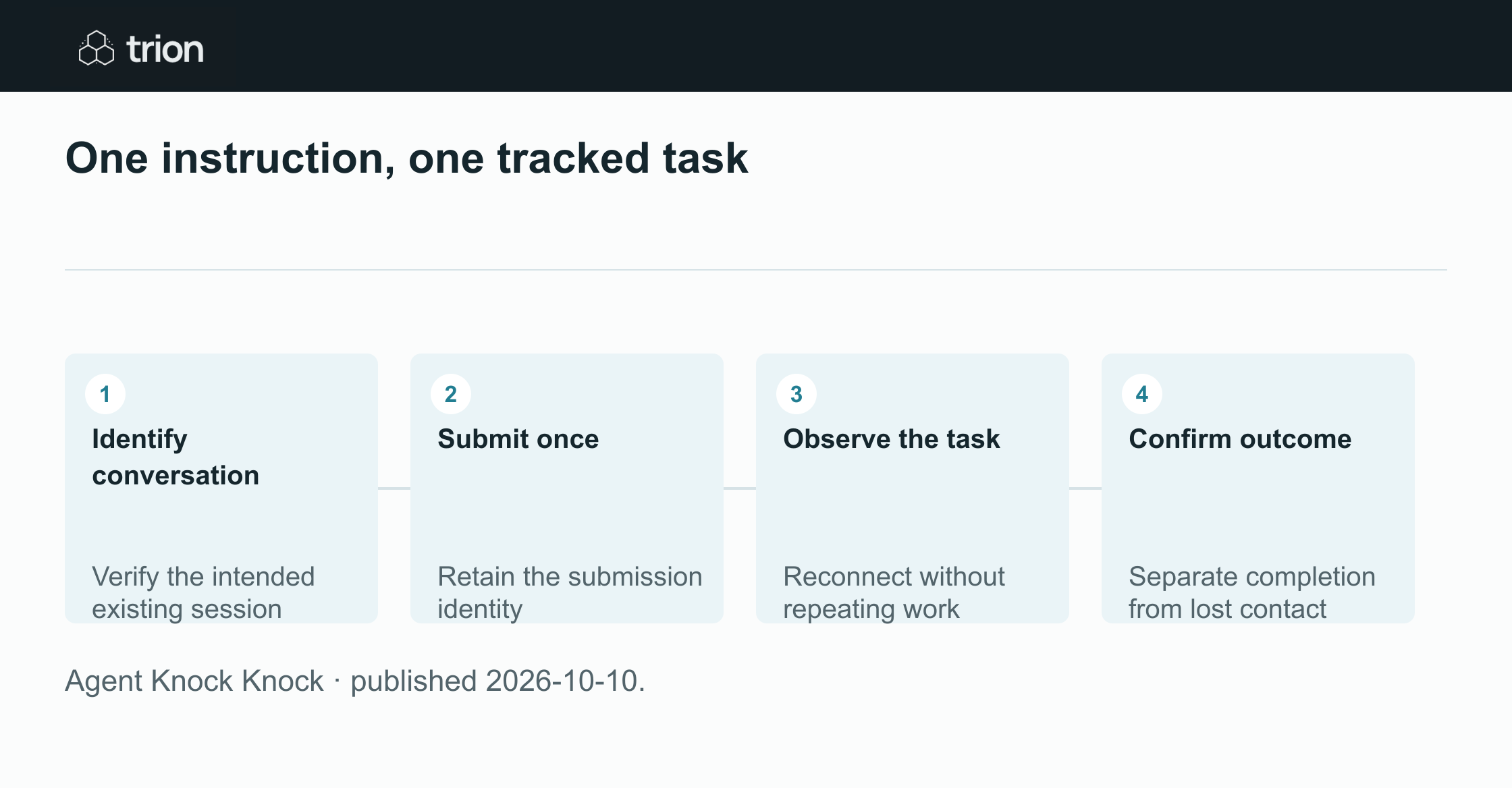

One instruction, one tracked task
- Identify conversation
Verify the intended existing session
- Submit once
Retain the submission identity
- Observe the task
Reconnect without repeating work
- Confirm outcome
Separate completion from lost contact
- Identify conversationVerify the intended existing session
- Submit onceRetain the submission identity
- Observe the taskReconnect without repeating work
- Confirm outcomeSeparate completion from lost contact
Agent Knock Knock · published 2026-10-10.
The release boundary matters. Seeing a conversation in a list does not establish that a controller can safely send work to it. Nor does compatibility with one reviewed application build establish support for every newer version. Evaluate the exact setup you intend to operate.
A dropped connection is an uncertain outcome
Suppose a controller sends an instruction to create a report, then loses contact before receiving confirmation. Starting the instruction again might create a duplicate; assuming nothing happened could leave completed work unnoticed. The system needs a durable identity it can use to reconcile the original request.
The same distinction applies beyond coding. A purchasing workflow should not submit a second order merely because its first acknowledgement was lost. A status view needs to distinguish not submitted, accepted, running, completed and unknown, with recovery appropriate to each state.
Evaluate recovery on harmless work
The following is a proposed controller test, not a report that Trion has run this project. Use a disposable workspace and a task with an easily counted result before allowing consequential operations.
Confirm the target
Choose an existing conversation by project and identity. Check that the displayed target remains the execution target when another conversation becomes active. A friendly title alone is not a unique identifier.
Interrupt observation
Reconnect the monitoring side while a harmless task runs. Verify that observation resumes for the original task and does not submit new work. Count the resulting files or records to detect duplicates.
Separate stopping from cancelling
Check what each control actually ends: the status watch, the controller’s management or the underlying task. Label those actions clearly so closing a panel does not give a false impression that execution stopped.