
OpenAI reports two false-front influence operations
OpenAI reports disrupting two influence operations that used AI while presenting themselves as journalists or research organizations. The investigation shows how false identities can give fabricated material an appearance of authority.
The identity behind a document matters
The OpenAI investigation describes a Russia-linked operation called Dark Clark and an Iran-origin operation called Bogus Bylines. The latter used deceptive bylines to pitch long-form articles; the former included fake communications and a self-described research platform.
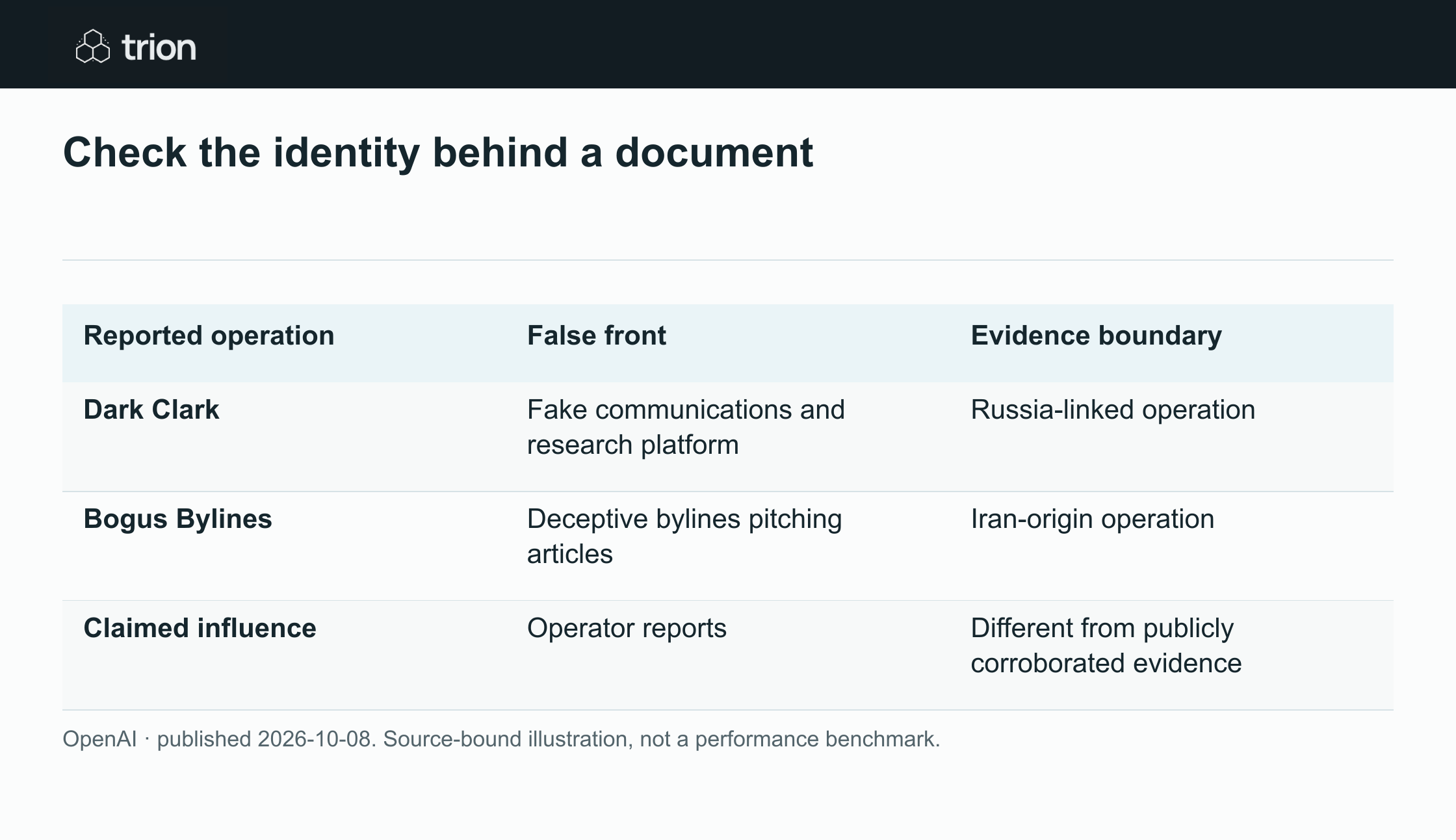

Check the identity behind a document
- Dark Clark
- False frontFake communications and research platform
- Evidence boundaryRussia-linked operation
- Bogus Bylines
- False frontDeceptive bylines pitching articles
- Evidence boundaryIran-origin operation
- Claimed influence
- False frontOperator reports
- Evidence boundaryDifferent from publicly corroborated evidence
View data
| Reported operation | False front | Evidence boundary |
|---|---|---|
| Dark Clark | Fake communications and research platform | Russia-linked operation |
| Bogus Bylines | Deceptive bylines pitching articles | Iran-origin operation |
| Claimed influence | Operator reports | Different from publicly corroborated evidence |
OpenAI · published 2026-10-08. Source-bound illustration, not a performance benchmark.
Download imageOpenAI separates operators’ own claims of influence from evidence it could corroborate publicly. That distinction is consequential: some internal reports took credit for events the operators had not caused. The report presents a disruption and an evidence trail, not a general detector that can classify any suspicious document.
Original sources
- OpenAI: original research reportopenai.com
Checked 9 Oct 2026 · A manually curated edition. Availability may change; company performance claims are not Trion test results. Editorial method.