
OpenAI outlines its EU text provenance approach
OpenAI has outlined a phased approach to marking generated text in response to EU provenance requirements. Its announcement treats watermarking as a useful but limited signal about where text came from.
Different rollout paths for the API and ChatGPT
The OpenAI provenance update makes text watermarking an opt-in choice for select API models globally, with the API default remaining off. Eligible ChatGPT and Codex text output in the European Union will receive an invisible watermark over the following weeks.
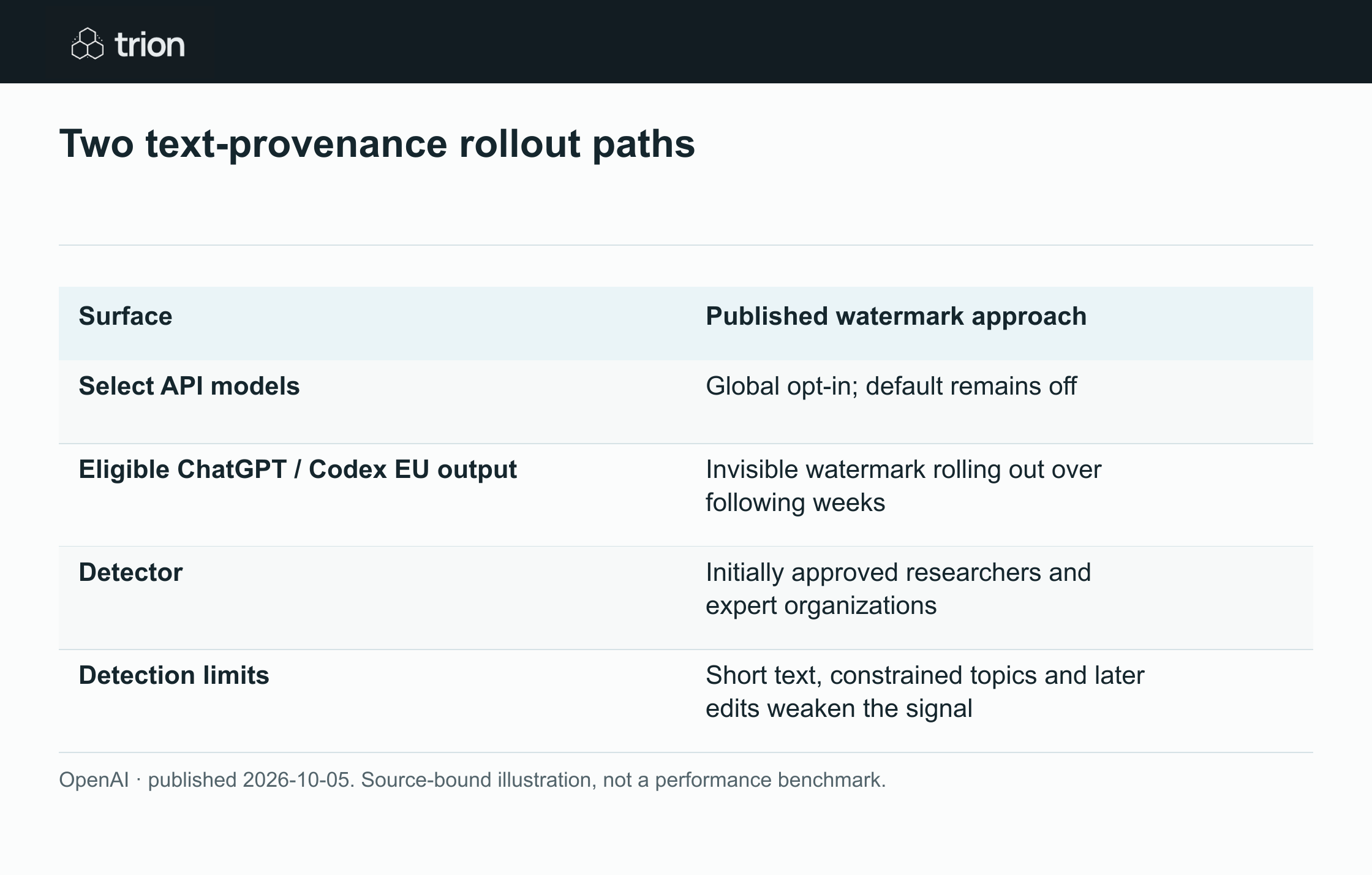

Two text-provenance rollout paths
- Select API models
- Global opt-in; default remains off
- Eligible ChatGPT / Codex EU output
- Invisible watermark rolling out over following weeks
- Detector
- Initially approved researchers and expert organizations
- Detection limits
- Short text, constrained topics and later edits weaken the signal
View data
| Surface | Published watermark approach |
|---|---|
| Select API models | Global opt-in; default remains off |
| Eligible ChatGPT / Codex EU output | Invisible watermark rolling out over following weeks |
| Detector | Initially approved researchers and expert organizations |
| Detection limits | Short text, constrained topics and later edits weaken the signal |
OpenAI · published 2026-10-05. Source-bound illustration, not a performance benchmark.
Download imageDetector access initially requires approval for researchers and expert organizations. OpenAI describes a statistical signal in word choices and notes that short passages, constrained subject matter and later edits can weaken detection. The watermark does not establish that the text’s assertions are accurate.
Original sources
- OpenAI: original announcementopenai.com
Checked 9 Oct 2026 · A manually curated edition. Availability may change; company performance claims are not Trion test results. Editorial method.