
Separate an answer from a search hit
RAG retrieves relevant material and supplies it to a language model when preparing a response. Microsoft’s overview describes grounding in proprietary content and highlights query understanding, content preparation, token limits and access controls. Retrieval makes evidence available; it does not establish that every generated conclusion follows from that evidence.
Distinguish a directly supported instruction, an interpretation and an unresolved question. A link to a whole handbook may be insufficient when the conclusion depends on a specific exception. Preserve the passage, its document version and the relationship between that passage and the answer.
Select only evidence the user may read
Begin with a source register. Name the owner, audience, effective date and replacement relationship for each source. Remove obsolete material from the current-answer path while retaining it for historical questions. Keep draft procedures distinct from accepted instructions.
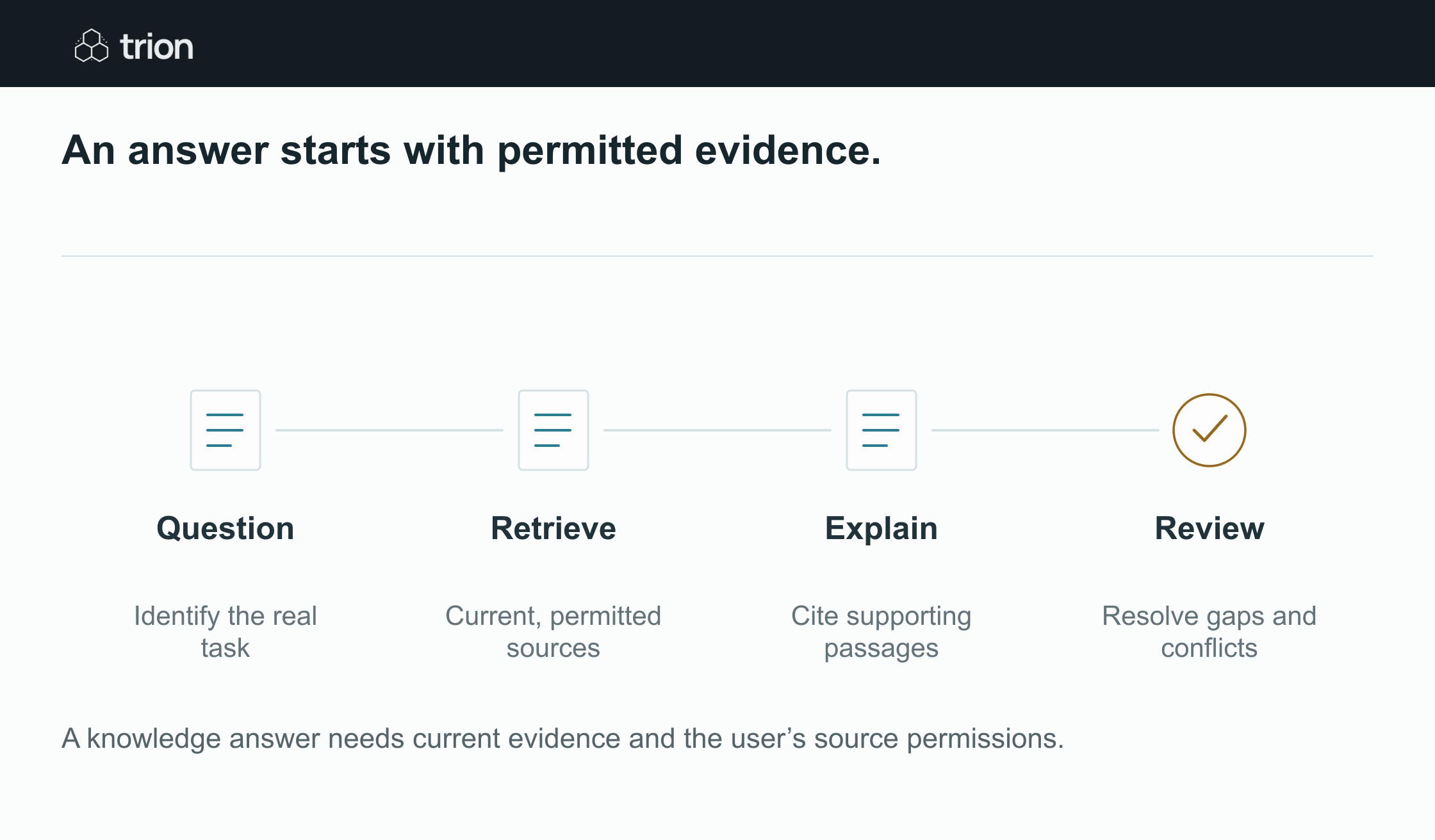

An answer starts with permitted evidence.
- Question
- Identify the real task
- Retrieve
- Current, permitted sources
- Explain
- Cite supporting passages
- Review
- Resolve gaps and conflicts
| Evidence | Meaning |
|---|---|
| Question | Identify the real task |
| Retrieve | Current, permitted sources |
| Explain | Cite supporting passages |
| Review | Resolve gaps and conflicts |
A knowledge answer needs current evidence and the user’s source permissions.
Enforce access in the retrieval layer before protected content reaches the model. A request for a summary should not bypass the permissions on its source files. Test this with different legitimate roles, including a user who cannot read a document that another user can. A helpful refusal or narrower answer is preferable to exposing the unavailable material indirectly.
Work through an equipment-return question
Consider an operations team asking, “Where should a failed workshop sensor go?” Its current service guide says to contact the support desk before shipment. An older warehouse note names a return address, and a supplier email proposes a different route for one particular unit.
The proposed answer should identify the current service instruction and its supporting passage. It should explain that the supplier email concerns a particular unit, ask for the unit reference if necessary and leave the shipping address unresolved until the correct route is confirmed. Relevance, recency and authority are separate checks; the newest message does not automatically replace the procedure.
| Source | Treatment |
|---|---|
| Current service guide | Use its stated procedure and cite the section. |
| Superseded warehouse note | Retain for historical lookup; exclude from current instructions. |
| Unit-specific supplier email | Check the unit and applicability before applying its exception. |
Build a small retrieval test
- Write questions colleagues actually ask, using both ordinary wording and the terminology in the source.
- Identify the passages that support each answer before running the assistant.
- Add a conflicting revision, missing answer and permission-restricted source.
- Inspect retrieval separately from the generated response.
- Record whether the final answer preserves conditions, evidence and uncertainty.
A failed answer can originate before generation: the relevant source may be absent, incorrectly split or ranked below an outdated passage. Fix that problem at its actual location. Rewriting the answer prompt cannot reliably compensate for evidence that never reaches the model.
Operate the source lifecycle
Assign responsibility for updates, withdrawal and replacement. When a procedure changes, record which version is authoritative and check when the retrieval index reflects it.
Record enough about each answer to investigate a challenge: the question, permitted source identities, versions and accepted response. Avoid keeping unnecessary private document contents in logs. For a review with Trion, identify the evidence maintainer and owner of unsupported questions.
Know when retrieval is not the next step
A current stock balance may require a supported system lookup rather than a passage from a document. An exception requiring approval needs a decision from the responsible person. Show which route applies and who owns the next action; a retrieved passage cannot authorize a record change.