
Ticket routing needs to answer two questions: which team can handle the work, and who can take it now? A category alone cannot account for language, product expertise, availability, workload, or a ticket that changes after its first response.
Separate classification from assignment
Dynamics 365 unified routing distinguishes classification, which adds information to a work item, from assignment based on requirements and workforce conditions such as skills, availability, and workload. This is a useful platform example of why detecting a topic and choosing a representative are separate operations. Microsoft’s routing overview.
Define a ticket’s required language, product skill, verified customer entitlement, issue type, urgency basis, and expected effort. Some fields can come from authoritative customer records. AI can propose an issue type from message text, with evidence. Keep uncertainty visible where the information cannot be verified.
Make eligibility a gate
A representative is eligible only if the required skills, access, and permitted work type match. Then assess presence and available capacity. Do not assign a restricted-account case to an unqualified person merely because they have the shortest queue.
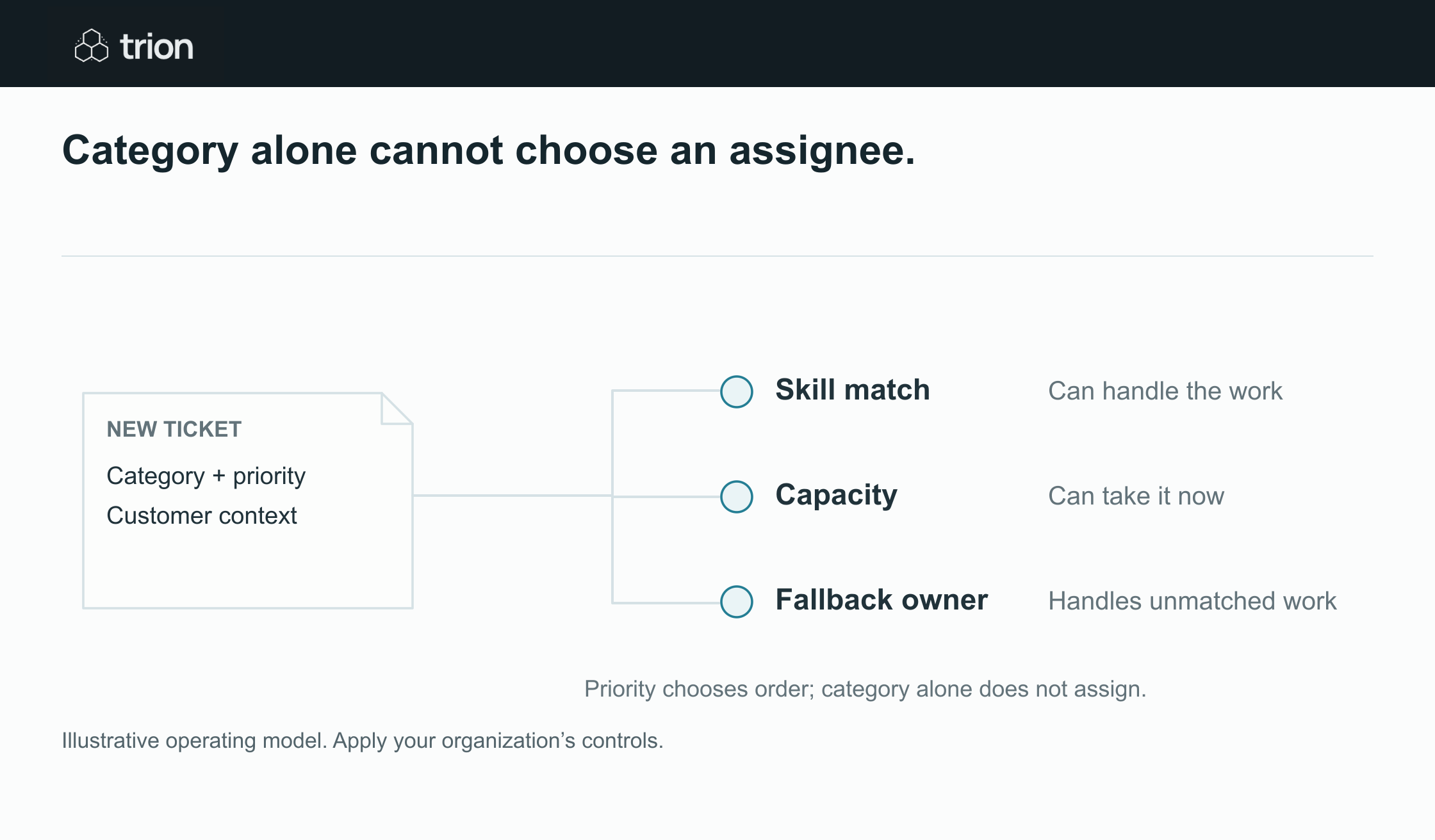

Category alone cannot choose an assignee.
- Skills
- Who can handle this?
- Capacity
- Who can take it now?
- Priority
- What should go first?
- Fallback
- Who owns unmatched work?
View data
| Evidence | Meaning |
|---|---|
| Skills | Who can handle this? |
| Capacity | Who can take it now? |
| Priority | What should go first? |
| Fallback | Who owns unmatched work? |
Illustrative operating model. Apply your organization’s controls.
Download imageFor a fictional support team, Maya has capacity for eight internal work points and currently carries six. Karim has capacity for four and carries four. Both speak the required language, but only Maya can take a new two-point case. A three-point case fits neither person and should remain visible in the queue. Work points here are a made-up planning unit, not a platform standard.
| Representative | Required skill | Free capacity | Two-point case |
|---|---|---|---|
| Maya | Matches | 2 points | Eligible if present |
| Karim | Matches | 0 points | Keep queued |
| Other team | Missing required skill | 5 points | Ineligible despite spare capacity |
Define priority with an explanation
Record why the ticket has its priority: verified service interruption, an agreed response commitment, or another approved criterion. An angry phrase or a VIP label should not silently invent a new service promise. Let the policy owner define how those signals affect escalation.
Preserve the original arrival time when an item is reclassified or moved. Otherwise repeated transfers can reset its apparent age. Add an aging rule so lower-priority work does not remain invisible indefinitely, and identify the team lead who reviews tickets that exceed the agreed wait.
Specify the no-match behavior
A route is incomplete if it works only when someone is immediately eligible. Define separate reasons for missing skill, full capacity, unavailable team, incomplete entitlement data, and uncertain classification. Each should have an owner and a next check.
Do not make silent reassignment the default repair. A transfer should carry the reason, current notes, customer commitments, and required action. Prevent two representatives from accepting the same item simultaneously by using the platform’s supported assignment and claim behavior.
Use this routing policy worksheet
- Required fields: issue, product, language, entitlement source, urgency evidence.
- Eligibility: required skills, access, work type, and presence rule.
- Capacity: effort unit, capacity limit, and when capacity is released.
- Priority: ranking rule, tie-breaker, arrival timestamp, and aging rule.
- No match: reason code, responsible queue, review time, and escalation owner.
- Transfer: permitted triggers, preserved context, and acceptance confirmation.
Test a high-priority item when all qualified representatives are busy, a language mismatch, a returning customer reply, and a ticket with two issue types. Measure transfer rate, queue age, capacity accuracy, and unresolved reasons. Use the readiness tool to capture policy and account-access gaps. Good routing makes constraints explicit; it does not create capacity or authority the team lacks.