
Accounts payable automation should make a liability traceable from its source document through validation and authorized posting. It should also preserve credits, duplicates, and exceptions as separate records. Receiving a readable invoice does not establish that the amount is due or approved for payment.
Start with one invoice register
Give each received document a source reference, supplier identity, document type, invoice or credit reference, date, currency, amount, related purchase record, and review state. Preserve the original document and extraction evidence. A new email containing an existing invoice should create another source relationship, not another liability.
Microsoft’s vendor invoice automation includes configurable receipt matching, workflow submission, and posting simulation for supported vendor invoices. It explicitly distinguishes those invoices from journal routes. A product capability therefore needs to be checked against the transaction types and configuration your organization uses. Vendor invoice automation overview.
Route by the evidence required
| Transaction | Evidence to request | Exception owner |
|---|---|---|
| PO goods | Approved order, relevant receipts, line and charge checks | Purchasing or receiving owner |
| Services | Approved engagement, service acceptance, agreed billing basis | Service budget owner |
| No purchase reference | Business purpose, correct owner, approval under policy | Finance-designated reviewer |
| Advance invoice | Explicitly approved advance terms and applicable purchasing record | Authorized finance reviewer |
| Credit note | Original invoice relationship and reason for adjustment | Accounts payable owner |
These routes are a planning worksheet, not accounting or tax policy. Finance defines the evidence, treatment, tolerances, and authorized actions. Do not force a service invoice into a goods-receipt test if that evidence does not exist for the transaction.
Keep credits and duplicates visible
In a fictional example, supplier invoice INV-084 requests $2,200. The supplier emails the same PDF again and later issues credit CN-012 for $200. The repeat PDF is a duplicate submission candidate. The credit is a new financial document that needs to be connected to the original invoice and reviewed.
If the credit is accepted under the company’s policy, the net amount represented by the two documents is $2,000. That arithmetic does not authorize posting or payment. Keep the original invoice amount, credit amount, connection, and approval evidence rather than overwriting the original invoice with a smaller total.
Check duplicate candidates using supplier identity and document reference, with date, currency, amount, and source evidence as additional signals. Do not treat the invoice reference as globally unique across every supplier. Record why a suspected duplicate was retained or excluded.
Distinguish matching from approval
Microsoft defines invoice matching as comparing invoice, purchase order, and receipt information, with policy and tolerance settings determining discrepancies. Matching is a configured control, not a general confirmation that every commercial or accounting question is resolved. Invoice matching overview.
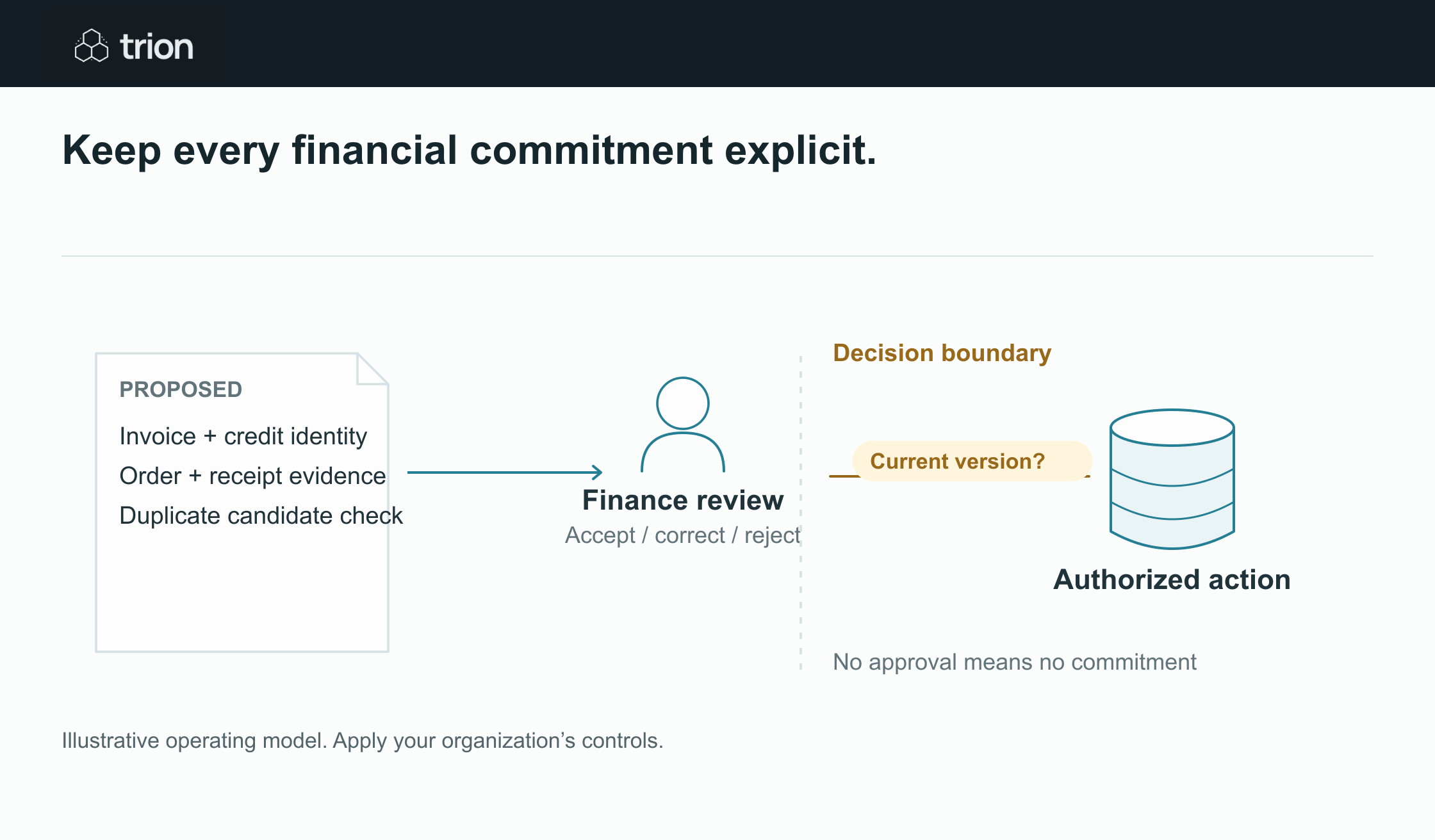

Keep every financial commitment explicit.
- Register
- Invoice, credit or candidate duplicate
- Match
- Order and receiving evidence
- Approve
- Authorized liability decision
- Post
- Controlled finance update
View data
| Evidence | Meaning |
|---|---|
| Register | Invoice, credit or candidate duplicate |
| Match | Order and receiving evidence |
| Approve | Authorized liability decision |
| Post | Controlled finance update |
Illustrative operating model. Apply your organization’s controls.
Download imageUse the three-way match tool to explore goods-line comparisons. Keep unmatched charges, revised terms, missing acceptance, and supplier-detail changes in named review routes. The existing partial-receipt guide covers split-delivery quantities in more detail.
Separate the last two commitments
Posting a liability and authorizing a payment are different actions. Define each authority in the approval matrix tool, then confirm it with finance. Changed banking or payment instructions require the organization’s independent verification process; an invoice attachment should not update those details automatically.
For every unresolved invoice, record the exception reason, owner, due date, and next evidence required. Pilot duplicate submissions, service invoices, credits, advances, and invalid supplier references before integrating write actions. Extraction needs representative documents and account access; legal, tax, posting, and payment decisions remain with the authorized people.