
Claude-assisted research finds a novel enzyme system
Anthropic reports finding a novel enzyme system through research with Claude. The system has properties reminiscent of CRISPR, but its biological function is still unknown.
A hypothesis pipeline reaches the laboratory
The research report introduces an Anthropic life-sciences research group and lab. Its approach combines exploring DNA datasets, proposing hypotheses and testing them experimentally. Claude helped identify a system involving a reverse transcriptase and an array of repeating sequences.
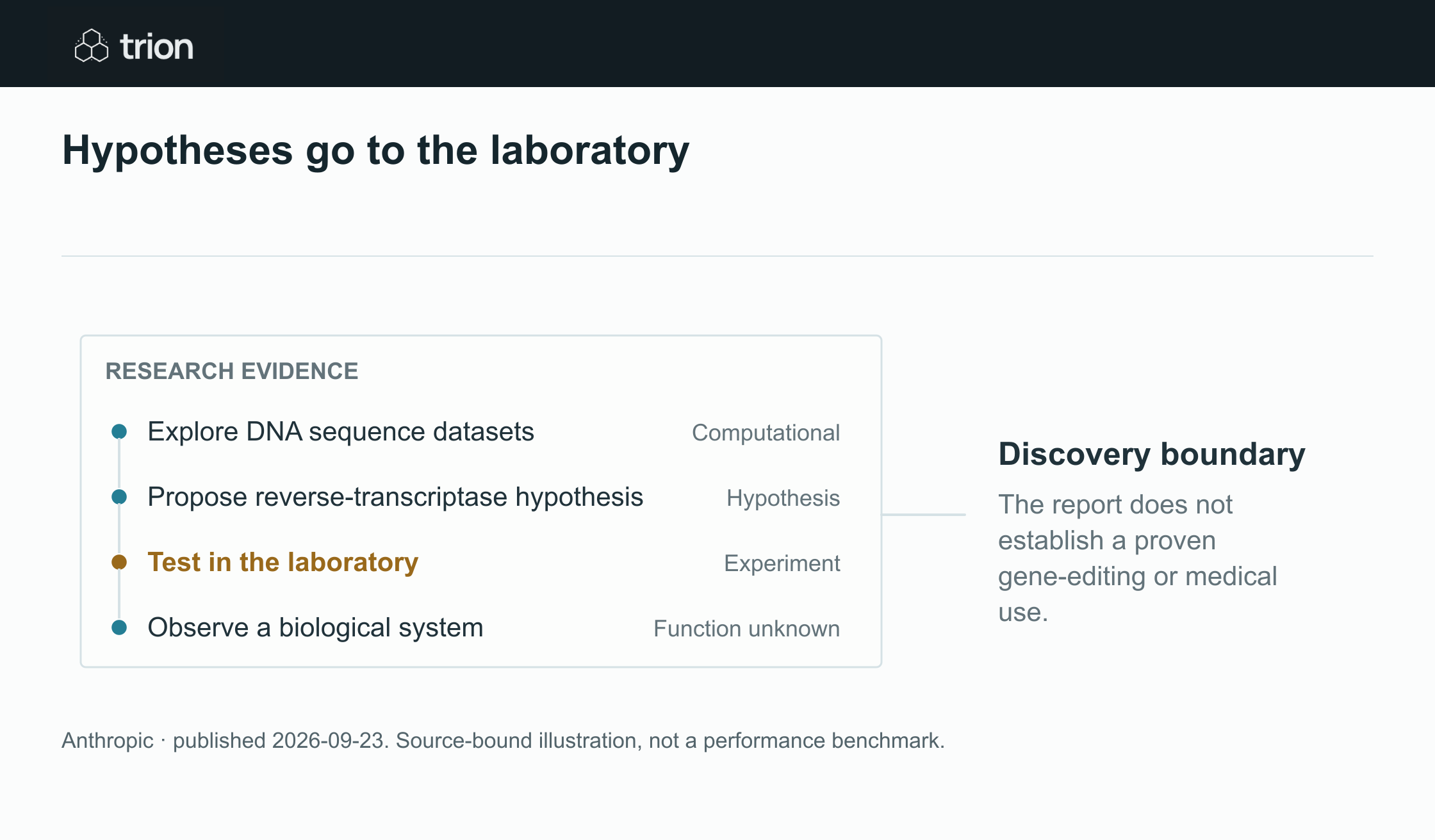

Hypotheses go to the laboratory
- DNA datasets
- Explore biological sequences
- Proposed hypothesis
- Reverse transcriptase and repeat array
- Experimental test
- Laboratory investigation
- Observed system
- Unknown function; no proven editing or medical use
View data
| Evidence | Meaning |
|---|---|
| DNA datasets | Explore biological sequences |
| Proposed hypothesis | Reverse transcriptase and repeat array |
| Experimental test | Laboratory investigation |
| Observed system | Unknown function; no proven editing or medical use |
Anthropic · published 2026-09-23. Source-bound illustration, not a performance benchmark.
Download imageAnthropic says the combination of characteristics is unusual and potentially interesting. That does not make it a proven gene-editing tool or establish a medical application. The distinction between an observed system, its unknown function and a future use is central to reading the result accurately.
Original sources
- Anthropic: original research reportwww.anthropic.com
Checked 9 Oct 2026 · A manually curated edition. Availability may change; company performance claims are not Trion test results. Editorial method.