
n8n shows how to build a quieter AI news digest
A useful news brief should save attention, not create another queue. A new n8n tutorial offers a concrete way to make selection happen before a model writes the summary.
Filter before writing
The 13 October n8n tutorial, a guest post by You.com engineer Tyler Eastman, combines You.com search, Jev relevance scoring and cited research with Slack delivery. Previously seen items are skipped. A topic without a material development produces no post. Jev remains in early access, so reproducing the template depends on obtaining access.
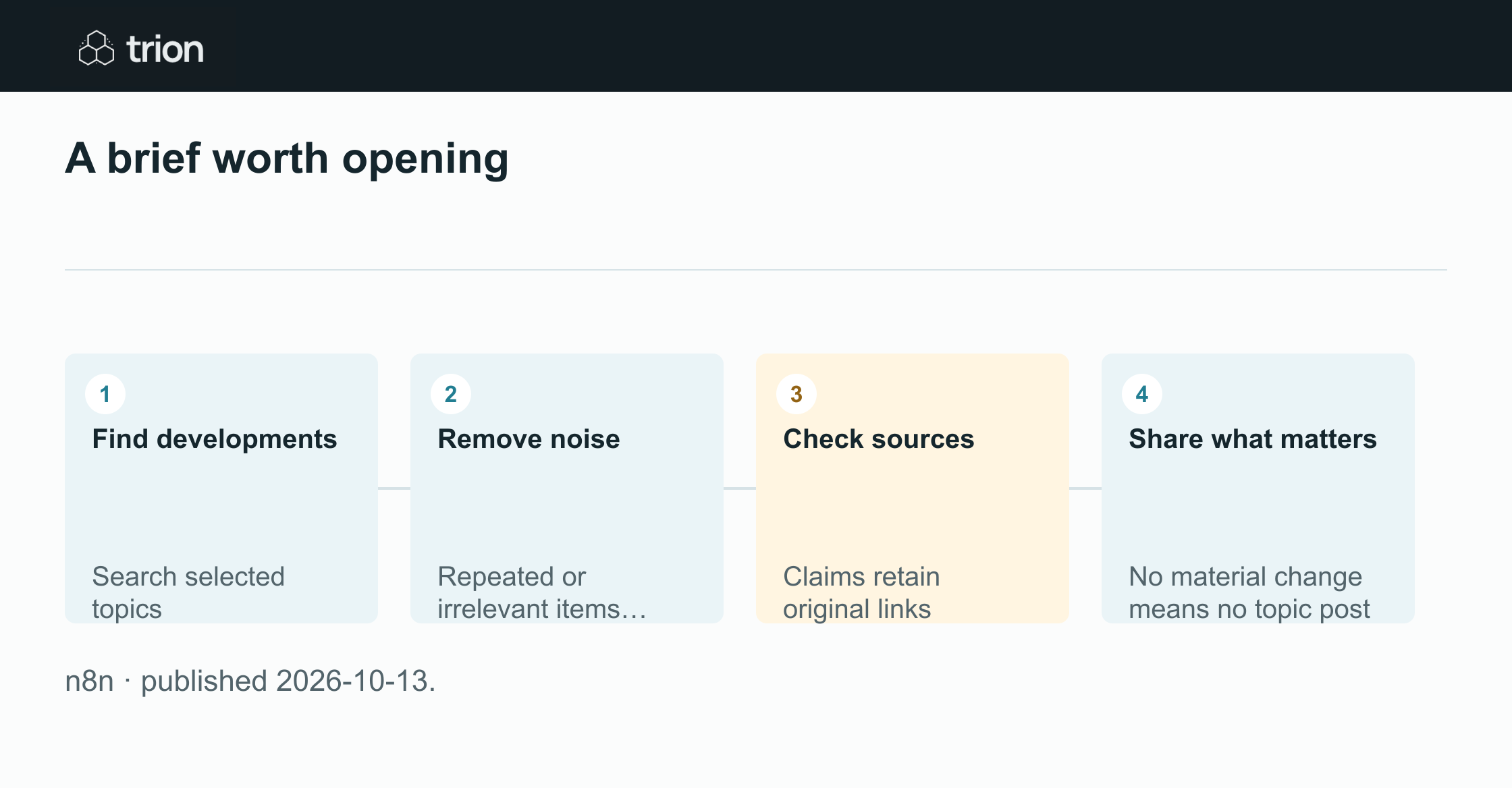

A brief worth opening
- Find developments
Search selected topics
- Remove noise
Repeated or irrelevant items leave the flow
- Check sources
Claims retain original links
- Share what matters
No material change means no topic post
- Find developmentsSearch selected topics
- Remove noiseRepeated or irrelevant items leave the flow
- Check sourcesClaims retain original links
- Share what mattersNo material change means no topic post
n8n · published 2026-10-13.
For a team evaluating this pattern, the useful question is whether the brief changes a decision. A procurement manager might need a supplier policy change or a connector being withdrawn; a broad digest of model launches could remain accurate while missing both. Start from the decisions the reader owns, then define what would make a development relevant.
Try a small editorial test
This is a suggested evaluation, not a claim about the template’s measured accuracy. Use a small set of public announcements that includes an important change, repeated coverage, an opinion article and an update with a future effective date. Decide the expected treatment before running the workflow.
Write one reader’s brief
Describe one role and its decisions. For example, a support operations lead cares about integration availability, service limits and changes to customer data handling. Avoid an instruction as broad as “important AI news.”
Review what was excluded
Inspect rejected items as well as the finished summary. A quiet output can mean good filtering or a missed development. Keep the original URL, decision and reason long enough to diagnose the difference.
Check each actionable claim
Open the source for any date, price or availability statement that could change a plan. Record whether the brief distinguishes an announcement from general availability. Correct the filtering rule when the same type of mistake recurs.
Make silence observable
Readers do not need a daily message saying nothing happened. Operators still need to know the run completed. Keep execution health separate from editorial output so a failed search is not mistaken for a quiet day.
After a trial, ask which items led to useful follow-up and which caused unnecessary reading. That feedback is more informative than counting summaries produced. A smaller brief can be the better result.
Original sources
- n8n: original tutorialblog.n8n.io