Microsoft shares what built trust in its support agent
Microsoft’s employee support research found that accurate answers alone were not enough to win adoption. People also needed confidence that the agent understood their situation and could get them to a useful resolution.
Trust follows the whole support journey
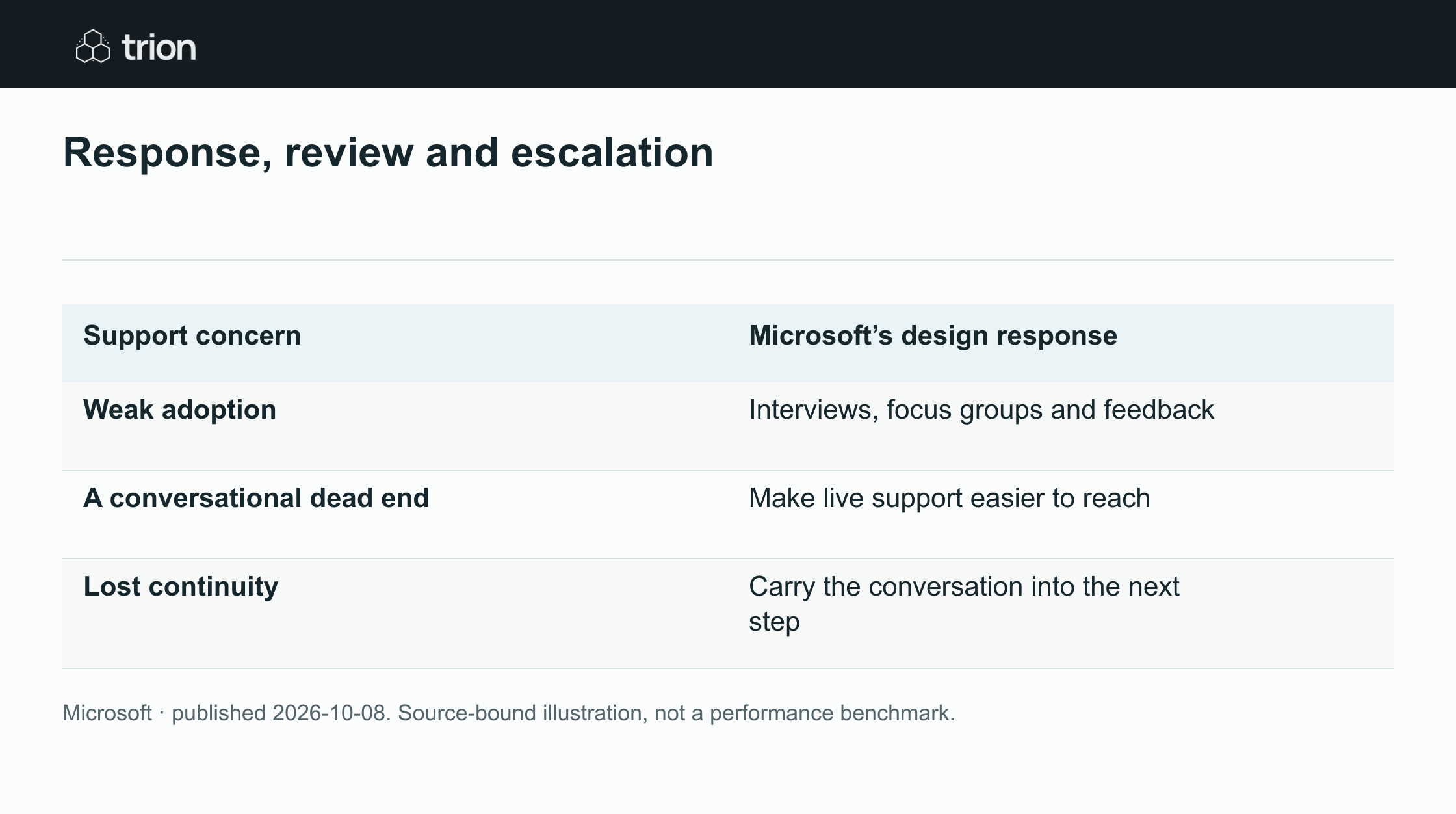
In its Employee Self-Service case study, Microsoft describes interviews, focus groups and feedback gathered after adoption was weaker than expected. The work examined context, expectations and continuity as well as technical performance.

Response, review and escalation
- Weak adoption
- Interviews, focus groups and feedback
- A conversational dead end
- Make live support easier to reach
- Lost continuity
- Carry the conversation into the next step
View data
| Support concern | Microsoft’s design response |
|---|---|
| Weak adoption | Interviews, focus groups and feedback |
| A conversational dead end | Make live support easier to reach |
| Lost continuity | Carry the conversation into the next step |
Microsoft · published 2026-10-08. Source-bound illustration, not a performance benchmark.
Download imageA recurring concern was whether the agent would become a dead end. Microsoft describes making the route to a live support person clearer and improving how a conversation carries into the next step. These are lessons from its own employee environment, rather than measured results for every help desk.
Original sources
- Microsoft: original case studywww.microsoft.com
Checked 9 Oct 2026 · A manually curated edition. Availability may change; company performance claims are not Trion test results. Editorial method.