
Microsoft plans a larger role for its Maia AI chips
Microsoft is expanding its own AI infrastructure, with a clear distinction between hardware already serving work and systems planned for next year. For application teams, that roadmap is context rather than a new price list.
Production now, expansion later
In its 12 October Maia update, Microsoft says Maia 200 is serving production workloads including Microsoft Copilot. GitHub Copilot and Microsoft Foundry are expected to follow by year-end. Multi-gigawatt deployments and Maia 300 production are planned from 2027. Microsoft positions the next generation around long-context and sustained agent workloads.
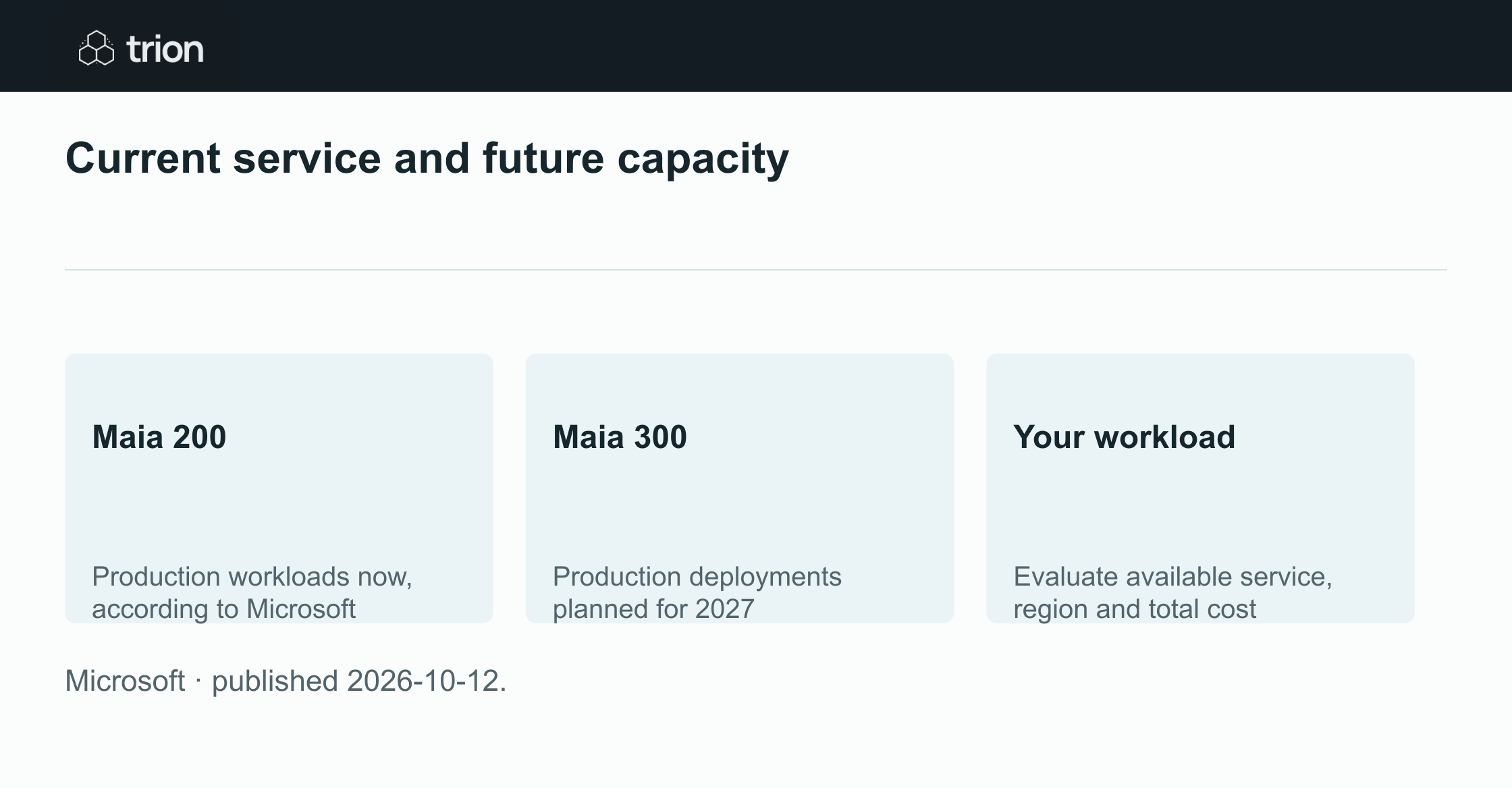

Current service and future capacity
- Maia 200
Production workloads now, according to Microsoft
- Maia 300
Production deployments planned for 2027
- Your workload
Evaluate available service, region and total cost
- Maia 200Production workloads now, according to Microsoft
- Maia 300Production deployments planned for 2027
- Your workloadEvaluate available service, region and total cost
Microsoft · published 2026-10-12.
The announcement includes vendor efficiency forecasts. It does not establish the price, capacity or response time a particular customer will receive. A hardware improvement can affect the provider’s operating economics without appearing as an equivalent reduction on an application’s bill.
Measure the service your workflow uses
For an automation buyer, the comparison should start with a completed unit of work. A document workflow may require extraction, several model calls, validation and human correction. The cheapest individual call is not necessarily the cheapest accepted result.
Use the same document set, completion definition and quality threshold across alternatives. Keep failed and retried cases in the denominator. Separately record how quickly a person sees the first useful response and how long the entire task takes; those two timings affect different experiences.
A useful capacity review
Before changing a deployment plan, ask questions that connect infrastructure to an actual operating requirement. These are suggested purchasing checks, not features or contractual terms promised by the Maia announcement.
Confirm the available service
Record the model, region, quota and support arrangement you can use today. Mark a roadmap item separately so future capacity does not become an assumption in this quarter’s delivery commitment.
Exercise a busy period
Test realistic concurrent demand, including a backlog after an outage. Measure waiting time and the treatment of rejected or throttled requests. An average over quiet hours can conceal the delay users notice most.
Price the complete result
Include retries, storage, orchestration and review effort. Recalculate when the actual service offer changes. Keep a provider’s projected efficiency improvement separate from savings you have observed in the workflow.
Original sources
- Microsoft: original announcementblogs.microsoft.com