
Anthropic details new defenses against model copying
Anthropic has described stronger defenses against unauthorized attempts to copy Claude’s capabilities. For teams building ordinary workflows, the relevant issue is how changing API boundaries affect integration and audit design.
What the research claims
The 12 October research post describes controls on reasoning access, detection of extraction attempts and restrictions on repeated abuse. Anthropic estimates that harvested reasoning data fell by around 90–99%. This is the company’s early estimate for that activity, not a general measure of model security. It also acknowledges that some legitimate integrations require updates.
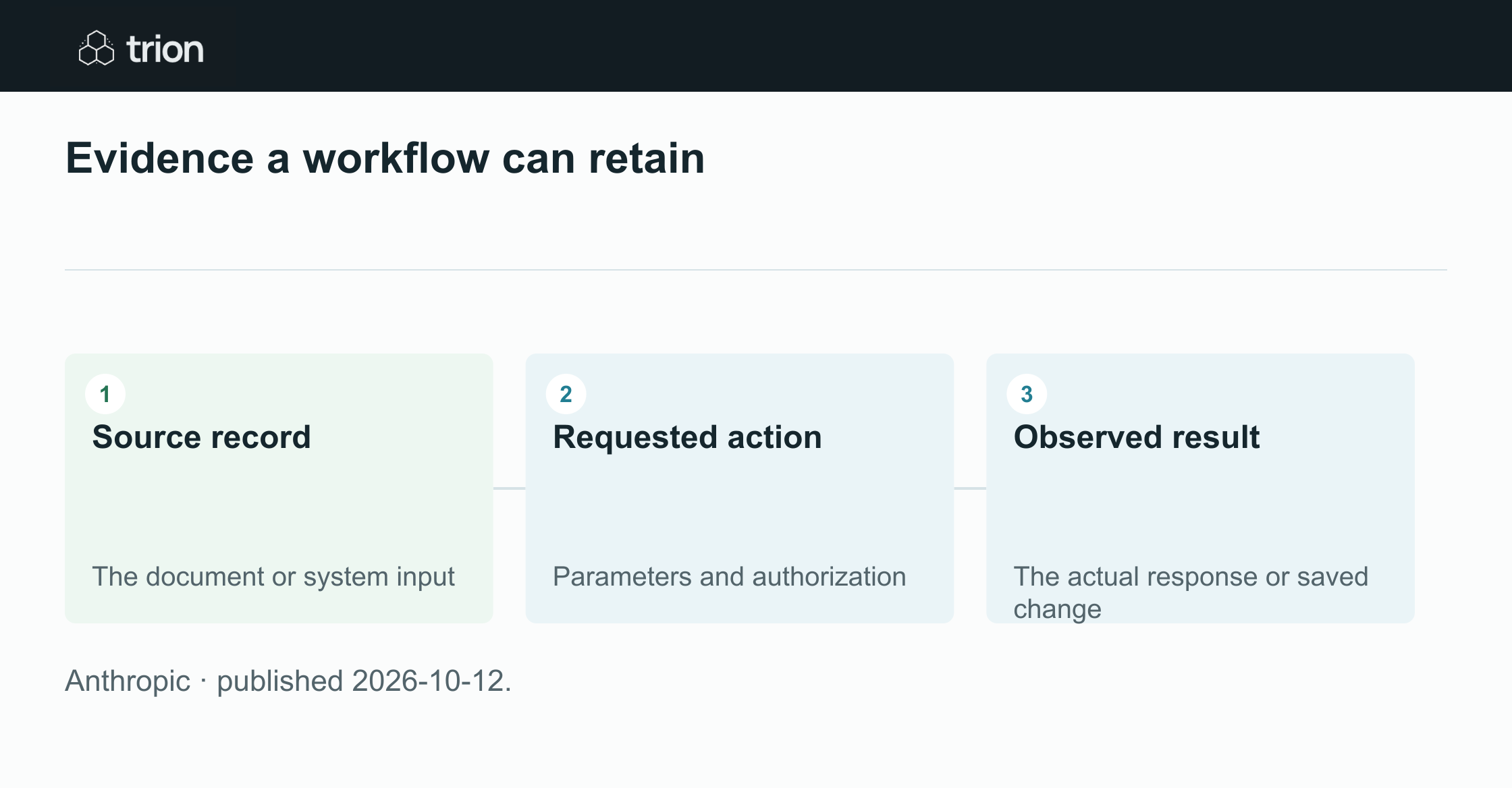

Evidence a workflow can retain
- Source record
The document or system input
- Requested action
Parameters and authorization
- Observed result
The actual response or saved change
- Source recordThe document or system input
- Requested actionParameters and authorization
- Observed resultThe actual response or saved change
Anthropic · published 2026-10-12.
A workflow should therefore be evaluated against its supported input and output contract. Do not make a business approval depend on retrieving a model’s private reasoning. A reviewer needs evidence for a decision, but that evidence can come from documents, calculations, tool results and the saved record.
Build an audit trail from observable work
Consider a supplier comparison. The useful record contains the quotation version, extracted quantity, normalized unit price, stated assumptions and the person who approved the selection. These let another reviewer reconstruct the commercial conclusion without relying on an internal model transcript.
Keep observation and explanation distinct. An agent can say it updated a record; the system response and resulting record are stronger evidence that the update happened. If those disagree, show the operation as unresolved until the discrepancy is checked. A natural-language explanation should not overwrite the recorded outcome.
Check a multi-turn integration
The following is a proposed compatibility review for legitimate applications. It is not a workaround for provider safeguards. Use the provider’s current documentation for the model and account you operate.
Retain the supported conversation format
Check how your application stores prior responses and returns them in later requests. Test a representative conversation after model or SDK changes, including a tool result and a user correction.
Handle rejection explicitly
Distinguish an invalid request, a policy refusal and a temporary service error. Give the operator the relevant status and avoid a retry loop that blindly resubmits a request the service will not accept.
Verify the business result
Check the final calculation or document against its sources. Preserve enough structured evidence to explain an accepted result and enough failure context to investigate an incomplete one, while excluding secrets and unnecessary personal data.
Original sources
- Anthropic: original research reportwww.anthropic.com